How AI Plans Your Next Meta Creative Test: AI Creative Test Planning for Meta Ads


TL;DR
At Deepsolv, we treat AI creative test planning for Meta ads as a transparent way to rank hypotheses, not promise a winner. We show DTC teams how to convert account results, customer signals, market evidence, novelty, effort, and risk into a weekly test queue that learns from every launch.
How AI Plans Your Next Meta Creative Test: AI Creative Test Planning for Meta Ads
Meta creative testing gets harder when a backlog grows faster than the team can evaluate it. Meta recommends budgeting across at least seven days so its delivery system can learn, which is a useful reason not to mistake an early result for a final verdict.
AI creative test planning for Meta ads does not identify a guaranteed winner. It turns account performance, creative attributes, customer language, public market observations, novelty, production effort, and risk into a transparent, ranked weekly queue of testable hypotheses, each with evidence, confidence, a success metric, and a stop condition.
We will show how that queue is built, how to rank a crowded Figma backlog, and where human judgment must override the model.
What Is AI Creative Test Planning for Meta Ads?
AI planning is not the same thing as asset generation, campaign scheduling, or budget automation. We use it to decide which hypothesis deserves a clean test next, then make the reasoning visible enough for a strategist, media buyer, and creative lead to challenge it.
That distinction matters because an unexplained score encourages false confidence. A useful planning system does not say, “This ad will win.” It says, “This concept is worth testing now because it has traceable evidence, fills a knowledge gap, fits the current objective, and can be produced without introducing avoidable risk.” For a deeper look at what prediction can and cannot do, see our prediction guide.
| Job | What It Does | What It Cannot Prove |
|---|---|---|
| Prediction | Estimates a likely outcome or confidence range | That a creative will certainly win |
| Prioritization | Ranks hypotheses by evidence, learning value, and constraints | That the highest-ranked concept has causal lift |
| Scheduling | Sequences approved tests around capacity and timing | Which concept deserves approval |
| Budget Automation | Redistributes spend after launch | Why an idea should enter the queue |
| Asset Generation | Produces visual or copy variations | Whether a concept is strategically worth testing |
A/B testing still matters, but planning comes first. A test can be cleanly scheduled and still be the wrong test if it repeats an exhausted angle, lacks a measurable decision, or depends on footage the team cannot produce this week.
What Inputs Build a Ranked Meta Creative Test Queue?
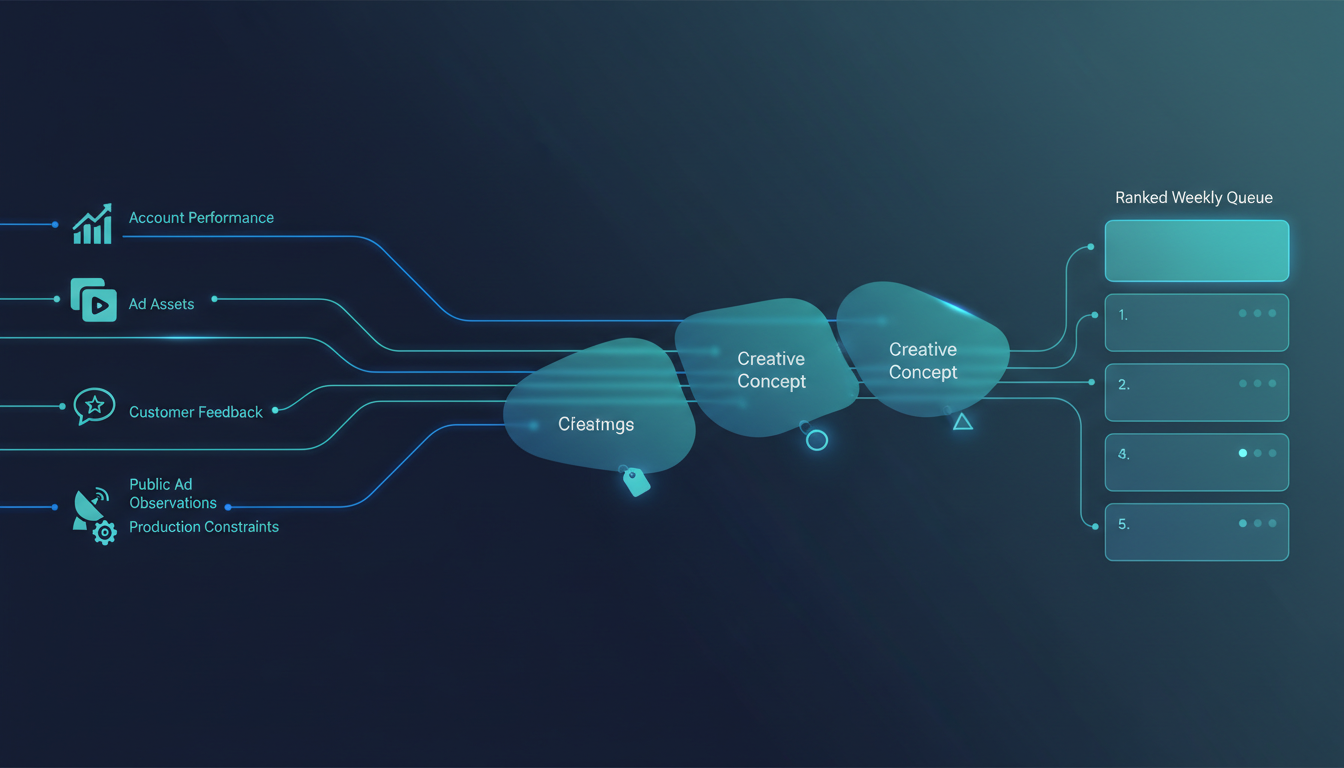
The queue begins with data quality, not a creative score. We connect account results to the conditions around those results: objective, optimization event, audience, placement, spend, delivery status, landing page, offer, and the asset itself. Meta’s Conversions API can receive website, app, offline, CRM, and messaging events, making it valuable context when account reporting alone is incomplete.
Which Account Signals Matter Most?
We look for patterns across performance, not isolated spikes. That includes conversion outcomes, click-through behavior, cost efficiency, view behavior, frequency, spend distribution, and performance by audience or placement. We also preserve when the result occurred, because a concept that worked during a promotion or stockout may not transfer cleanly to the next week.
Every proposed test needs a test card before it is ranked:
- Hypothesis: The customer problem, promise, or execution expected to change the outcome.
- Controlled Variable: The one primary change the team wants to learn from.
- Audience: The intended prospecting, retention, or remarketing group.
- Success Metric: The business outcome that decides whether to continue.
- Minimum Evidence: The agreed level of data needed before interpretation.
- Stop Condition: The pre-agreed reason to pause, iterate, or declare the read inconclusive.
This is also why we connect planning with creative angle tracking. Without consistent attributes and context, “winning creative” becomes a label instead of reusable knowledge.
Which Customer and Market Signals Belong in the Queue?
Customer reviews, comments, support conversations, surveys, and sales calls can reveal language, objections, and desired outcomes worth testing. We treat them as evidence for a hypothesis, not proof that the hypothesis will convert. Each signal should retain its source, date, customer context, and approval status.
Public category advertising is useful in a similar way. Meta’s Ad Library lets people search active ads across Meta products, so we can identify repeated formats, offers, and messaging patterns. We do not treat public visibility as a proxy for spend, profitability, or conversion rate.
How Does AI Turn Creative Concepts into Comparable Attributes?
A backlog of 40 concepts is not directly comparable when one is a creator-led demo, another is a founder story, and another is a discount offer. We first convert each concept into a shared attribute language, then compare concepts by what they are actually testing.
Computer vision can help identify visible elements such as product use, creator presence, setting, framing, text overlays, format, pacing, and colour. A peer-reviewed study demonstrated how computer vision could extract interpretable keywords and colour information for creative-performance analysis. That supports systematic tagging, not a claim that visual features alone determine Meta results.
What Does the Message Layer Capture?
Language models can tag the hook, customer problem, desired outcome, mechanism, proof, offer, objection, claim strength, and call to action. We still require human review for brand claims, compliance, ambiguous phrasing, and whether the creative accurately represents the product.
The goal is not to reduce creative work to a checklist. It is to make related concepts findable. If several ads use the same objection, proof type, and offer, we should know that before launching another near-duplicate.
| Attribute Family | What We Tag | Why It Changes The Queue |
|---|---|---|
| Concept And Angle | Problem, desired outcome, mechanism | Reveals repeated bets and unexplored territory |
| Hook | Demonstration, question, testimonial, contrast | Enables meaningful follow-up tests |
| Visual Execution | Creator, product use, setting, pace, format | Separates execution from message |
| Offer And Proof | Bundle, review, guarantee, demonstration | Identifies commercial-variable changes |
| Audience Context | Funnel stage, audience, placement, objective | Prevents invalid comparisons |
| Operations | Production time, approval, rights, inventory | Keeps unlaunchable ideas out of the top queue |
A complete taxonomy also makes feedback usable. Our feedback workflow shows how to preserve customer language without confusing qualitative reaction with verified conversion evidence.
How Do We Prioritize 40 Meta Ad Concepts?
For a DTC team spending $80,000 a month, the first goal is not to launch every concept. It is to choose a small set that can receive a meaningful read while preserving enough budget and production capacity for the next round.
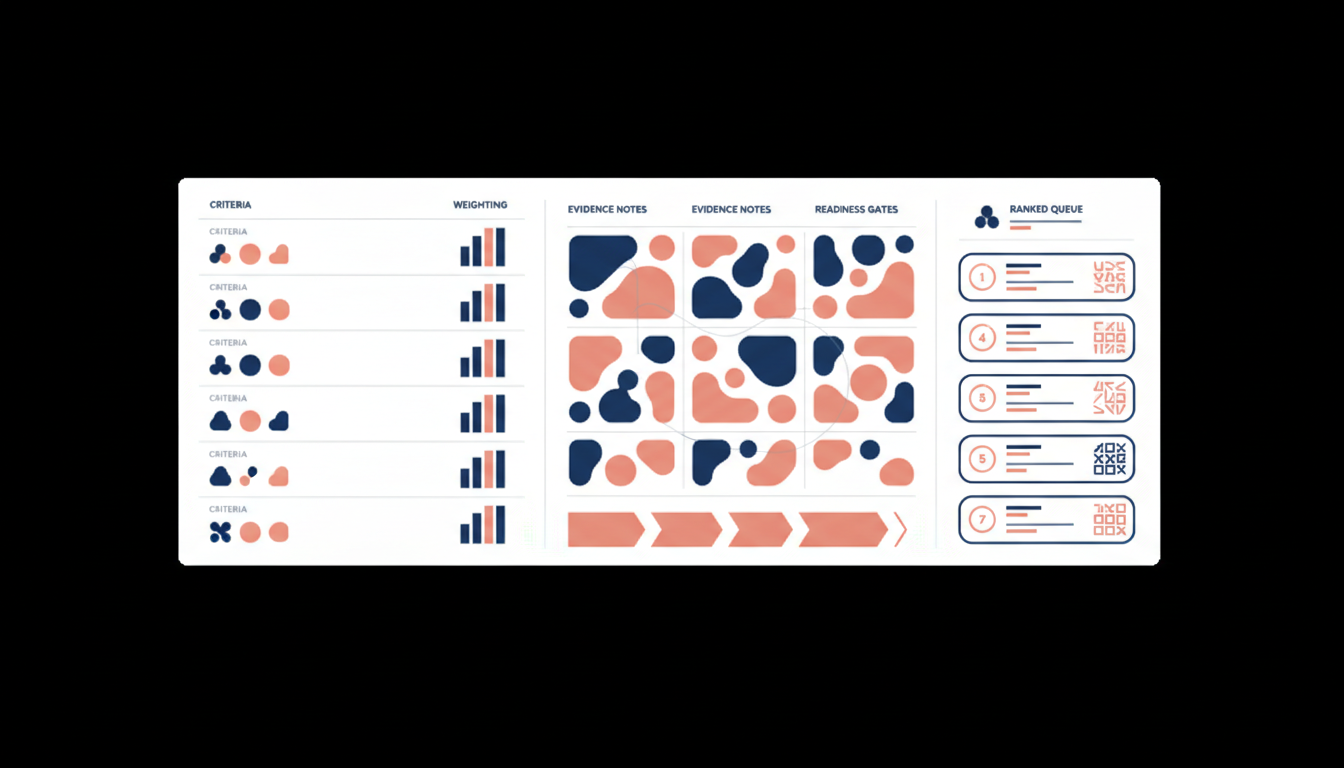
We use a transparent rubric rather than a single performance prediction. The team sets the relative weights based on its current goal, then every score must point back to evidence a reviewer can inspect. A concept with limited evidence can still rank highly when its learning value is strong, but its confidence should remain lower.

| Criterion | Planning Question | Evidence To Review |
|---|---|---|
| Evidence | Is the hypothesis supported by account, customer, or market observations? | Source, date, and context |
| Novelty | Does it explore an under-tested combination? | Similarity and redundancy check |
| Expected Learning | Will either outcome change the next decision? | Named follow-up action |
| Strategic Fit | Does it match the audience and business objective? | Approved brief and campaign context |
| Production Effort | Can the team produce it on time? | Capacity, approvals, and rights |
| Risk | Could policy, stock, claims, or measurement invalidate it? | Risk owner and mitigation |
Dependencies change rank. A promising product demo that needs legal approval, creator permission, and inventory confirmation should not displace a launch-ready concept with strong learning value. Redundancy changes rank too: if three concepts test the same hook and offer, we usually launch the clearest representative first.
A ranked backlog might begin with a high-evidence iteration, followed by a distinct exploratory concept, followed by a useful concept held for approval. That is a better operating model than asking the team to guess which Figma board “feels strongest.” Our concept prioritization framework expands on how to turn this into a repeatable decision process.
How Does a Weekly Test Plan Learn from Results?
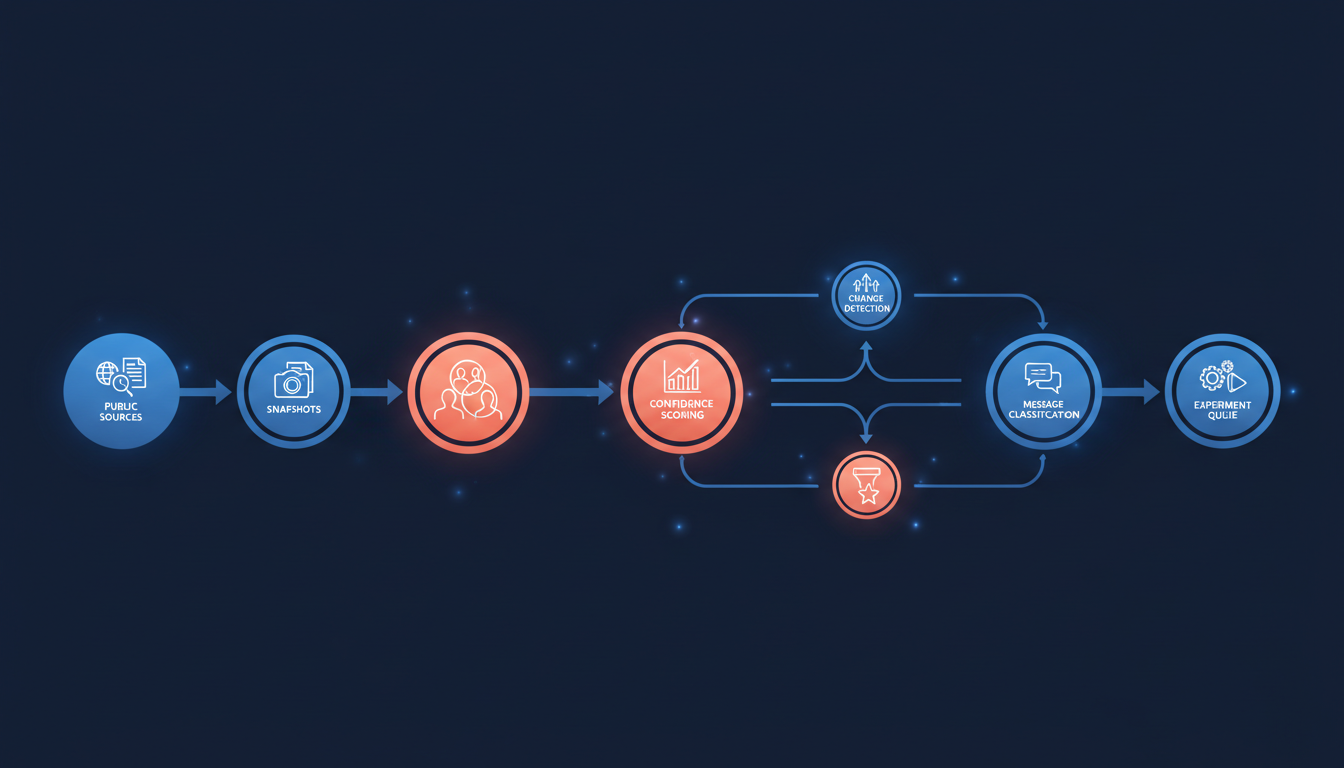
A planning queue only earns trust if it updates after every launch. We treat weekly planning as a loop: verify inputs, tag and cluster concepts, score the backlog, select the launch-ready set, write test cards, monitor validity, then save the result as creative memory.
During the live test, we check whether the read is interpretable before debating which ad won. Meta describes delivery states including learning, learning limited, rejected, processing, and active in its delivery guidance. A rejection, tracking issue, uneven delivery, landing-page outage, or material edit can change a result without proving anything about the creative idea.
What Should the Team Log During a Test?
The validity log should capture delivery status, policy feedback, tracking health, spend distribution, audience overlap, placement mix, inventory, landing-page availability, major edits, and technical asset issues. It should also preserve useful qualitative feedback, such as recurring objections or confusion in comments.
This replaces vague review questions with a clear record of what could have changed the outcome. If a creative underperforms because its product feed was broken, the model should not learn that the angle failed.
How Does Creative Memory Improve the Next Queue?
A winner becomes evidence for adjacent tests, not a universal rule. A losing test can still be valuable when it rules out a message, proof type, or audience assumption. We preserve the outcome, confidence, caveats, and follow-up decision so the next plan reflects what the team actually learned.
That memory needs to account for concept drift. Offers change, audiences saturate, creative conventions evolve, and platform delivery changes. Our creative test memory explains how we retain useful learning without treating old results as permanent truth.
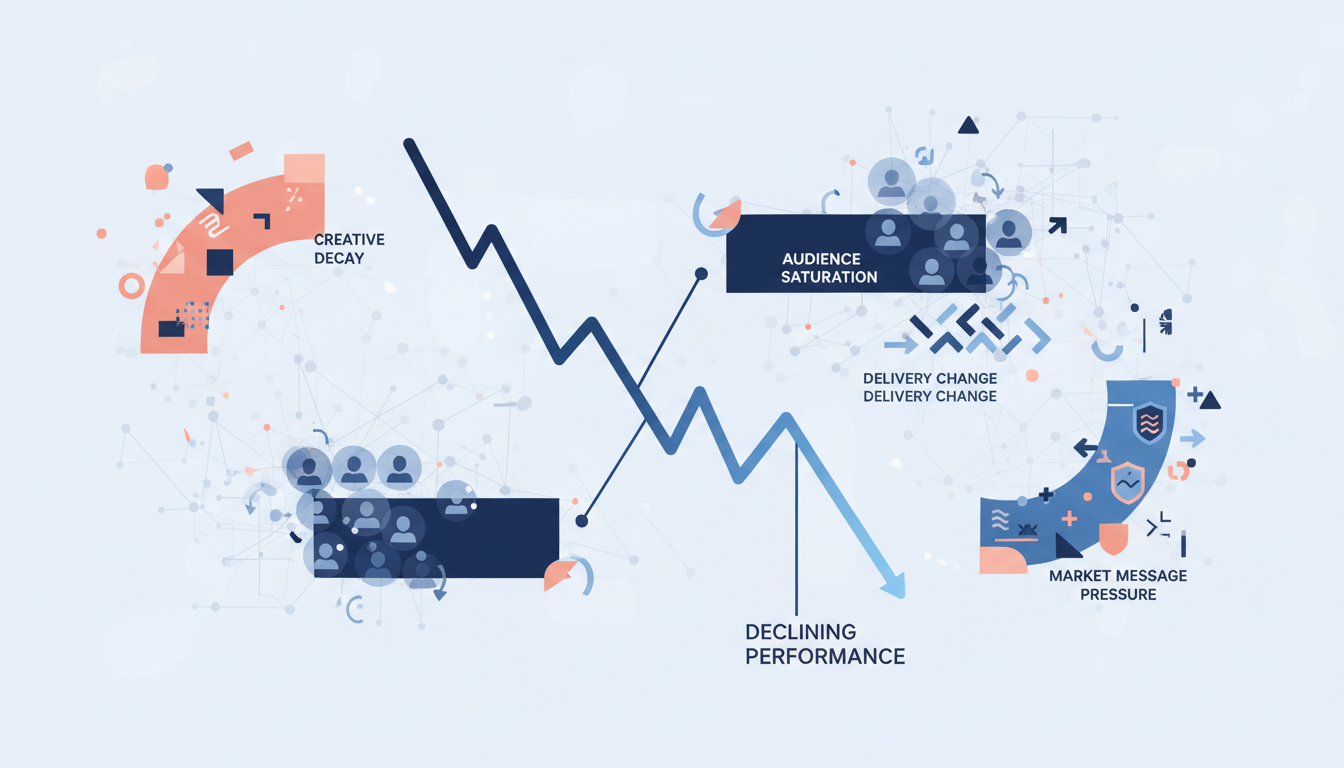
When performance starts declining, the next plan should examine creative wearout, audience saturation, offer changes, and measurement shifts before deciding what to test. This keeps a temporary decline from becoming a permanent assumption in the queue.
What Can AI Not Predict Before a Meta Test Runs?
AI can rank hypotheses, estimate confidence, and surface patterns that humans miss across a large creative history. It cannot establish causal lift before the ad has run, guarantee that a past pattern will hold in a new audience, or know whether a sudden change came from creative rather than delivery, offer, landing page, seasonality, or attribution.
Sparse data creates unstable signals. Attribution noise can misstate the relationship between an ad and a purchase. Correlated variables make it hard to know what caused a result when the audience, offer, format, and landing page all change together. Research on incrementality design shows why advertising experiments require deliberate attention to power and sample size rather than casual before-and-after comparisons.
False precision is another risk. We prefer confidence bands, visible evidence, and clear caveats over a decimal score that implies certainty. Human review should override the queue when a claim needs substantiation, inventory is constrained, tracking is incomplete, or the proposed test creates brand or customer risk. Our hook stop guide helps teams write a decision rule before they see the result.
How Can Deepsolv Help You Plan Meta Creative Tests?
At Deepsolv, we help DTC teams turn crowded creative backlogs into evidence-led weekly plans. We connect account outcomes, creative attributes, customer feedback, and market observations so strategists can see why a concept ranks, what would change the decision, and where uncertainty remains. Instead of treating a score as a verdict, we keep the hypothesis, evidence, confidence, test design, and decision rule visible. That gives media buyers, creative leads, and founders a shared way to choose what ships next and learn from what happens afterward. Bring us the concepts already sitting in Figma, the account context behind them, and the constraints your team actually faces. We will help you turn that raw backlog into a clearer queue for production, launch, and learning, with an audit trail your whole team can inspect, challenge, and improve from week to week without pretending the future is settled. Book a demo
FAQs on AI Creative Test Planning for Meta Ads
AI creative test planning works best when the team treats it as a decision system with visible evidence, not an automatic prediction tool.
Can AI Predict Which Meta Ad Creative Will Work?
AI ranks hypotheses and confidence, not guaranteed performance. Use it to choose testable concepts, preserve evidence, and define decisions that live results can validate or overturn.
How Do I Prioritize 40 Meta Ad Concepts?
Cluster duplicate concepts, score evidence, novelty, learning value, strategic fit, effort, and risk, then select the smallest launch-ready set your budget and production capacity can evaluate.
What Data Signals Drive AI Ad Test Planning?
Use account outcomes, creative tags, audience and placement context, approved brand constraints, customer feedback, public ad observations, production dependencies, and measurement quality. Preserve dates and evidence sources.
Is AI Test Planning Just A/B Test Scheduling?
Scheduling picks when approved tests run. AI planning also explains what to test, why it ranks there, which variable changes, and what outcome changes the next decision.