


TL;DR
How Deepsolv’s creative testing memory connects ad-test evidence to explain failures and recommend safe paid-social stop rules.
Paid social tests become expensive when teams remember only the final result, not the conditions that produced it. Meta advises allocating budget across at least seven days so delivery can learn, which makes a universal two-day verdict especially risky. We will show how to record evidence, diagnose failure, retrieve comparable tests, and set guarded stop recommendations.
A creative testing memory system stores more than final metrics. It links each hypothesis, audience, hook, angle, offer, format, asset, delivery context, result, and failure reason so future recommendations can retrieve comparable evidence. It can flag repeated losing patterns and propose stop rules, but pausing should depend on account-specific economics, minimum evidence, attribution delay, and safeguards against normal variance.
What Is Creative Testing Memory?
An asset library tells you where the files live. A results database tells you what an ad spent or returned. Creative testing memory adds the missing layer: it preserves what was being tested, under which conditions, what evidence was sufficient, and why the team reached its decision.
| System | What It Retains | What It Can Answer | What It Cannot Reliably Explain |
|---|---|---|---|
| Asset Library | Files, thumbnails, basic tags | Which assets exist? | Why did this concept fail? |
| Results Database | Metrics by asset and date | What did the ad spend or return? | Was the creative, delivery, or tracking the issue? |
| Testing Memory | Test context, comparable evidence, failure reason, decision | What happened before in a similar test, and why? | Whether to act without account rules |
| Recommendation Engine | Retrieved evidence and proposed action | What should the team review next? | Whether it may safely pause without approval controls |
This distinction matters because delivery context changes the meaning of a result. An ad can be structurally strong but receive weak delivery, or it can earn attention while a landing page or offer loses the conversion. Our creative intelligence software approach treats the ad, audience, objective, placement, and outcome as one evidence record instead of isolated rows.
What Does a Useful Test Record Contain?
A memory is only as useful as the record it receives. We start with a clear hypothesis and make the variables visible, so a future buyer can distinguish a new concept test from a minor opening-frame variation.

Hypothesis and Taxonomy
- Hypothesis: State the expected outcome and the decision criterion before launch.
- Taxonomy: Tag the hook, angle, offer, format, creator style, visual treatment, opening frame, and call to action.
- Test Scope: Record which variable changed and which variables were intentionally held constant.
A useful taxonomy makes comparison possible. It also supports ad concept prioritization, because the team can see whether a supposed new idea is actually another version of a previously tested hook.
Audience and Delivery Context
- Audience: Capture prospecting or retargeting status, geography, exclusions, funnel stage, and audience definition.
- Delivery: Record objective, optimization event, placements, bid approach, budget, schedule, attribution setting, and delivery status.
- Execution: Preserve asset IDs, copy, destination, campaign structure, and launch date.
Meta separates campaign objective, ad-set audience and budget, and ad-level creative, so the record must preserve all three layers. Otherwise, a system may mistake a delivery shift for a creative failure.
Metrics and Decision
- Metrics: Store spend, impressions, reach, frequency, CPM, CTR, video attention, conversions, CPA or return, and the baseline used for comparison.
- Evidence: Note the observation window, conversion maturity, confidence range where applicable, and known tracking limitations.
- Decision: Mark continue, iterate, stop, or insufficient evidence, along with owner, timestamp, and reason.
The record should not force every test into a winner or loser label. “Insufficient evidence” is a valuable conclusion because it prevents weak data from becoming false memory.
How Does Creative Testing Memory Explain Failure?
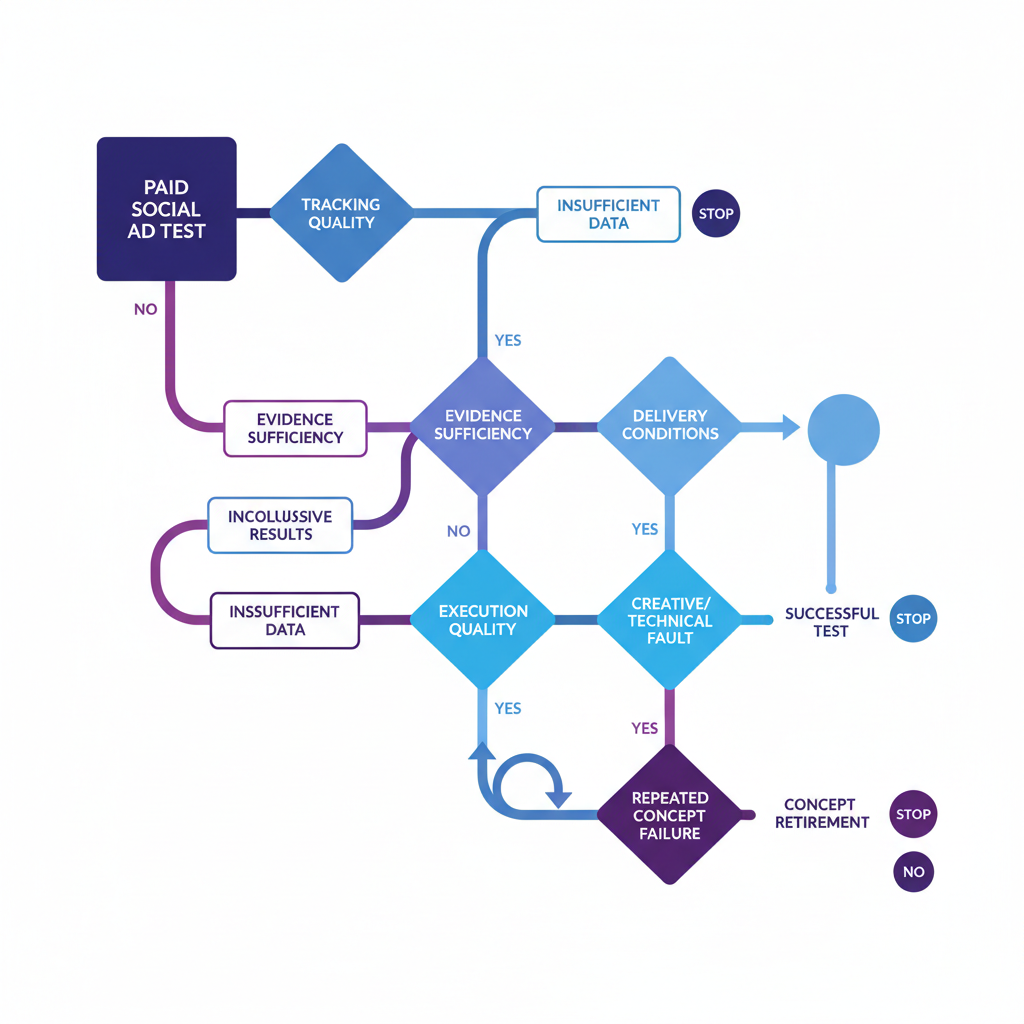
A credible system does not call every low-performing ad a bad idea. It first asks whether measurement is trustworthy, whether the test received enough comparable delivery, and whether the intended conversion had time to appear. Meta’s Conversions API can support website, app, offline, and messaging events, which is why tracking quality belongs inside the failure diagnosis.
Is the Evidence Valid?
If the conversion event is missing, duplicated, delayed, or disconnected from the ad platform, label the outcome as a tracking issue. If an ad is still learning, underdelivered, or affected by an unusual placement mix, label it as insufficient or non-comparable evidence.
Is the Execution Weak?
A weak hook, unclear opening frame, poor message retention, mismatched format, or confusing call to action can make a sound idea look bad. We use qualitative signals, including analyze Meta ad comments, to help teams separate audience objections from creative-execution problems.
Is Delivery the Problem?
Audience saturation, policy review, bid constraints, limited delivery, and optimization-event changes can alter results without proving that the concept failed. The test record should make these conditions visible before a recommendation compares it with history.
Is the Idea a Repeat Failure?
Only then should the system examine comparable tests. If the same hook, angle, offer, format, and audience combination repeatedly underperforms across valid tests, the evidence can support a “do not repeat without a material change” recommendation.
How Does It Create Safe Stop-Loss Recommendations?
Stop-loss logic should protect budget without teaching the team to overreact. A threshold that makes sense for a low-consideration purchase may be destructive for a longer sales cycle, and a test cannot be judged before its attribution window and evidence requirements are met. NIST’s sample-size guidance shows why required evidence depends on the baseline rate, detectable change, confidence, and power.
Set the Economic Ceiling
Define a margin-aware target before launch. The rule can use an account-specific CPA ceiling, a return floor, or a maximum additional spend, but it should never borrow a generic benchmark simply because it sounds precise.
Require Mature Evidence
The rule should state its evidence minimum and attribution delay. It should also exclude tests affected by learning, tracking incidents, policy issues, promotions, or unusually low delivery.
Choose the Right Action
| Action Mode | Best Use | Control Needed |
|---|---|---|
| Manual Recommendation | New concepts or ambiguous evidence | Analyst review and documented decision |
| Alert | Clear risk that still needs judgment | Named owner and response deadline |
| Automated Pause | Narrow, repeatable, low-regret guardrails | Approval policy, exception logic, rollback |
Preserve Approval and Rollback
Every recommendation should show the records retrieved, the similarity criteria, the threshold crossed, the owner, and the final action. Our creative strategy platforms guidance helps teams evaluate whether a tool can expose that evidence instead of returning an opaque score.
How Does It Rank the Next Test?
Historical performance is useful only when the system retrieves the right history. We rank a next test by matching creative attributes and business context, then discounting records with weak evidence, tracking concerns, or non-comparable delivery. That keeps a prior failure from blocking a genuinely new angle.

The loop is simple:
- Retrieve comparable historical tests.
- Evaluate similarity, evidence quality, and failure reason.
- Recommend a new test, iteration, or stop action.
- Obtain approval, or apply the permitted guardrail.
- Learn from the matured outcome and append the audit trail.
We use competitor analysis tools to help teams inform future hypotheses without treating external observations as proof of what will work in their account. The relevant evidence remains the record of prior tests, measured against the objectives, audiences, and economics the team actually controls.
Fatigue belongs in this ranking, but it is not a verdict by itself. Rising frequency alongside worsening economics can move fresh creative higher in the queue, while strong historical evidence may point to a proven alternative. A useful system records whether declining performance appeared after a stable run, whether the audience or placements changed, and whether the conversion event still reflects business value.
The recommendation should also show its uncertainty. A ranked idea can be promising without being ready to launch, and a repeated losing pattern can justify deprioritization without proving that the underlying proposition will never work. We keep those distinctions visible so buyers can decide whether to test, iterate, or stop.
An audit trail closes the loop. It identifies the recommendation, the evidence retrieved, the criteria used to match it, excluded records, the owner who approved the action, and the matured result. Explore more decision frameworks in our insights when building a repeatable review process.
Why Use Deepsolv for Creative Testing Memory?
We built our approach for paid-social teams that are tired of opening a spreadsheet, seeing a red number, and guessing whether to cut an ad. Our work connects creative context to delivery, measurement, and the decision that followed, so every recommendation can show the tests behind it. That gives media buyers a practical way to protect budget without teaching the system that every early dip is a failure.
Bring your existing naming, performance data, and review process. We help you organize the evidence first, then make the next decision easier to inspect, approve, and reverse. Our team can show how this framework fits alongside your current reporting, test planning, and creative workflow. You leave with a clearer decision model rather than another opaque score to chase. See the workflow in Deepsolv.
FAQs on Creative Testing Memory
How Does Creative Testing Memory Work?
Testing memory stores the hypothesis, creative tags, delivery conditions, results, and decision. When a new test is similar, it retrieves evidence to explain recommendations clearly.
What Tools Remember Failed Ad Tests?
Useful tools retain structured test records, matching logic, failure reasons, and evidence rules. Galleries and metric dashboards cannot explain whether a similar test should stop.
How Do Stop-Testing Recommendations Work for Paid Social?
Recommendations compare mature evidence with account economics and guardrails. Safe rules include exceptions, attribution delay, approval, and rollback controls before a live ad is paused.
What Should a Creative-Level Stop-Loss Rule Include?
Include an account threshold, budget ceiling, evidence minimum, attribution delay, exceptions, action mode, owner, approval deadline, and rollback control for every tested creative decision made.
What Is the Difference Between Ad Test Storage and Testing Memory?
Storage preserves files and results. Testing memory preserves the hypothesis, context, evidence quality, failure reason, and decision, helping comparable future tests inform recommendations safely.