
How Should DTC Brands Rank Ad Concepts? A DTC Ad Concept Prioritization Framework


TL;DR
Rank DTC Meta ad concepts with a defensible scorecard for evidence, brand fit, learning value, and launch readiness.
When a large Figma backlog meets active Meta spend, launch decisions need more than taste. Meta says ads are typically reviewed within 24 hours, so a clear pre-launch decision system helps teams move quickly without sending avoidable problems into review.
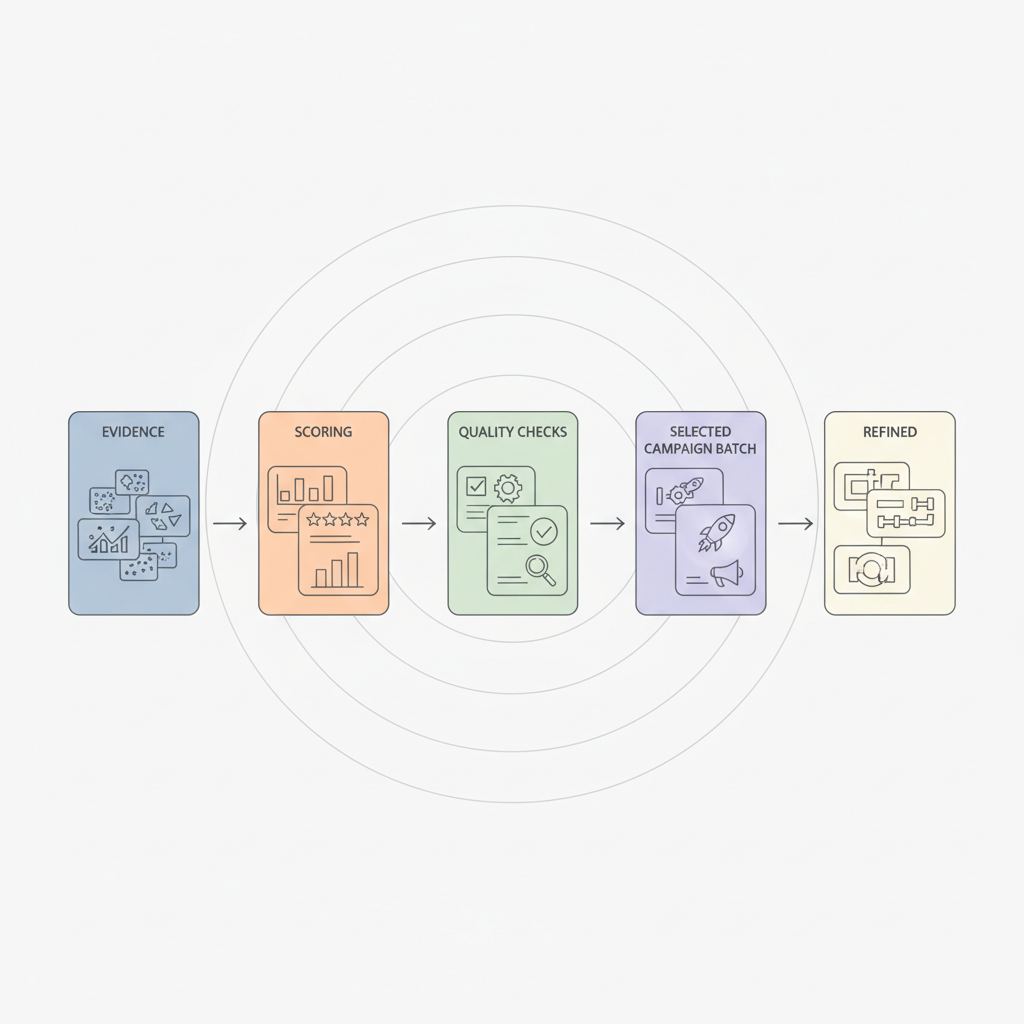
DTC ad concept prioritization means ranking each idea by expected impact, evidence strength, learning value, brand fit, and execution readiness before budget is assigned. Score every concept consistently, remove duplicates that test the same hypothesis, clear policy and technical risks, then launch a balanced batch that answers distinct strategic questions instead of rewarding internal enthusiasm.
This framework shows how to turn Figma concepts into testable hypotheses, score them, remove overlap, and select a first batch that creates useful learning.
How Should DTC Brands Rank Ad Concepts Before Testing?
A concept backlog is not a testing roadmap. Some ideas are visually strong but weakly evidenced. Others are close to prior winners but teach little. A few may be strategically important, yet unfinished or unsuitable for the brand. We separate those conditions before anyone assigns budget.
The first decision is not, “Which ad will win?” It is, “Which set of concepts gives us the best combination of commercial potential, credible evidence, and useful learning?” That distinction keeps teams from treating a ranking system as a prediction engine. We use the ranking to make assumptions visible, then let live results refine them.
This approach also gives brand, creative, and performance teams a shared language for discussing tradeoffs. If a concept is held back, the reason should be clear: duplicate hypothesis, insufficient evidence, brand conflict, production gap, or a technical issue. For a broader view of the systems that support this decision, explore creative strategy platforms.
How Do You Turn Figma Concepts into Testable Hypotheses?
A Figma frame becomes testable only when the team defines what it is trying to learn. “Founder story video” is a production description. It becomes a concept when it states the audience, the message, the format, the variable, and the expected response.
Use this structure: for a defined audience, a specific message in a chosen format should improve one primary KPI against a relevant control because of stated evidence. The evidence might come from customer language, comments, prior account results, offer performance, or an approved brand insight. A concept without that logic can still be produced, but it should not receive the same confidence as one that has it.
AI can speed up this documentation work, flag similar concepts, and make scorecards consistent. It cannot guarantee the outcome. Meta notes that its own optimization score does not guarantee future performance, which is a useful reminder to treat every pre-launch rank as an informed hypothesis.
Build one test card for each concept:
| Test Card Field | What To Record |
|---|---|
| Concept ID | Stable name and Figma source |
| Audience | Prospecting or retention segment, plus exclusions |
| Hypothesis | Audience, angle, format, and changed variable |
| Primary KPI | The metric that determines the decision |
| Guardrails | Brand, efficiency, comment-quality, and measurement limits |
| Evidence | Customer language, prior learning, research, or offer data |
| Next Action | Scale, iterate, retest, archive, or investigate |
Customer comments are particularly useful when they reveal objections, language, or confusion that performance metrics alone cannot explain. Our guide to comment analysis can help turn those signals into better hypothesis inputs.
What Scorecard Supports DTC Ad Concept Prioritization?
The scorecard should be simple enough for a team to use honestly and specific enough to expose weak reasoning. Score each factor from one to five, then apply weights that brand and performance leaders agree on before the ranking begins. There is no universal set of weights because a mature brand protecting a strong identity should not score the same way as a brand entering a new category.
Start with Evidence, Not Aesthetic Preference
Expected impact asks whether the concept addresses a meaningful commercial opportunity. Evidence strength asks whether the claim rests on something more substantial than enthusiasm. A polished frame can score well on execution readiness while still scoring low on evidence, which is useful information rather than a failure.
Give Learning Value Its Own Factor
A concept can be worth launching even if it is not the perceived favorite. If it answers a high-stakes uncertainty about an audience, offer, or angle, it may earn a place as a deliberate exploration. That is how the portfolio avoids becoming a row of safe variations.
Use Brand Fit as a Real Constraint
Brand fit is not a final cosmetic review. It should consider approved claims, voice, visual rules, exclusions, category sensitivities, and prior learnings. We recommend preserving those decisions in creative testing memory so the next planning meeting starts from institutional knowledge, not recollection.
| Factor | What A Strong Score Means | Brand-Approved Weight |
|---|---|---|
| Expected Impact | Addresses a meaningful audience or commercial opportunity | Set by the brand team |
| Evidence Strength | Uses credible first-party or validated account evidence | Set by the brand team |
| Learning Value | Resolves an important strategic uncertainty | Set by the brand team |
| Brand Fit | Meets approved claims, voice, visual rules, and exclusions | Set by the brand team |
| Execution Readiness | Has complete assets, a valid destination, and dependable measurement | Set by the brand team |
A weighted score should guide debate, not conceal it. Record dissent when needed. If a team chooses a lower-ranked exploratory idea, name the strategic question it is buying the right to answer.

Which Brand and Technical Gates Matter Before Launch?
A strong score does not override a failed gate. Gates protect the integrity of the test itself, because a broken destination, unclear claim, or missing event can make an otherwise promising concept impossible to evaluate fairly.
Use a short pre-launch review that covers the concept, the asset, the destination, and the measurement path together.
-
Brand Gate: Confirm approved claims, voice, visual rules, mandatory disclosures, and excluded themes before production is treated as complete.
-
Policy Gate: Review copy, image or video, audience treatment, and destination continuity. Meta may assess creative, targeting, and the destination during review.
-
Asset Gate: Check crops, captions, audio, safe zones, CTA legibility, product visibility, formats, and final exports for every intended placement.
-
Landing-Page Gate: Match the offer, promise, product, and call to action from the ad through to the destination. A mismatch turns a creative test into a funnel-quality test.
-
Measurement Gate: Validate URLs, UTMs, events, deduplication, reporting names, and the primary KPI before launch. Meta describes the Conversions API as helping create reliable measurement alongside pixel-based signals.
Research can also reveal category conventions and crowded visual territories before a concept reaches production. Use a disciplined research workflow to inform originality without copying the market.
How Do You Select a Balanced First Test Portfolio?
After scoring and gating, selection becomes a portfolio problem. A batch should not contain six expressions of the same claim, even if every one ranks well. Each launch slot should earn its place by answering a distinct question.
Normalize and Deduplicate the Backlog
Group concepts by audience, message angle, format, and changed variable. If two concepts target the same people with the same promise and differ only in minor styling, choose the stronger execution as the lead concept. Queue the other as a later variation or redesign it around a genuinely different question.
Balance Proven, Adjacent, and New Territories
A useful first batch contains three types of work: proven territories that reinforce what is already working, adjacent variations that isolate a meaningful change, and new concepts that explore an untested strategic direction. The exact mix should reflect the brand’s current risk tolerance and evidence base.
Preserve the Learning Loop
Before launch, name the primary KPI, guardrails, decision owner, and next action for each concept. After launch, review the outcome with a postmortem rubric: KPI result, guardrail status, delivery context, technical defects, policy status, comment signals, learning confidence, and next action.
Do not confuse unstable early delivery with a conclusive creative result. Meta notes that performance can be less stable during the learning phase, so diagnosis should include delivery and measurement conditions before the team declares an idea a winner or loser.
The result is a backlog that compounds learning over time. Our creative intelligence software is built to help teams connect those decisions to the evidence and outcomes that follow.

What Does a First Launch Batch Look Like?
Imagine a DTC team with 40 concepts in Figma. After hypothesis writing, scoring, deduplication, and pre-launch QA, six concepts remain in the first batch. This is an illustrative decision pattern, not a universal launch volume.
| Concept | Portfolio Lane | Unique Question | Scorecard Signal | Decision |
|---|---|---|---|---|
| Customer Proof Video | Proven Territory | Does verified proof still strengthen the established value angle? | Strong evidence and brand fit | Launch |
| Product Demonstration | Proven Territory | Does showing the product in use improve clarity for cold audiences? | Strong readiness and learning value | Launch |
| New Opening Hook | Adjacent Variation | Can a different opening improve attention without changing the core promise? | Strong learning value | Launch |
| Offer Framing Variant | Adjacent Variation | Does a different value frame affect qualified conversion behavior? | Moderate evidence, clear variable | Launch |
| Founder Perspective | New Territory | Does a personal authority angle build trust with a new audience segment? | High learning value | Launch |
| Objection Response | New Territory | Can directly resolving a documented objection unlock demand? | Strong customer evidence | Launch |
The remaining concepts are not failures. Some belong in a second batch after their duplicate angle is resolved. Others need a clearer claim, a better destination, or a stronger evidence trail. This is the practical value of DTC ad concept prioritization: the team can explain why each idea launches now, later, or not at all.
For more examples of how strategic decisions become repeatable operating habits, visit our insights.
Put Deepsolv at the Center of Your Test Planning
Deepsolv helps brand teams turn scattered creative opinions into a traceable decision system. We bring together approved claims, creative rules, audience evidence, comments, prior performance, and testing history so each proposed concept starts with context instead of a blank slate. Our workflow makes the first-batch choice visible: what is proven, what is adjacent, what is exploratory, what is blocked, and what each test must teach next. That matters when creative, media, and brand leaders need to move quickly without sacrificing the standards that make the brand recognizable. Instead of relying on a score alone, we help teams preserve the rationale, QA status, and postmortem behind every launch with a shared record that connects each launch decision to the evidence your team trusts most. If your next planning session needs a sharper source of truth, contact our team or Book a Demo
FAQs on DTC Ad Concept Prioritization
Can AI Predict Which Meta Creative Will Win?
No. AI can organise evidence, identify repeated hypotheses, and apply rules consistently, but live delivery, audience response, landing page performance, and measurement determine the outcome in market.
How Many Concepts Should We Launch First?
Launch only concepts your budget can measure while preserving distinct hypotheses. For a forty-concept backlog, a six-concept illustrative batch provides diversity without treating every idea as independent.
What Makes Two Concepts Duplicates?
Two concepts are duplicates when they target the same audience, make the same angle or promise, and change no meaningful variable. Keep one, then redesign the other.
When Should We Call a Creative Fatigued?
Treat fatigue as a diagnosis, not a frequency rule. Check declining outcomes, delivery, audience saturation, comments, technical quality, destination continuity, and tracking before deciding what changed.