How to Prioritize Paid Social Creative Tests: A Paid Social Creative Test Prioritization System

TL;DR
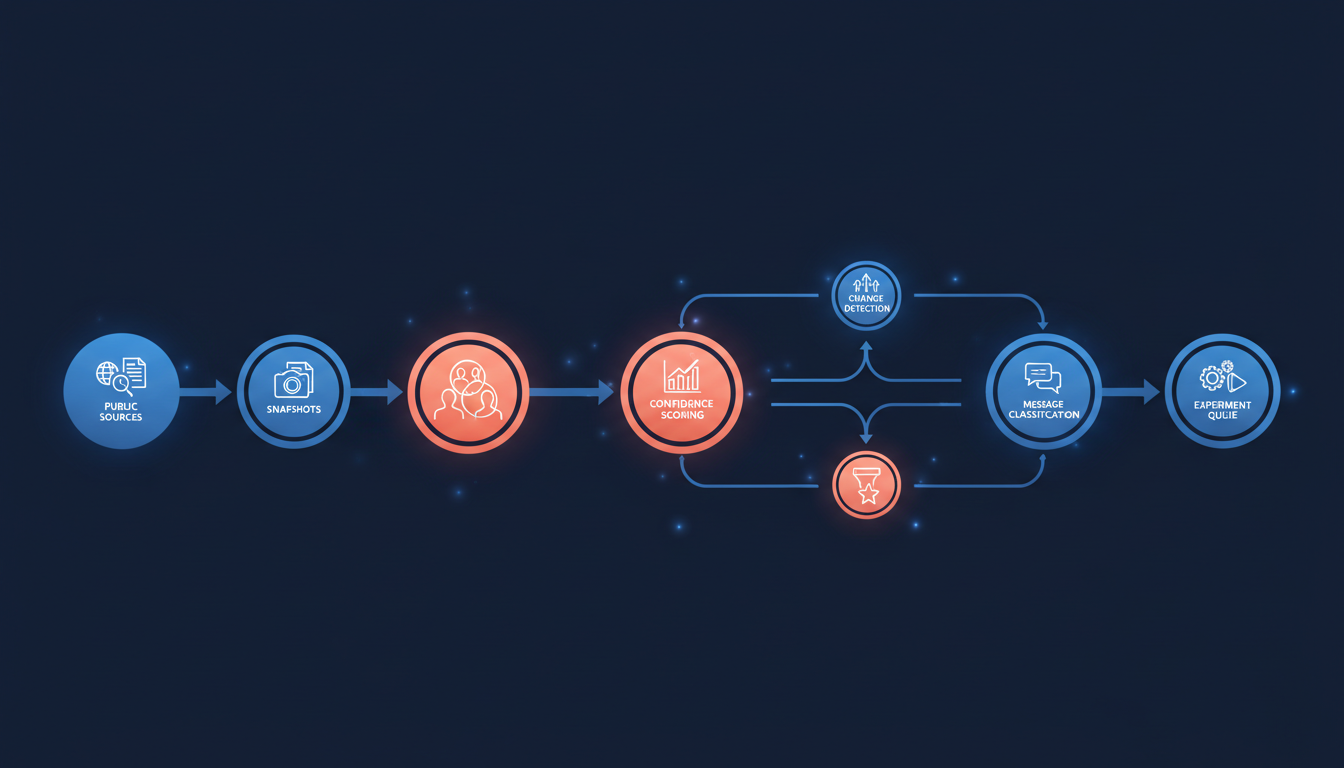
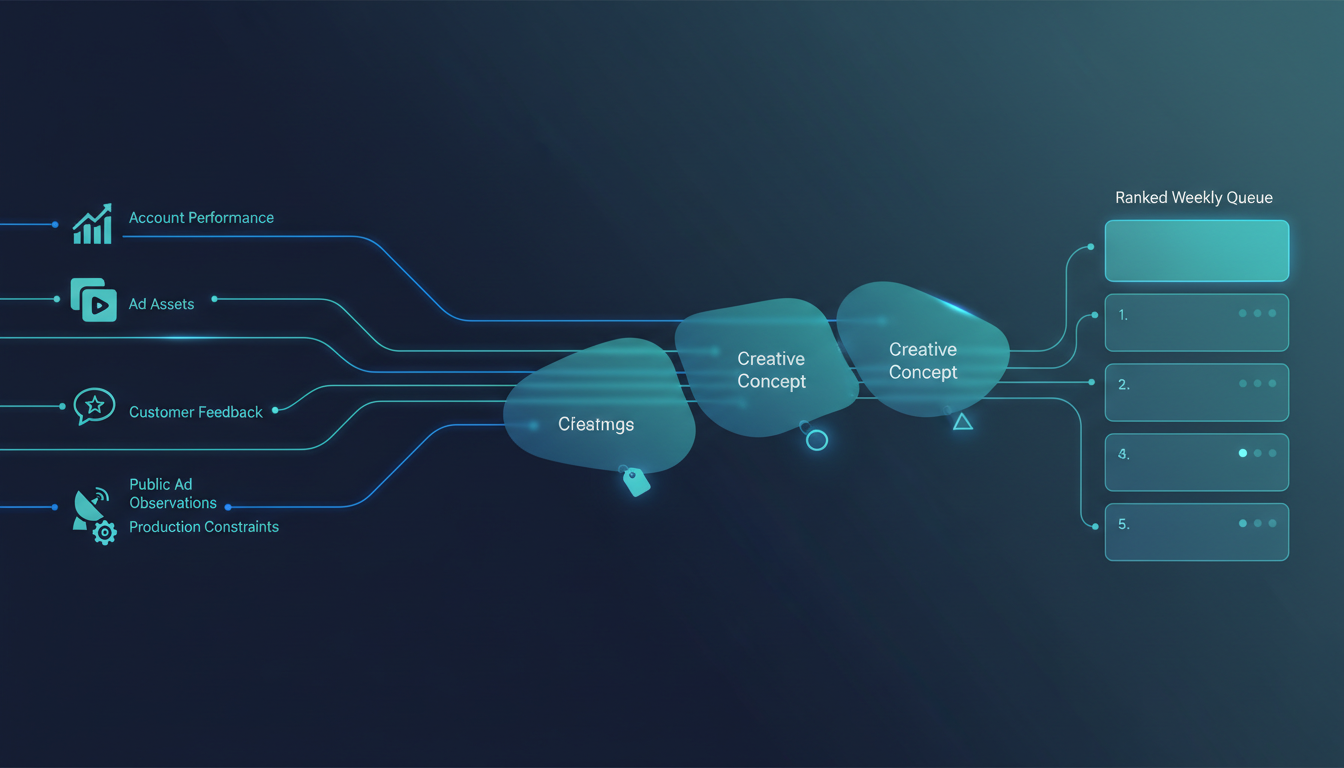
At Deepsolv, we help paid social teams rank hypotheses before executions by combining audience evidence, a weighted scoring matrix, capacity checks, fatigue replacement, and a weekly decision memo. This article defines the testing hierarchy, shows how to plan a defensible weekly queue, and explains how each outcome reshapes the next round of creative work.
How to Prioritize Paid Social Creative Tests: A Paid Social Creative Test Prioritization System
Most teams can produce more variations than they can defend. A 56,984-asset global study found that creative features such as human presence, visual dynamism, and fast storytelling can materially affect advertising effectiveness, which makes random test selection an expensive habit.
Paid social creative test prioritization works best when teams score each hypothesis for evidence strength, expected impact, audience relevance, novelty, production effort, and learning value. We rank hypotheses before executions, reserve weekly capacity for proven ideas, exploration, fatigue replacement, and unresolved questions, then update the queue from documented results.
This framework gives paid and creative teams a shared way to move from a crowded idea backlog to a small, evidence-backed weekly plan.
What Belongs in a Paid Social Creative Test Queue?
A request for “three new ads” is not yet a test plan. It may contain one audience insight, one strategic angle, several executions, and no decision anyone can learn from. We separate those layers so the queue rewards broader learning rather than the easiest assets to produce.
| Level | What It Means | What Gets Prioritized | Example |
|---|---|---|---|
| Audience Insight | Verified customer language, behavior, or need | Evidence source | “I need proof this will work for a team like mine.” |
| Angle | Strategic promise or framing | Primary queue unit | Peer proof |
| Hypothesis | Falsifiable prediction for an audience and outcome | Test candidate | Peer proof will improve qualified clicks from cold audiences |
| Concept | Story used to test the hypothesis | Chosen after ranking | Customer-results narrative |
| Hook | Opening attention device | Secondary variation | “Here is what changed after week one” |
| Format | Delivery container | Suitability constraint | Founder video, static image, carousel |
| Execution | Finished asset version | Production output | A 15-second vertical founder video |
The angle and hypothesis belong at the top of the queue because they answer the expensive question: what should we learn next? Hooks and formats are useful, but several of them can test the same underlying belief. Our angle tracking approach helps teams preserve that parent-child relationship instead of declaring every asset a separate idea.
This also keeps production convenience from taking over. If a team can make six simple hook changes quickly, those executions should not crowd out a distinct audience-relevant angle that could change future briefs, spend allocation, or positioning.
What Evidence Tells Us Which Ad Angles to Test Next?
Good prioritization starts before the meeting. We want each proposed angle to arrive with a reason, an audience, and a link to the evidence behind it. That turns a creative request into a testable claim.
Pull Evidence from Customer Language
Customer language is usually the strongest starting point because it exposes the terms buyers use when describing pains, desired outcomes, objections, and alternatives. We look across sales calls, support conversations, reviews, comments, DMs, surveys, and on-site search, then tag patterns by audience and stage of awareness.
Our comment analysis process is especially useful when customer feedback is abundant but scattered. A repeated objection can become an angle candidate, while a one-off request remains an observation until more evidence supports it.
Add Account History and Category Patterns
Account history tells us what the brand has already tested, what held spend, what exhausted quickly, and what only appeared to win because conditions changed. Category patterns can add useful prompts, but public creative is evidence of messaging activity, not evidence of profitable performance.
The Meta Ad Library lets teams review currently active ads, which makes it useful for observing repeated claims, visual patterns, and whitespace. We treat those observations as prompts to investigate with our own audience evidence, never as a reason to copy someone else’s work.
Check Market Events and Brand Strategy
A market event can make an angle more urgent, but only if it changes what the audience needs now. Product launches, seasonal deadlines, policy changes, supply constraints, and pricing shifts belong in the backlog when they affect the customer’s decision, not merely because they are timely.
Brand strategy sets the guardrails. Claims must be supportable, the audience must be a priority, and the angle must fit the offer we actually want to grow. Before scoring, we disqualify any idea that duplicates a live test, lacks an evidence link, cannot clear review, cannot be measured, or cannot ship within the planned window.
How Does Paid Social Creative Test Prioritization Rank Hypotheses?
Paid social creative test prioritization is not a vote for the most exciting concept. We use a transparent scoring model so every function can see why one learning opportunity outranks another.
Score the Hypothesis Before the Execution
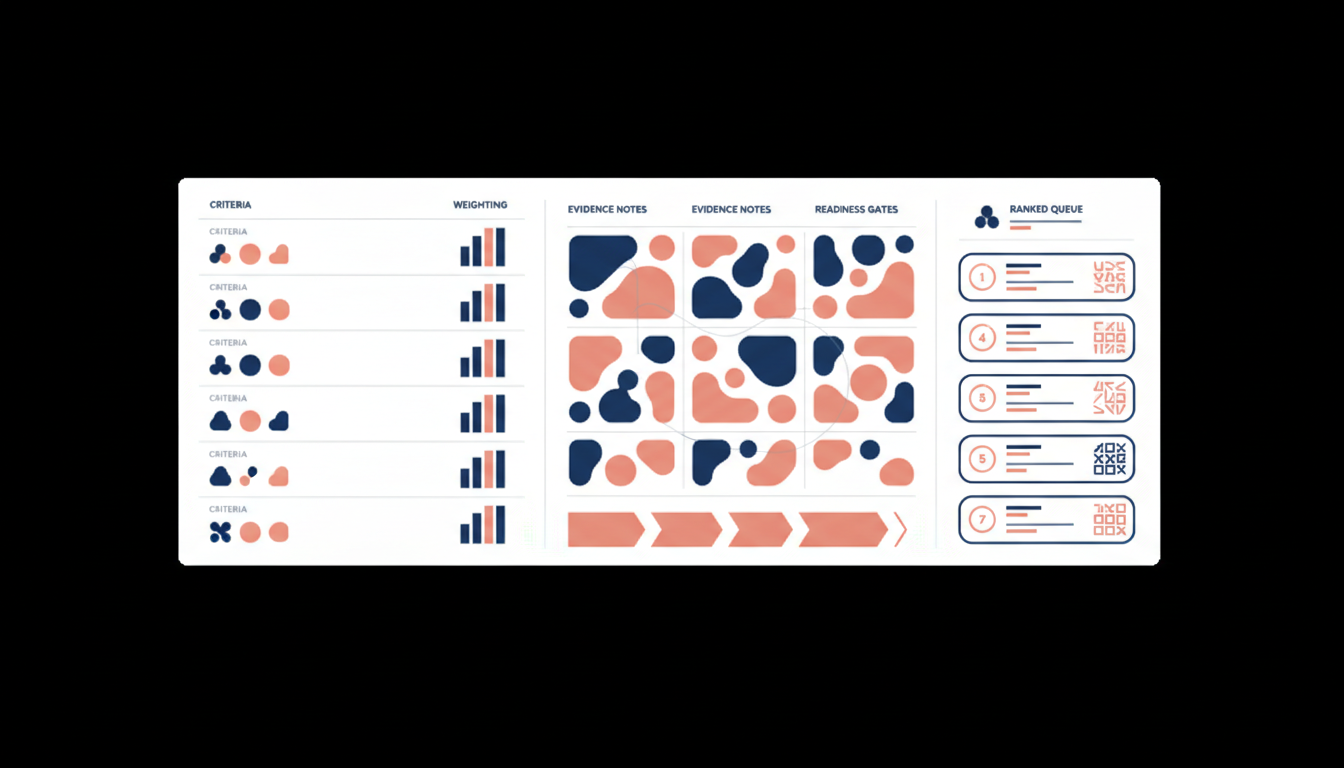
Score each hypothesis on a one-to-five scale, then set weights according to the team’s actual business constraints. A brand facing serious fatigue may give replacement urgency more influence. A brand entering a new category may value novelty and learning more heavily.
Calculate the priority score by adding weighted impact, confidence, audience relevance, novelty, and learning value, then subtracting weighted effort.
| Criterion | A Low Score Means | A High Score Means |
|---|---|---|
| Impact | Little changes if the result is positive | The outcome could affect a primary business KPI |
| Confidence | The idea is based on taste or a weak signal | Multiple direct, recent signals support it |
| Audience Relevance | The message is generic or poorly matched | It speaks to a priority audience and current need |
| Novelty | It repeats settled learning | It opens a distinct, decision-relevant angle |
| Effort | It requires heavy production or review | It can ship with available resources |
| Learning Value | The result would change little | The result resolves an important future choice |
Prevent One Angle from Crowding Out Learning
We give one primary slot to an angle before we consider multiple executions of it. A second hook, creator, or format can earn a place only when it answers a separate diagnostic question, such as whether a proven message needs a different delivery style for a specific audience.
This rule prevents a backlog from filling with cosmetic variants. It also gives us a clearer testing memory, because outcomes remain connected to the original hypothesis instead of disappearing into individual asset names.
Apply Readiness Gates Before Launching
A high score does not override reality. Before an idea enters the weekly plan, we confirm budget, production capacity, audience size, measurement readiness, claim approval, and a stable control or comparison condition.
Clear experiment design guidance recommends defining a hypothesis, testing one variable at a time, and selecting success metrics before the test begins. We use that discipline to decide whether a hypothesis is ready now, needs reframing, or belongs in the future backlog.
How Do Capacity and Fatigue Shape a Weekly Plan?
A queue is only useful when it respects the account’s ability to learn. Budget, production bandwidth, audience volume, review time, and analytics capacity all limit how many valid questions a team can answer at once.
Meta recommends setting enough budget across at least a seven-day budget guidance window so delivery can learn. That does not create a universal test duration or spend threshold, but it does explain why thin budgets split across many ideas often produce more dashboard noise than usable learning.
Use the smallest practical queue, then divide it among four purposes.
| Queue Lane | Purpose | Entry Rule | Expected Output |
|---|---|---|---|
| Exploitation | Extend a validated message | A proven angle has room to scale or adapt | Durable performance asset |
| Exploration | Test a distinct audience-relevant angle | Strong evidence supports a new learning question | New strategic insight |
| Fatigue Replacement | Protect an active audience from declining response | The asset meets the team’s fatigue trigger | Ready rotation asset |
| Unresolved Learning | Finish an important inconclusive test | More data could change a meaningful decision | Closed question |
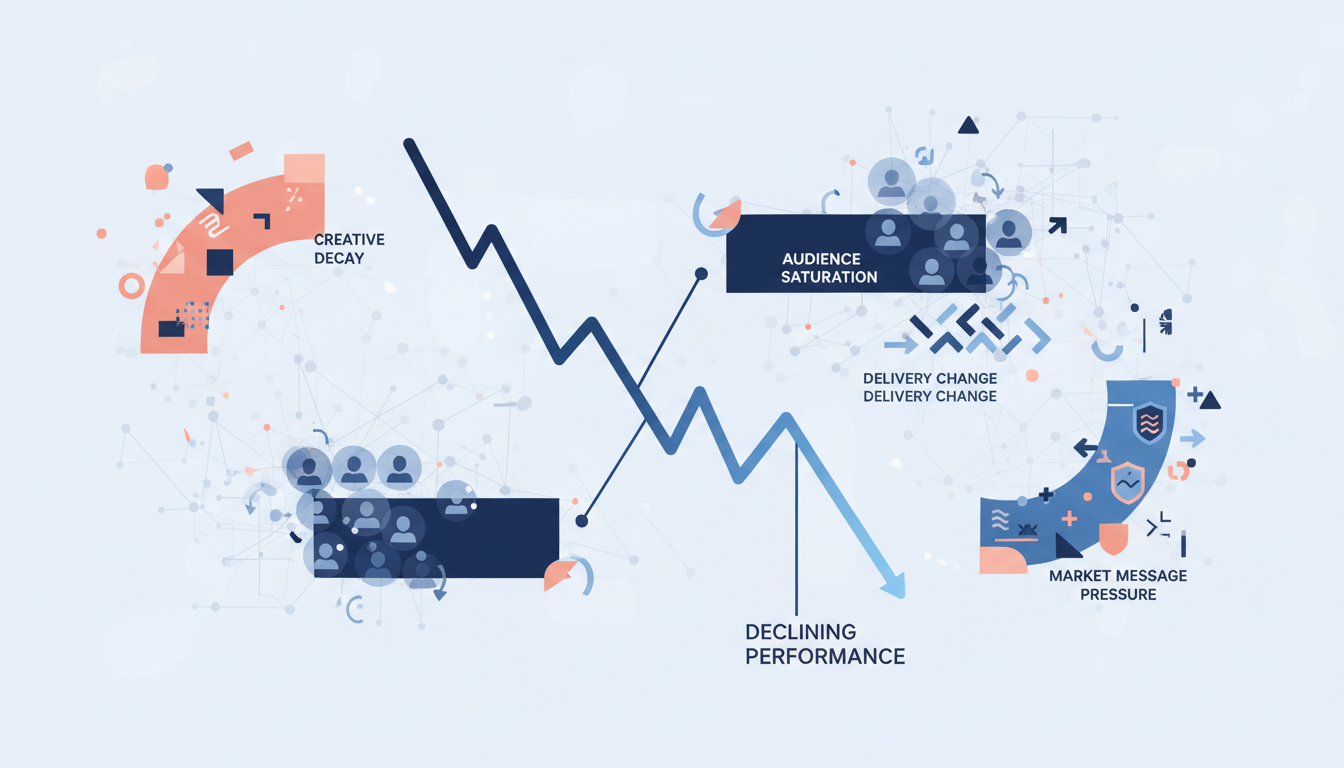
Fatigue should change the ranking because a strong active asset can still become risky to rely on. We diagnose it against the creative’s own baseline across delivery, attention, response, and conversion quality, rather than relying on one universal frequency threshold. Our fatigue diagnosis guide helps separate creative fatigue from audience saturation before the team replaces the wrong thing.
When an asset needs replacement, we do not automatically remake it with a new background or headline. We first ask whether the original angle remains sound, then decide whether the queue needs a new opening, a new format, or a genuinely different promise.
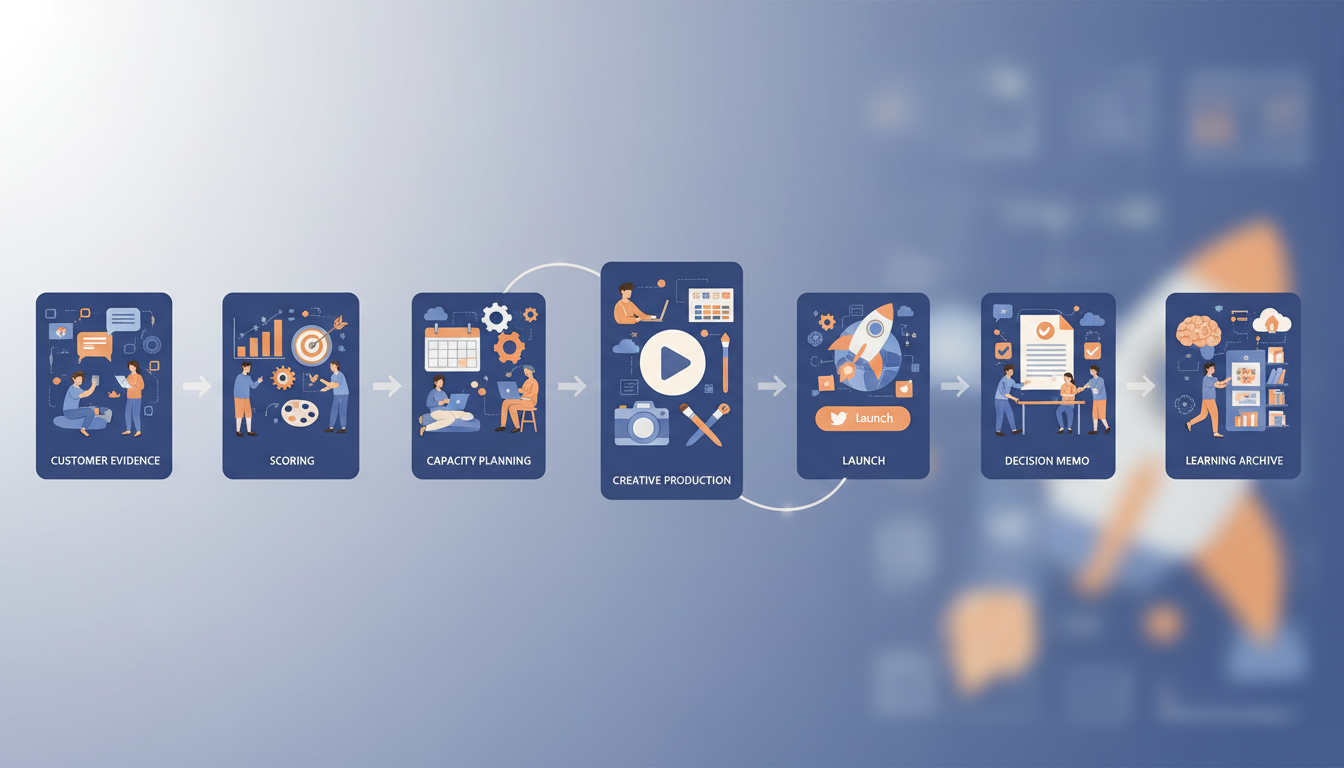
What Is the Seven-Step Weekly Decision Workflow?
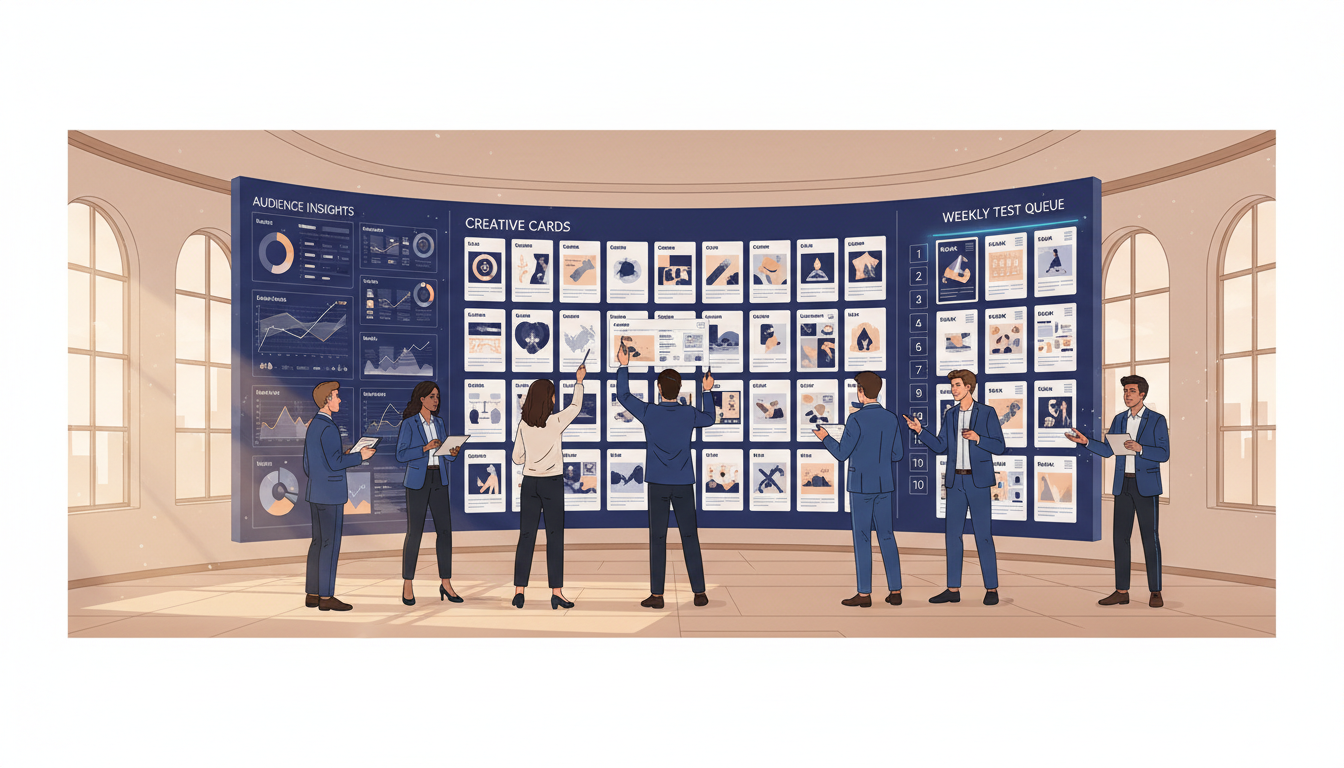
A practical weekly ritual should make disagreements useful. We ask people to bring evidence and scores to the meeting, not fresh opinions that force the group to brainstorm from zero.
-
Freeze Inputs: Collect new customer evidence, account findings, active fatigue risks, market events, production availability, and measurement constraints.
-
Normalize Ideas: Translate requests into insight, angle, hypothesis, concept, hook, format, and execution, then merge duplicate executions under their parent angle.
-
Disqualify Early: Remove ideas without evidence, readiness, differentiation, or a decision that would matter to the business.
-
Score Independently: Have paid, creative, and insight owners score the remaining hypotheses before group discussion begins.
-
Rank And Allocate: Apply the scoring matrix, one-angle rule, readiness gates, and queue lanes to select only work the team can measure and ship.
-
Write The Decision Memo: Lock the hypothesis, audience, control, variable, primary metric, decision rule, owner, evidence, and launch date before production starts.
-
Read Out And Re-Rank: Label the result scale, iterate, retire, or inconclusive, then update confidence, novelty, and disqualifiers for next week’s backlog.
When a team needs to compare several strategic ideas before production, our concept prioritization framework keeps the discussion focused on evidence and expected learning instead of personal preference.
A concise decision memo keeps the learning portable:
Decision: Iterate
Audience: First-time visitors comparing solutions
Angle: Team-wide visibility
Evidence: Repeated customer comments about handoff confusion
Variable: Problem-led opening versus proof-led opening
Primary Metric: Qualified landing-page engagement
Next Move: Keep the angle active, test stronger proof in the opening
Backlog Change: Lower priority for generic productivity claims
The outcome is not merely a label for the winning asset. It is a change to the next ranking. A clear result raises or lowers confidence in an angle. An inconclusive result may reserve one more slot if it can answer a consequential question. A valid loss can add a disqualifier that stops the team from rebuilding the same idea next month.
When a hook is responsible for an inconclusive result, our hook decision framework helps teams determine whether to iterate the opening or retire the broader direction.
Why Teams Plan with Deepsolv
We help paid social teams turn scattered comments, account history, and live performance into a decision-ready creative queue. We connect customer feedback with the creative angles, hooks, formats, and outcomes that matter, so your next test starts with evidence rather than a blank brief. Our workspace preserves the why behind each decision, flags repeat ideas before they consume production time, and gives paid, creative, and insight teams one place to agree on the next move. That makes weekly planning calmer: you can see which angles deserve exploration, which proven ideas merit another execution, and which assets need a fatigue replacement. We do not ask teams to hand control to a dashboard. We help them build a documented system that keeps human judgment, business constraints, and customer language together. It also gives us a clearer way to learn from each completed test and move forward. Start with Deepsolv
FAQs on Paid Social Creative Test Prioritization
These answers address the decisions that most often slow weekly creative planning. They apply the same evidence, capacity, and learning principles used throughout this framework.
How Do We Choose Which Paid Social Creative Test to Run First?
Use linked audience evidence to write a falsifiable hypothesis, remove duplicate and unready ideas, then score impact, confidence, relevance, novelty, effort, and learning value before production.
What Counts as a Separate Creative Angle?
An angle is a strategic promise for a defined audience. Different hooks or formats remain executions of that angle unless they test another documented learning question.
How Do We Prevent Too Many Variants from Running at Once?
Limit each angle to one primary learning question, apply readiness gates, and launch only tests that available budget, capacity, audience volume, and measurement can support.
When Should a Failed Test Stay in the Backlog?
Keep an inconclusive test when more data could change a material decision. Retire a valid loss when its hypothesis, conditions, metric, and decision rule were clear.