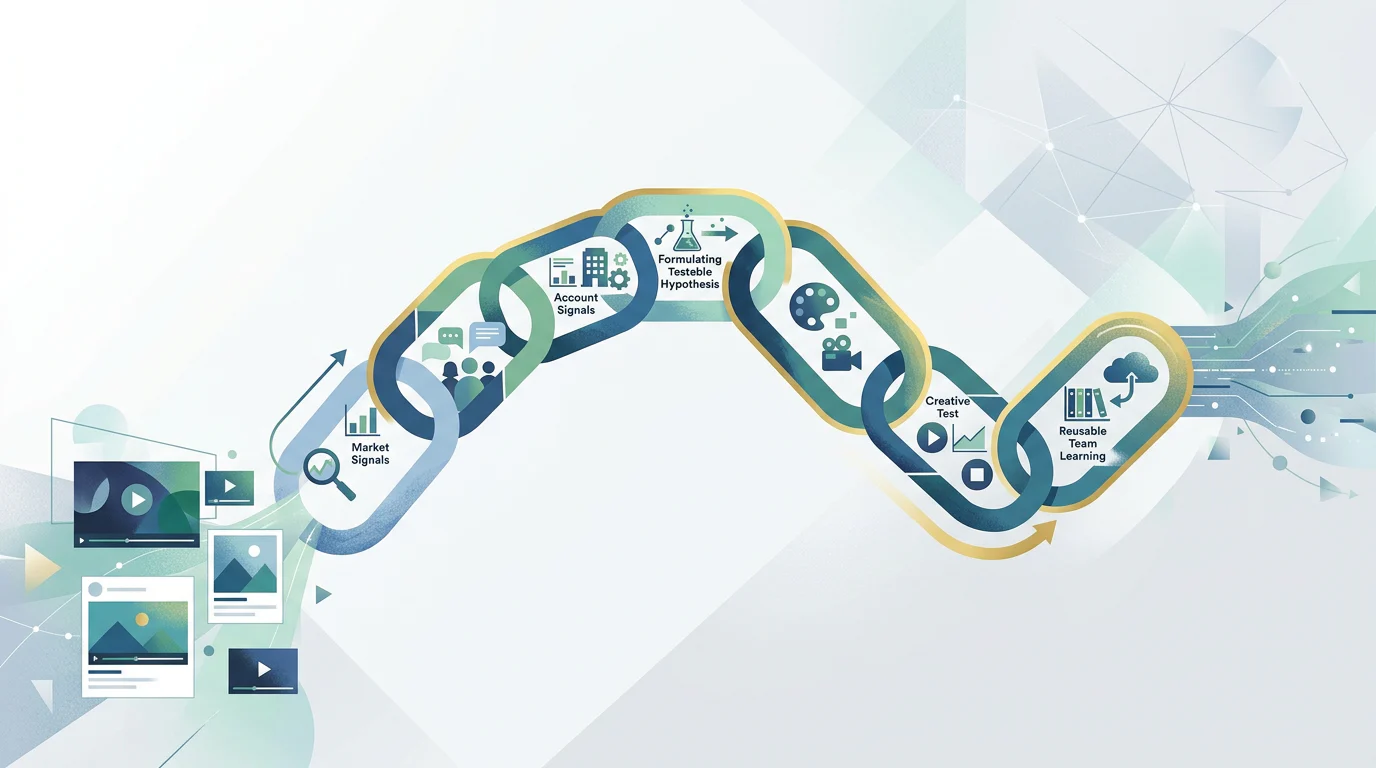
Can AI Predict Winning Meta Creative? AI Creative Prediction for Meta Ads


TL;DR
At Deepsolv, we use AI creative prediction for Meta ads to rank evidence-backed hypotheses, not promise a winning ad before launch. We show what evidence belongs in brand memory, how to score and batch concepts, and how verified results update the next decision while human review and controlled testing remain essential.
A large ad study examined 1 million real creatives across 10-billion-scale impressions, but it modeled when ads were discontinued after serving, not whether an unlaunched concept would win. That distinction matters when a DTC team has a crowded concept board and a finite Meta budget.
AI creative prediction for Meta ads cannot reliably guarantee which concept will win before it receives delivery and conversion data. It can make test selection smarter by organizing prior results, detecting patterns, comparing concepts with brand and market evidence, and ranking hypotheses by impact, learning value, and uncertainty. Human review and live experimentation still decide what actually works.
Here is how we separate useful planning from false certainty, then turn a prioritized list into tests that keep teaching the brand.
Can AI Predict Winning Meta Creative?
Not in the literal sense. Before launch, an ad has not encountered the auction, an audience, a placement mix, or the conversion path that determines its observed result. Meta also cautions that even a high pre-publish campaign score does not reflect actual or future performance in its Ads Manager guidance.
What AI can do is narrow the question from “Which ad will win?” to “Which hypothesis is most worth testing now?” That is a materially better operating decision. It gives a team a visible rationale, identifies weak evidence, and keeps a speculative concept from receiving the same priority as a well-supported one.
| AI Capability | Useful Output | Claim We Avoid |
|---|---|---|
| Performance estimation | A confidence-aware test priority | A guaranteed winner |
| Concept scoring | A ranked hypothesis backlog | A promised CPA or ROAS |
| Test scheduling | A sequence that protects learning | A replacement for experiments |
| Creative generation | Variations to evaluate | Proof that more assets will perform |
| Brand memory | Context from prior evidence | A rule that past results always repeat |
We use this distinction to keep planning honest. When a concept enters our creative lifespan framework, it is a candidate for learning, not a prediction dressed up as certainty.
What Evidence Makes AI Creative Prediction for Meta Ads Useful?
A useful score needs more than images and copy. It needs the conditions that made prior results meaningful, including audience, offer, placement, objective, and measurement setup. Without that context, an AI system can recognize a familiar creative pattern while misunderstanding why it performed.
Internal Brand Evidence
We start with the brand’s own test record: hypothesis, creative attributes, spend, delivery status, conversion outcome, attribution setting, and confidence in the result. First-party conversion data deserves more weight than an attractive engagement signal because it is closer to the business decision. Meta describes its Conversions API as a way to connect website, app, CRM, offline, and messaging events to optimization and measurement.
Creative and Audience Context
Each proposed concept should carry structured attributes: angle, objection, promise, proof type, opening, format, creator style, offer, funnel stage, and intended audience. That structure lets us compare concepts as hypotheses rather than treating every thumbnail as unrelated creative.
Market Signals and Constraints
Current ads in the market can reveal recurring formats, messaging density, and potential similarity. They cannot reveal commercial performance. Meta’s Ad Library help confirms that commercial searches show currently active ads, which makes them a useful market signal but not proof of conversion efficiency.
For a team with 40 concepts and $80,000 in monthly Meta spend, the goal is not to launch all 40 faster. The goal is to identify the few concepts that are distinct enough to teach something, feasible enough to produce, and relevant enough to the current business objective. Our creative testing memory structure keeps that evidence available for the next decision.
How Does Brand Memory Improve Creative Testing?
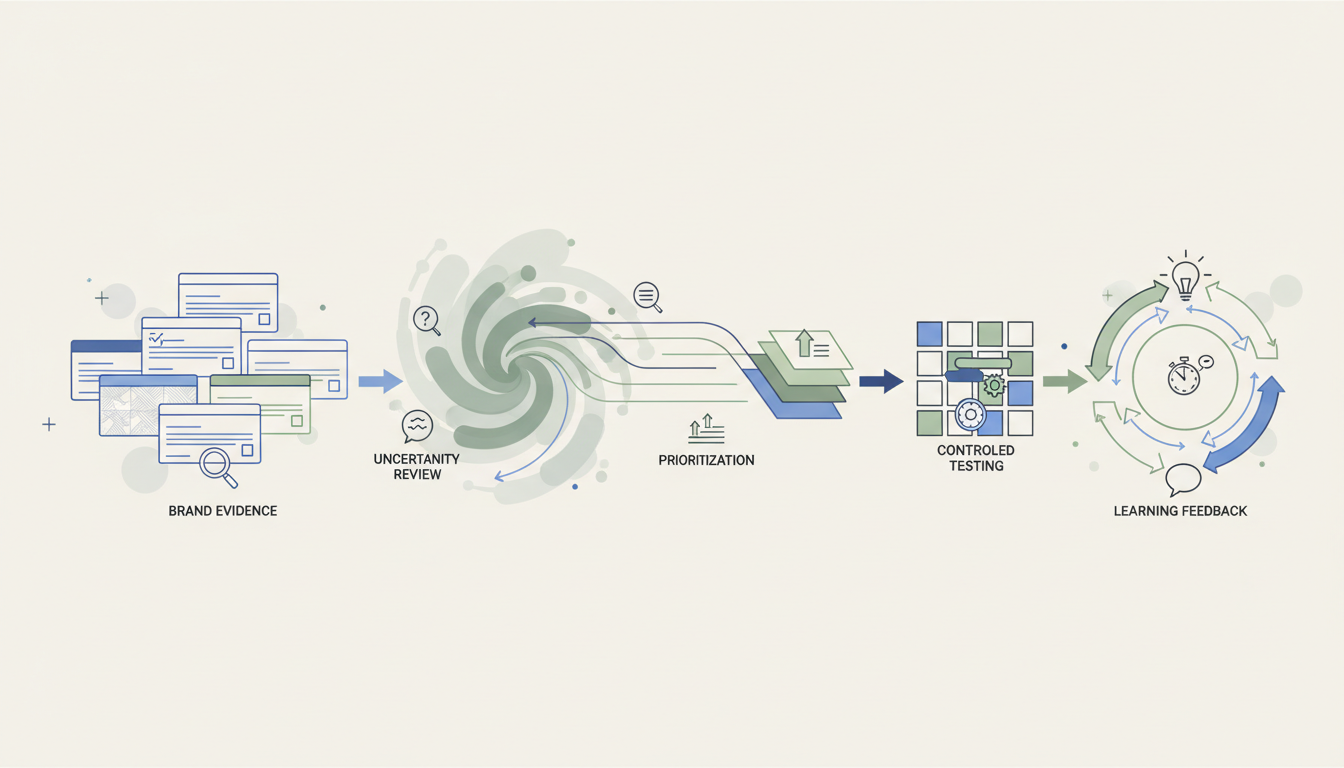
Brand memory is not a gallery of past winners. It is a record of what we believed, what conditions applied, what happened, and how confident we should be in the interpretation. That is how a brand avoids retesting the same failed hypothesis in a new visual wrapper.
Each memory record should connect a hypothesis to its context. For example, “customer proof will reduce hesitation” is incomplete. A useful record also captures the product, offer, prospecting or retargeting audience, format, placement, landing page, conversion definition, and whether the result was conclusive.
Contradictions belong in the record, too. A proof-led creative may work for one product launch and fail with a different offer. We do not flatten that into “proof works” or “proof fails.” We retain the conditions and let the next score reflect the uncertainty. Our creative angle tracking approach helps make those connections visible across launches.
This is also where we protect against false confidence. The NIST framework for trustworthy AI calls for attention to context, human oversight, and bias, all of which matter when historical data reflects old targeting, old offers, or incomplete attribution. NIST’s AI framework supports the principle that a model output should be reviewable, not treated as an unquestionable decision.
How Should We Score Meta Ad Concepts?
We prefer a transparent rubric over a mysterious score. The team should be able to see why a concept ranks where it does, edit the assumptions, and decide when an unusually novel idea deserves a deliberate exploratory test.
Our proposed weighting is a planning method, not an industry benchmark. It gives the brand brain a shared language for comparing different kinds of concepts without pretending that a score is a forecast.
| Criterion | Weight | What The Team Evaluates |
|---|---|---|
| Expected Business Impact | [30%] | Relevance to the current offer, margin, and business goal |
| Evidence Strength | [25%] | Relevant first-party tests, customer feedback, and context |
| Learning Value | [20%] | Whether the test resolves an important uncertainty |
| Novelty | [15%] | Meaningful difference from recent concepts and market patterns |
| Cost Efficiency | [10%] | Production and media cost relative to potential learning |
A five-concept illustrative batch might rank a product demonstration first because it tests a high-priority objection with relevant evidence, a customer-proof concept second because its evidence is promising but narrower, and a seasonal montage fifth because it adds less new learning. Those ranks are not predicted outcomes. They are a transparent order for spending the next test budget.
The score should also surface what is missing. A concept with little evidence can still make the batch if its learning value is high, but its uncertainty should be visible. That is the difference between disciplined exploration and a confident-looking guess. Our concept prioritization workflow keeps that rationale attached to each creative decision.
How Should We Turn Scores into a First Test Batch?
A ranking only matters if the resulting batch can produce a meaningful decision. Too many similar variants can fragment delivery, blur the learning, and create a dashboard full of numbers without a clear next action.
Choose Concepts That Teach Different Things
For a first batch, select concepts that represent different hypotheses, not merely different edits. A customer objection, a product demonstration, a founder explanation, a proof-led story, and an offer-led comparison can each answer a different strategic question.
Set the Test Rules Before Launch
Define the primary conversion metric, attribution rule, held-constant conditions, review point, and the next decision before the ads go live. Exploratory tests can vary more than one creative element when the purpose is discovery. Confirmation tests should isolate the important difference so the team can interpret the result.
Protect Delivery and Measurement
Similar ad sets running at once can receive fewer opportunities to learn and fewer results. Meta recommends simplifying overlapping structures to reduce fragmentation in its ad set guidance. Before launch, check audience overlap, placements, budget, tracking, landing-page readiness, policy status, and naming conventions.
We also separate creative fatigue from audience saturation before asking the team to make more variants. That diagnostic discipline is central to our fatigue versus saturation guide, because a declining result is not automatically a creative problem.
How Do Results Update the Next Test Plan?
Post-launch learning should produce three possible labels: supported, contradicted, or inconclusive. “Loser” is often too blunt. A low-spend ad, a broken event, a rejected asset, or a changing offer can make a test inconclusive rather than false.
Before we record a failed hypothesis, we check delivery status, policy or quality warnings, spend distribution, placement mix, landing-page behavior, event deduplication, attribution settings, and audience overlap. This replaces vague troubleshooting with a repeatable diagnostic gate.
Then we update the record. Supported hypotheses gain evidence only within their relevant context. Contradicted hypotheses remain searchable, so the next creative review does not unknowingly repeat them. Inconclusive tests become candidates for a cleaner rerun or a different method.
Customer comments and messages can add useful qualitative evidence to that loop, especially when they reveal recurring objections or language the brand should test. Our feedback-to-test workflow connects those signals to planned experiments, while our comment analysis process helps teams separate a creative insight from isolated noise.
Put AI Creative Prediction for Meta Ads to Work with Deepsolv
At Deepsolv, we built our workflow for the moment before media spend: the team has a crowded concept board, fragmented feedback, and no defensible order of operations. We connect performance history, customer comments, creative attributes, and the business question behind each proposed ad. Our role is not to declare a winner from a mockup. We help your team see the supporting evidence, the contradictions, the missing data, and the next experiment worth running. That gives creative, growth, and media teams one shared record instead of another spreadsheet of isolated results. We also make the evidence trail usable in the review meeting, where real launch constraints and brand judgment belong. If your DTC team wants a calmer way to decide what to test, learn from the outcome, and avoid recycling failed angles, we can show you the workflow in context. Book a demo
FAQs on AI Creative Prediction for Meta Ads
These questions address the practical boundary between smarter planning and unsupported prediction. We use AI to make evidence and uncertainty clearer, then let controlled tests determine what earns more budget.
Can AI Predict Winning Meta Ads?
AI ranks concepts with prior evidence and uncertainty, but delivery, audience response, and conversion measurement determine performance. We use controlled testing as the final decision mechanism.
How Does AI-Powered Ad Test Planning Work?
It organizes evidence, identifies repeated hypotheses, scores concepts transparently, flags uncertainty, and creates a test order. Human reviewers approve assumptions and strategic priorities before launch.
Is AI Creative Prediction Better Than A/B Testing?
No. Scoring decides what deserves a test, while a controlled experiment measures the result. The strongest workflow combines planning, execution, diagnosis, and memory after every launch.
How Does Brand Memory Improve Creative Testing?
Brand memory preserves hypotheses, contexts, outcomes, contradictions, and confidence. It helps teams avoid repeated failed ideas and apply successful evidence only where it remains relevant.
Can AI Choose Which Creative to Test First?
AI can recommend the first concept by weighing impact, evidence, novelty, cost, and learning value. We keep the rationale visible for human approval before launch.