
How to Track Which Ad Angles Convert: Creative Angle Performance Tracking
Track which ad angles convert with a repeatable system for taxonomy, attribution, first-party performance and competitor signals.

Competitor activity is easy to observe, but conversion performance is not: Meta’s public ad library makes active ads searchable, while its political-ad archive retains records for 7 years.
To identify which ad angles convert, use creative angle performance tracking: assign every asset a consistent angle label, preserve campaign, audience, and attribution context, then compare pooled conversion outcomes instead of individual ads. Competitor activity can generate hypotheses, but only your first-party conversion and incrementality evidence can show whether an angle works for your business.
This guide explains the taxonomy, data fields, comparisons, external signals, and repeatable review process that turn scattered ad results into a usable learning system.
What Is an Ad Angle, and What Is Not?
An ad angle is the central reason a customer should care or act. It is the proposition behind the creative, such as “solve this costly problem,” “get this desired outcome,” “avoid this objection,” or “trust this proof.” It is not simply a catchy opening, a creator, or a product shot.
That distinction matters because teams often label every creative element as an angle. When the label changes whenever a hook, visual, or offer changes, reporting becomes too fragmented to answer the question that matters: which message is actually earning profitable conversions?
Separate the Variables Before You Measure Them
A useful creative record distinguishes the core proposition from the execution around it.
| Variable | What It Means | Example |
|---|---|---|
| Angle | The persuasive reason to act | “Avoid expensive mistakes” |
| Hook | The opening attention device | “Most teams miss this signal” |
| Offer | The commercial incentive | Free trial or bundle |
| Format | The asset type | Creator video or carousel |
| Visual Treatment | How the message appears | Product demo or testimonial |
| Audience | Who received it | Cold prospecting or retargeting |
The angle should remain stable when you test new openings, different creators, or alternate formats that communicate the same proposition. If the proposition itself changes, create a new angle ID. That simple rule gives our teams a durable way to group creative without pretending that every variation is identical.
Use Controlled Labels, Not Free-Text Names
Use a short, governed naming pattern such as angle__hook__offer__format__audience__version. The angle label should be understandable without opening the ad, while the remaining fields explain why two ads may have performed differently.
A controlled taxonomy also makes past results reusable. When a new concept enters planning, we can compare it with previous message families instead of hunting through ad names and screenshots. Our concept prioritization framework is a useful companion for turning those grouped findings into a testing queue.
Keep the Hypothesis with the Asset
Every angle needs a one-sentence hypothesis. For example: “A risk-reduction message will improve qualified conversion rate among first-time visitors.” This forces a clear distinction between the customer proposition and the creative execution.
It also prevents a common reporting failure: calling an ad a winner because it received inexpensive traffic. An attention-grabbing hook can improve clicks while the angle, offer, or landing page still fails to convert.
How Do You Tag Creatives so Results Stay Comparable?
Tagging is the bridge between the ad platform, web analytics, CRM data, and the creative record. Without it, an angle may look different in each system and the team will spend review time reconciling names instead of learning.
Start before launch. Assign a unique creative ID, an angle ID, a campaign ID, and a taxonomy version. Keep those values in the ad name and pass the creative identity into analytics through consistent campaign parameters. Google recommends that marketers use relevant parameters such as source, medium, campaign, campaign ID, and platform, because incomplete values create fragmented or unset reporting in its UTM guidance.
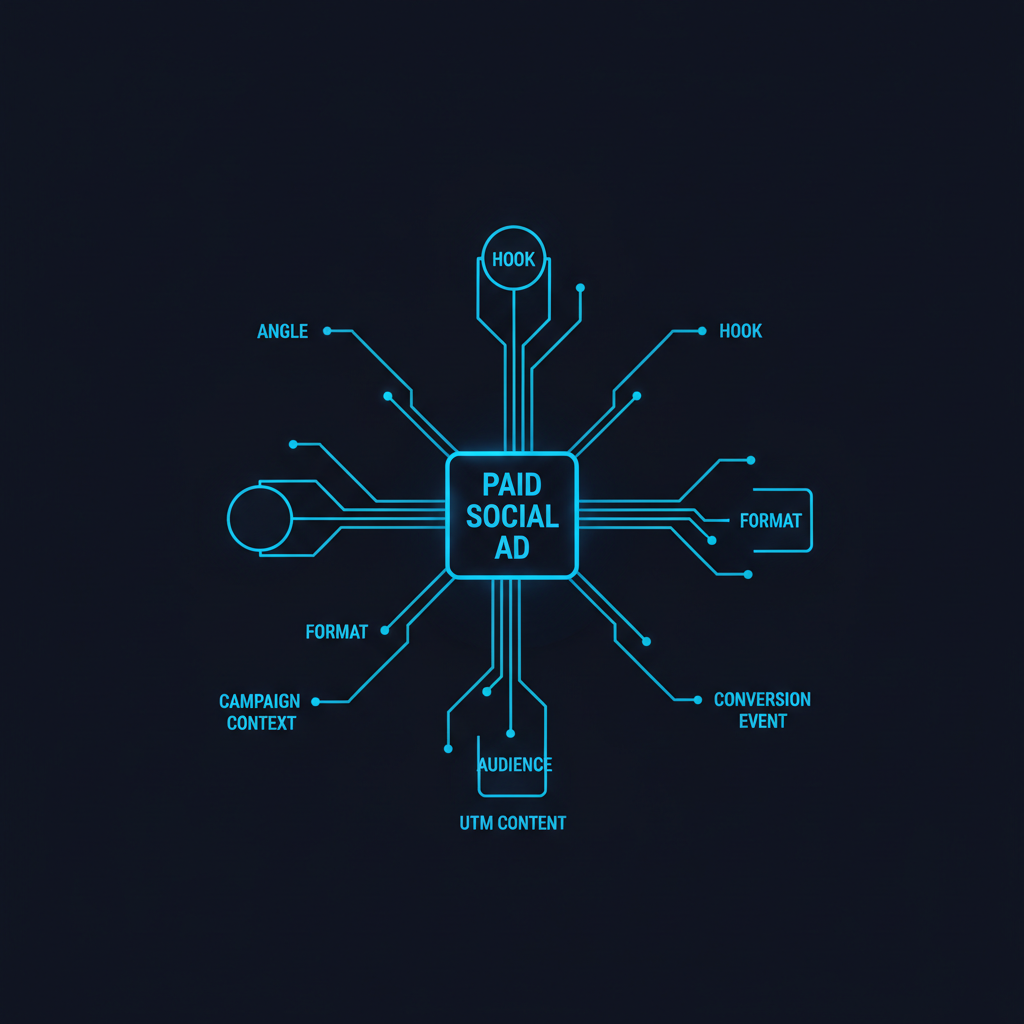
Tag the Creative and the Context
Use utm_content for the stable creative ID or controlled creative label, not an improvised phrase. Use campaign fields for campaign identity, source and medium for channel identification, and internal fields for angle, hook, offer, audience stage, geography, and placement.
The practical goal is not a longer URL. It is a joinable record that lets us see the same creative in platform delivery data, web analytics, and downstream conversion data.
Verify the Conversion Event Before Trusting It
A measurement model cannot repair duplicate or incomplete conversion events. Check that browser and server events are reconciled, that the event definition matches the business outcome, and that lead-quality or purchase data can return to the record where appropriate.
Use a shared event identifier where browser and server events describe the same conversion. Then review the platform event setup, analytics event, CRM outcome, and finance record as separate checks rather than assuming one dashboard is the entire truth.
Preserve Learning Across Test Cycles
A tagged creative should not disappear when a campaign ends. Store its angle, context, results, decision, and caveats in a persistent learning record. That is how a team avoids re-testing the same proposition under a new ad name. Our creative testing memory explains how we structure that continuity across launches.
How Do You Compare Ad Angles Beyond ROAS?
ROAS is useful, but it is a result, not an explanation. It can hide differences in conversion definitions, attribution windows, audience stages, spend allocation, and sample size. A productive comparison begins by asking whether two angle groups were measured under comparable conditions.
We recommend pooling compatible ads by angle, then recalculating results from totals. Add total spend, total conversions, and total revenue before calculating CPA, conversion rate, or ROAS. Do not average individual ad-level ROAS figures, because an underfunded ad and a heavily funded ad should not carry equal weight.
Track the Full Creative Measurement Set
Before judging whether an angle converts, review delivery, click quality, funnel progression, conversion outcomes, and fatigue together. Cheap clicks are only useful when they lead to valuable downstream behavior.
| Metric Pattern | What It May Indicate | What It Cannot Prove Alone | Next Check |
|---|---|---|---|
| Low CPM and high CTR | Efficient attention | A profitable angle | Landing-page progress and conversion rate |
| High CTR and high CPA | Strong hook, weak downstream fit | That the message converts | Offer and funnel drop-off |
| Low CTR and strong CVR | Narrow but qualified appeal | Scale potential | Reach, spend, and audience size |
| Strong platform ROAS and weak owned revenue | Attribution or event mismatch | Incremental profit | UTMs, event quality, and order data |
| Rising frequency and falling CVR | Possible fatigue | Why results declined | Audience, creative age, and delivery changes |
Normalize the Conditions Before Pooling
Compare like with like: the same conversion event, attribution setting, funnel stage, geography, campaign objective, and review period. A retargeting ad should not compete directly with a cold-prospecting ad simply because both are labeled with the same angle.
Campaign edits matter too. Meta records changes to budgets, schedules, targeting, and ads in its activity history, which is why our reviews retain a change log beside creative performance. An apparent angle winner may actually be the result of an audience expansion, budget shift, or different optimization event.
Read Attribution as a Lens, Not Proof
Attribution settings determine how conversion credit is reported. They can change the apparent result even when the creative itself is unchanged. Google Analytics similarly applies its selected attribution model to event-scoped reporting, so teams need to document the model alongside each comparison in its attribution documentation.
First-party performance is stronger evidence than platform-only reporting, but it is still attribution evidence. When a major scale decision depends on causal certainty, use a controlled test or incrementality study rather than assigning all credit to the last observed ad interaction.
Keep the Creative-Level Drill-Down
Angle-level aggregation should simplify the decision, not obscure the evidence. Keep each underlying ad visible with spend, impressions, reach, frequency, click quality, conversions, and context. This exposes whether one funded asset carried an entire angle family or whether several variants produced consistent results.
Our creative intelligence guide shows how we connect those ad-level records to the larger learning history without losing the detail needed for a defensible decision.
How Can Competitor Signals Help Without Proving Conversions?
External ads are useful market signals, not private performance data. They can show recurring offers, message categories, visual conventions, landing-page themes, active creative families, and how a category positions its product. They cannot reveal another advertiser’s conversion volume, CPA, ROAS, profit, event quality, or incrementality.
This is the line that keeps competitor research useful. We collect observable activity as a hypothesis source, then test the resulting angle against owned performance data. We do not label a long-running external ad as a “proven winner” because its business outcome is not public.

Separate Observation from Validation
A side-by-side workflow should have two records:
- Observed market signal: Creative, format, offer, visible date range, landing-page theme, geography, and apparent angle.
- Owned validation record: Spend, delivery, conversion event, revenue or lead quality, attribution setting, and decision.
This structure answers whether a research system pulls live data or relies on manual capture. Public sources can support scheduled collection or repeatable snapshots, but they do not grant access to another account’s private conversion reporting. Our competitor-ad analysis guide helps teams turn those observations into organized research rather than spreadsheet clutter.
Use Longevity Carefully
An active ad may suggest that a team is still willing to run it. It does not establish why. The creative could support awareness, retargeting, a limited audience, a brand campaign, a testing program, or an outcome that is not visible publicly.
Treat recurring patterns as clues worth testing. Then use your own taxonomy and scorecard to decide whether the same customer proposition performs in your account, with your offer, on your landing page, and under your attribution model.
Capture Comments as Qualitative Signal
Comments can surface objections, confusion, language customers repeat, and product questions that may improve an angle hypothesis. They are not conversion data, but they can sharpen the next creative brief. Our guide to analyzing ad comments shows how we turn that qualitative feedback into structured inputs.
How Do You Choose the Next Test?
A good review ends with a decision, not a screenshot. Each angle should move into one of four states: scale, iterate, hold, or stop. The decision should reflect the agreed conversion goal, financial guardrails, evidence quality, and whether the team can explain the result without ignoring context.
Avoid universal thresholds. The right minimum spend, conversion count, target CPA, and review window depend on margin, conversion lag, traffic volume, and the cost of being wrong. Meta notes that daily ad spend can fluctuate, while weekly spending remains bounded by the budget rules, so one-day performance is rarely a sound basis for an angle decision. Use a complete review window and the platform’s budget guidance as operational context.
Follow a Five-Step Workflow
- Connect And Validate: Confirm event definitions, first-party data connections, and campaign tagging before launch.
- Tag And Register: Assign the angle, hook, offer, format, audience, and creative ID with a written hypothesis.
- Normalize And Aggregate: Group compatible ads by angle, preserve context, and calculate results from pooled totals.
- Review And Decide: Compare against account-specific profitability thresholds, then scale, iterate, hold, or stop.
- Record And Plan: Save the evidence, caveats, and next variable to test so the learning compounds.
A practical scorecard includes the angle ID, hypothesis, eligible spend, valid conversion count, CPA, revenue, review window, attribution setting, audience stage, and next action. The fields are simple, but the discipline behind them prevents a team from confusing a cheap click, a visible competitor ad, or a single high-spend creative with a durable message-level finding.
For the broader operating model behind this process, use our ad creative strategy guide when assigning research, testing, and review responsibilities across the team.
How Deepsolv Supports Creative Angle Decisions
At Deepsolv, we give paid-social teams one operating record for the question spreadsheets obscure: which message, for which audience, produced a profitable customer outcome. We connect authorized account data, organize creative and competitor observations in the same research workspace, and preserve the context that makes a result useful later. Instead of asking analysts to rebuild a report every week, our platform helps teams search prior tests, compare angle families, spot repeated market patterns, and turn results into the next brief. We do not treat an external ad as proof of revenue. We keep observed market activity separate from owned conversion evidence, so the team can move quickly without overstating certainty. If your next planning meeting needs a clearer answer than “this ad looked good,” bring the evidence together, make the next test easier to defend with stakeholders, and start with book a demo.
FAQs on Creative Angle Performance Tracking
What Is an Ad Angle?
An ad angle is the central reason a specific audience should act. Hooks, visuals, formats, and offers support that proposition, but remain separate variables during tests.
Can Competitor Ads Prove Conversion Performance?
No. Public ads reveal messaging, offers, formats, and activity patterns, but they do not expose another advertiser’s orders, margins, attribution settings, or incremental lift.
Which Metrics Matter Before You Judge an Angle?
Review spend, impressions, reach, frequency, click quality, landing-page progress, conversions, conversion value, CPA, ROAS, and campaign, audience, attribution, and optimization context for every angle decision.
How Do I Aggregate Results Across Ads?
Pool compatible ads by angle, then calculate CPA and ROAS from total spend, total conversions, and total revenue. Keep creative-level detail visible to expose uneven allocation.
When Should I Test Incrementality?
Use an incrementality test when a major scale or budget choice needs causal confidence, especially if platform reporting conflicts with your first-party revenue or materially affects profit.