
TL;DR
We use continuous competitor ad tracking to collect permitted public ad records, preserve changes over time, and turn observable messaging shifts into ranked test hypotheses. It cannot reveal a competitor’s spend, conversions, or profitability, so we connect directional market signals with customer feedback, first-party test results, and stop-testing memory before recommending what to test next.
A public ad feed is not instant.Meta says its commercial library can take up to 24 hours to reflect an ad’s first view or a campaign update, which is why a responsible system records when it observed a change instead of pretending every source is live.
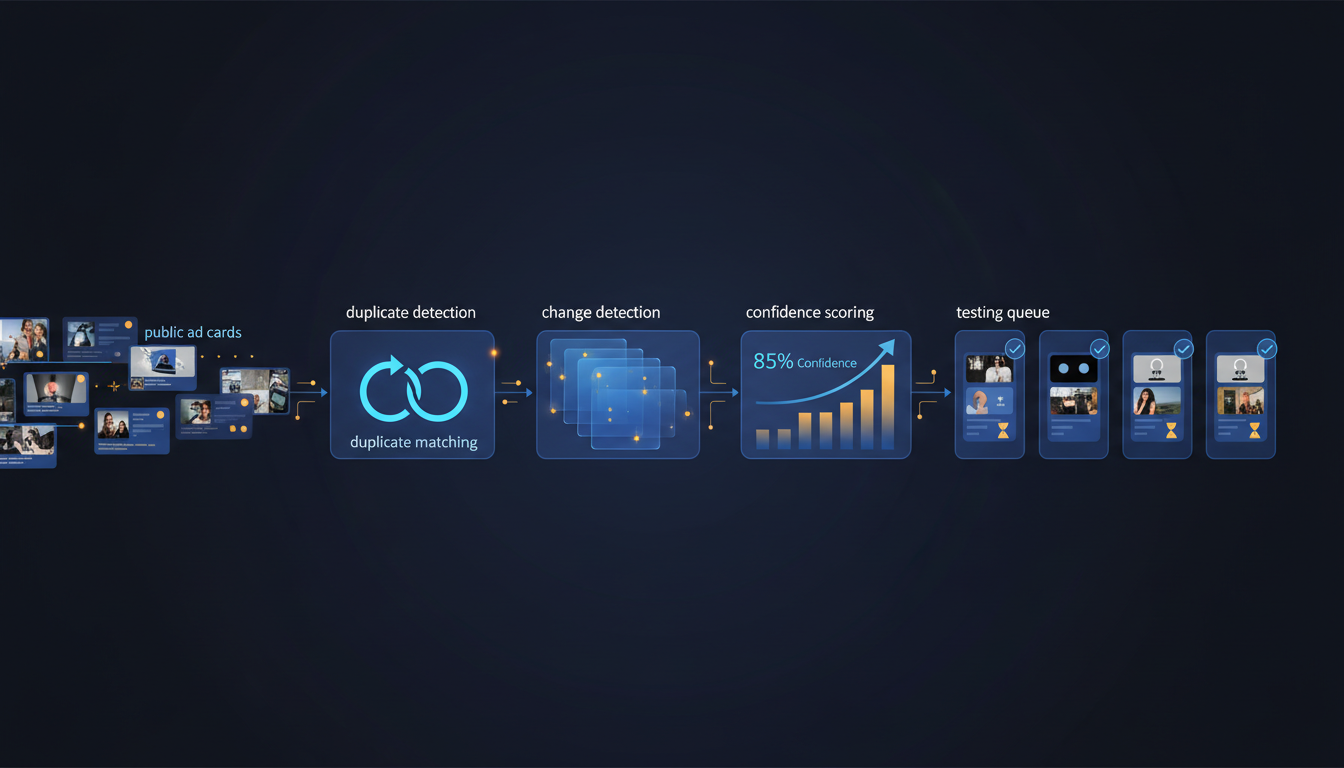
Continuous competitor ad tracking repeatedly collects permitted public ad records, reconciles duplicate creatives, records launches and removals, classifies hooks and offers, and alerts teams to meaningful changes. It does not reveal exact competitor spend or conversions. We use directional signals, customer feedback, and our own test history to rank hypotheses rather than imitate activity.
This guide explains the full pipeline, from source collection and creative matching to confidence scoring, fatigue-aware decisions, and evidence-linked test recommendations.
What Is Continuous Competitor Ad Tracking Beyond Ad-Library Scraping?
A library search answers, “What can I see right now?” Continuous monitoring answers a more useful operating question: “What changed, how certain are we, and does that change deserve a place in our next testing cycle?”
That difference matters when a team is launching many concepts. A one-off screenshot loses the launch context, the regional version, the landing page it pointed to, and the later variants that reveal whether the advertiser is exploring a message or simply refreshing a familiar asset. We treat the observation as raw evidence, then preserve the chain of reasoning that leads to a recommendation.
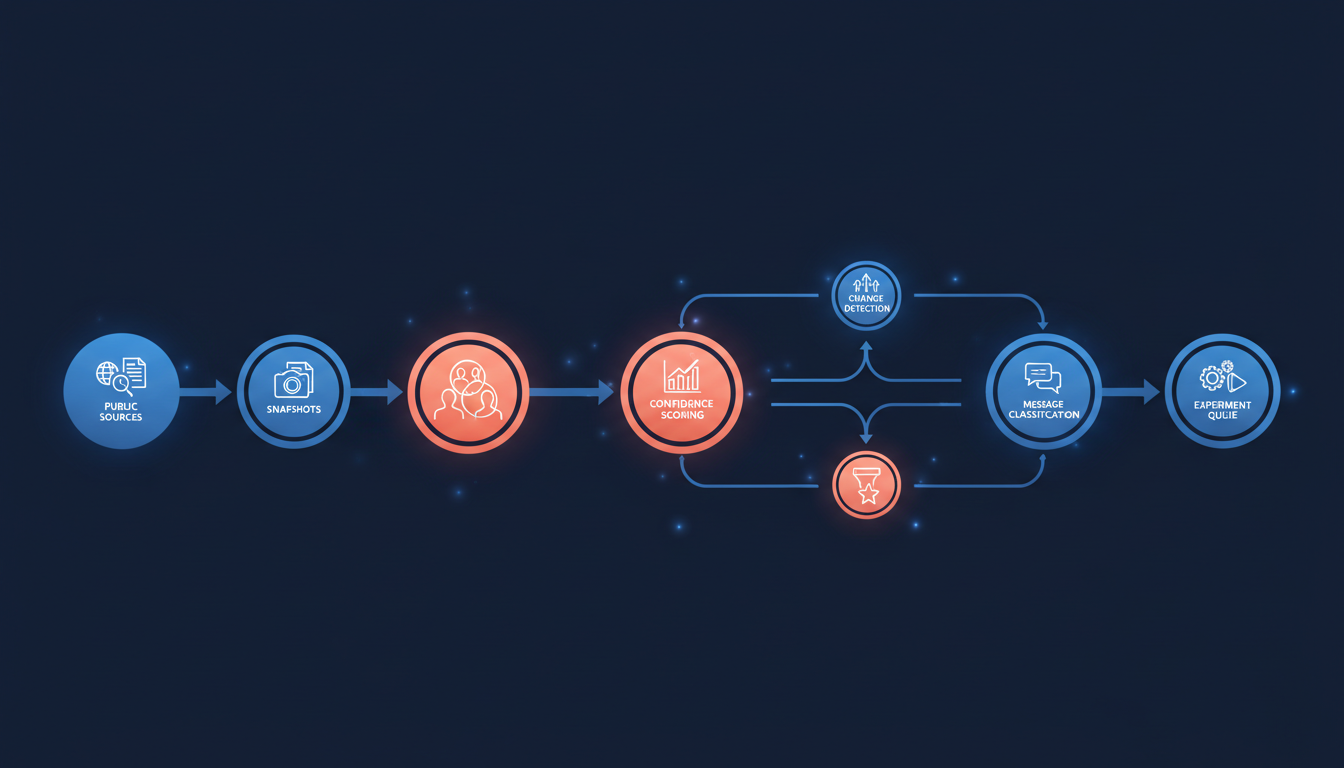
Our workflow has seven stages:
- Collect Permitted Public Records: Capture ads, destination pages, and other authorized surfaces with timestamps and source references.
- Snapshot The Evidence: Preserve what was visible at that time so later changes have a comparable baseline.
- Resolve Identities: Link advertiser pages, destination domains, reused assets, and localized variants without forcing uncertain matches.
- Detect Deltas: Identify launches, no-longer-observed ads, hook changes, offer changes, format shifts, and landing-page changes.
- Classify The Creative: Label the customer tension, proof type, product emphasis, CTA, format, and message angle.
- Score Confidence: Separate a clear, repeatable observation from an ambiguous or incomplete signal.
- Rank A Test Hypothesis: Check customer feedback and prior outcomes before moving an idea into a test queue.
This is why strategic ad intelligence should be more than an archive of ideas. The useful output is a documented decision: what we saw, what it may mean, what remains unknown, and what one variable we should test.
Which Public Sources Support Ecommerce Competitor Creative Monitoring?
Every source has a different visibility window. Meta describes its Ad Library as a searchable place for ads running across its products, while its seven-year archive applies to political, electoral, and issue ads. We should not turn that rule into a claim that ordinary commercial ads have a complete seven-year public history.
The right model is source-aware collection. We retain our own timestamped snapshots, track the country and surface where each record appeared, and label gaps instead of quietly filling them with assumptions.
| Source | Visibility | Typical Latency | History | Important Blind Spot |
|---|---|---|---|---|
| Meta Ad Library | Ads currently running across Meta products | Source-dependent | Political, electoral, and issue ads can remain available for seven years | Commercial spend, conversions, and profitability are not public |
| TikTok Commercial Content Library | Ads available to users in the EEA, Switzerland, and the UK | Up to 24 hours after first view or an update | Eligible ads remain for one year after their last view | Coverage is regional, not a universal market feed |
| TikTok Top Ads | Curated, authorized examples | Platform-controlled | Not a complete advertiser archive | Selection is not a representative competitor dataset |
| Google Ads Transparency Center | Searchable by advertiser or website, with date and region filters | No general public SLA stated | Build history through owned snapshots | It does not expose competitor business outcomes |
| Competitor Landing Pages | Public destination pages and offers | Based on the monitoring schedule | As complete as retained snapshots | Personalization, login walls, and geography can alter the page |
| First-Party Feedback | Authorized comments, messages, reviews, and test records | Based on connected systems | Based on the brand’s retention policy | It validates our audience, not a competitor’s results |
TikTok’s commercial library is especially useful because it documents its regional coverage, update window, and one-year retention period. Its Top Ads surface is valuable for inspiration, but advertisers must authorize assets to appear there, so we never treat it as a complete view of an ecommerce category.
For teams focused on Meta, our Facebook competitor analysis guidance helps turn active-ad observations into structured creative research without overstating what the public record can prove.
Why Source Latency Changes the Meaning of “Removed”
An ad that disappears may have paused, ended, changed region, been replaced, or simply not yet reflected in the public source. We mark it as “no longer observed” until repeat checks exceed the source’s known update window. That wording protects the integrity of the timeline and keeps a missing record from becoming a false conclusion.
Why Regional Coverage Must Stay Attached to Every Record
A localized offer, translated hook, or country-specific destination page is a variant, not necessarily a new strategy. Keeping geography attached lets us compare the same creative family across markets while preserving the evidence that makes each version distinct.
How Do We Detect Messaging Changes Without Creating False Duplicates?
The hard part is rarely finding another creative. It is deciding whether that creative is genuinely new, a resized asset, a translated version, a dynamic combination, or a familiar message pointed at a new product page.
We begin with advertiser identity. Page names, disclosed advertiser information, verified websites, destination domains, and manually reviewed relationships can create a strong match. When the evidence is weak, we keep the match uncertain. A clean uncertainty label is more useful than a confident but incorrect merged profile.
How We Match Creative Families
We compare visual frames, on-screen text, spoken language, caption copy, audio, format, CTA, destination URL, country, and language. That lets us connect a creator-led video with its localized versions, while still preserving the individual ad records that appeared in different places or at different times.
A reused asset might signal a new test if the hook, proof, offer, or landing page changes. It might be a routine refresh if only the dimensions change. The data model should make both possibilities visible.
How We Identify Meaningful Deltas
We treat these as review-worthy changes:
- Launches: A creative family or variant is first observed.
- Removals: A previously observed record remains absent after repeat checks.
- Hooks: The opening promise, problem, or attention device changes.
- Offers: Price framing, bundles, discounts, guarantees, or urgency changes.
- Formats: A static, video, carousel, creator-led, or product-demo shift appears.
- Landing Pages: The destination, page structure, product set, or proof modules change.
- Product Emphasis: The message shifts from one use case, audience, or product benefit to another.
A useful creative intelligence software workflow keeps the original record beside the changed one. That makes the alert auditable and gives a strategist the option to disagree with the automated classification.
Which Signals Deserve Confidence Before We Test Them?
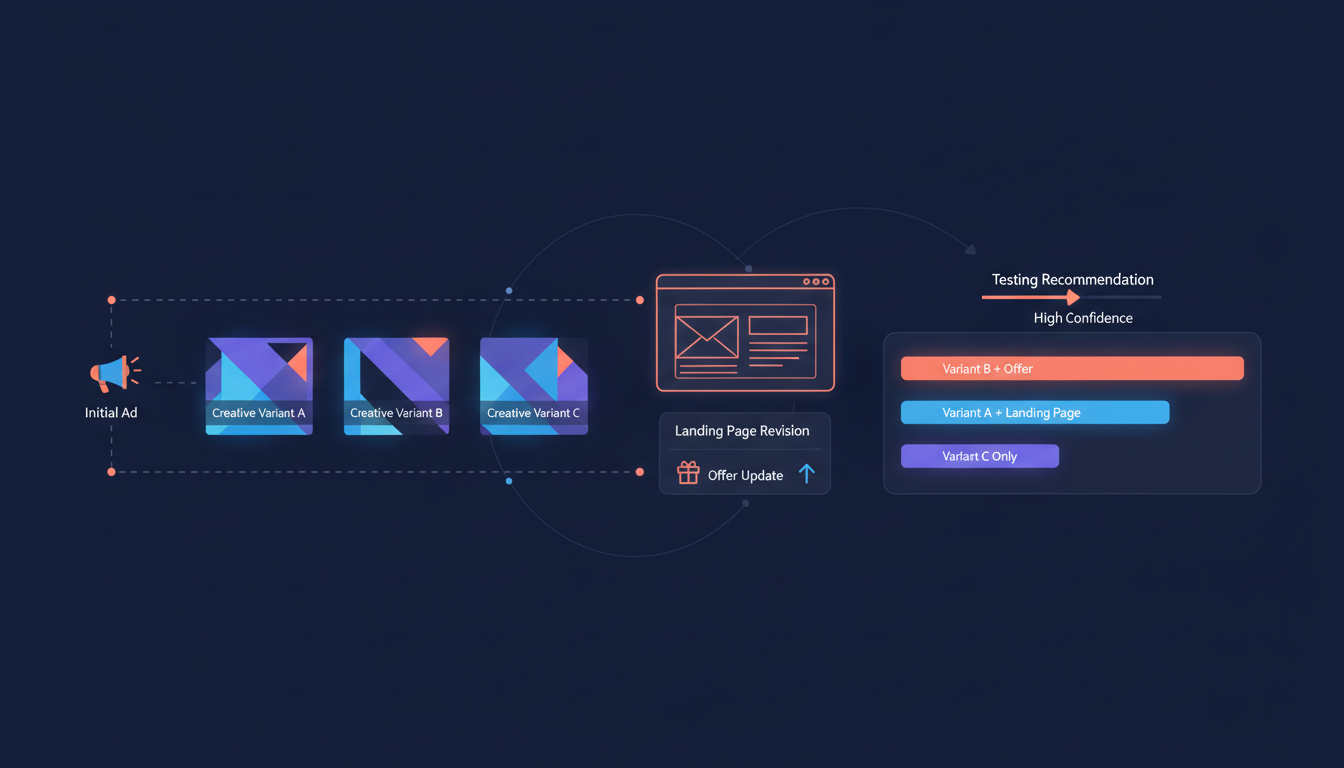
Run length and variant activity can be useful directional signals. An advertiser repeatedly using a message, creating nearby variants, or returning to a familiar product promise may be worth studying. None of those observations proves sales, conversion rate, spend level, or profitability.
We reserve causal language for our own experiments. Research on online controlled experiments explains why randomized assignment is what supports causal inference between a variant and an outcome. External monitoring helps us choose better hypotheses. It does not replace measurement in our account.
| Confidence Level | Evidence Required | Appropriate Action | Claim We Avoid |
|---|---|---|---|
| High | Clear identity match, repeated timestamped observations, first-party relevance, and supportive internal evidence | Prioritize a focused test | “The competitor’s ad is profitable” |
| Medium | Repeated public observations with a clear creative or landing-page change | Add to the research queue | “This message is winning” |
| Low | One snapshot, ambiguous advertiser match, or incomplete regional context | Keep as a reference only | “This ad is being scaled” |
How Customer Feedback Keeps the Hypothesis Grounded
We look for recurring language in authorized first-party comments, messages, reviews, and support interactions. A competitor’s hook may reveal a category tension, but customer feedback tells us whether that tension exists for our audience and whether our product has credible proof to answer it.
Our feedback-to-test workflow turns that language into a traceable input. The proposed angle should state the observed market change, the matching customer theme, and the proof our brand can honestly use.
How Test Memory Stops Exhausted Patterns from Returning
High-volume teams need more than a repository of past winners. They need a record of failed hooks, fatigued formats, weak-quality conversions, and stopped tests. Before we queue a competitor-inspired idea, we check whether we have already tested the same promise, proof type, offer, or execution.
That is the job of creative testing memory. If internal history says a pattern is exhausted, we down-rank it even when market activity looks interesting.
How We Choose What to Stop, Refresh, or Continue
A visible external pattern does not override a defined decision rule. We set the metric, guardrails, duration, and confidence threshold before treating a result as a learning. Then we distinguish an underperforming message from a message that may be suffering from format fatigue, audience saturation, or weak proof.
Our stop-testing framework gives that decision a consistent structure. The goal is not to copy what is visible. It is to preserve scarce testing capacity for the most defensible next question.
How Do Alerts Become Evidence-Linked Test Recommendations?
A good alert ends with a decision-ready brief, not an unexplained claim that a competitor “changed strategy.” We keep the observation and the proposed action together so a creative lead can review the evidence without reopening every source.
The recommendation should include:
- Verified Observations: Source URL, advertiser and region, first and last observed timestamps, exact creative or landing-page change, and identity confidence.
- Known Limitations: A direct statement that spend, conversions, profitability, and internal targeting are not observable.
- First-Party Validation: Matching feedback themes, related prior tests, and relevant fatigue or stop-testing history.
- Test Hypothesis: The customer tension, one variable to test, control, variation, primary metric, guardrails, and decision rule.
- Priority Rationale: Why this hypothesis outranks other ideas now, including confidence, novelty, strategic fit, and duplication risk.
This is where creative angle tracking becomes operational. We can see whether a message angle has already been tested across formats, whether the customer language changed, and whether a new execution is genuinely novel or simply a familiar pattern with a different visual wrapper.
A well-designed alert creates a useful fork in the road. It can move into testing, remain in research, or be rejected with a recorded reason. Rejected ideas matter because they prevent the same market signal from consuming attention again next month.
Why Use Deepsolv for Continuous Competitor Ad Tracking?
At Deepsolv, we help ecommerce teams turn market movement into a disciplined testing queue, not a louder feed of screenshots. Our approach connects permitted public observations with the feedback customers leave, the hooks your team has already tested, and the stop decisions that protect spend from tired ideas.
Each recommendation keeps its evidence trail visible, names what was observed, separates inference from fact, and gives the next owner a clear hypothesis, control, variation, and decision rule. That matters when creative volume is high, because the bottleneck is rarely finding another ad.
It is deciding what deserves a place in the next test cycle and what should remain a reference only. We built it for the point where research has to earn an operational decision, not simply fill a creative board.
Book a demo now!
FAQs on Continuous Competitor Ad Tracking
Does Continuous Competitor Ad Tracking Reveal Exact Competitor ROAS?
No public record reveals competitor ROAS, conversion rate, profit, or spend allocation. It may show creative, timing, and selected metadata, not validated commercial performance.
How Long Does It Take to Detect a Competitor Change?
Detection timing depends on the source, regional coverage, and update window. We timestamp observations, allow documented latency, and verify repeated absences before calling an ad removed.
How Do We Avoid Copying a Fatigued Competitor Pattern?
We connect each idea to customer feedback and internal test memory. Patterns that previously fatigued, underperformed, or lack credible proof are down-ranked or rejected before production.