

TL;DR
A Meta ad angle only drives conversions when the same idea holds up across five layers of evidence, from attention and qualified traffic through profit and incremental lift, not just a cheap click in the auction. We show how to tag angles cleanly, compare them fairly across normalized cohorts, read fatigue signals early, and treat competitor research as hypotheses you validate with your own first-party data.
Which Meta Ad Angles Drive Conversions?
A 2019 field study of Facebook advertising examined 15 U.S. experiments, 500 million user-experiment observations, and 1.6 billion ad impressions. Its lesson remains useful: granular reporting alone does not reliably show an ad's true causal effect.
Meta Ad Angles drive conversions when they beat alternatives on qualified visits, conversion rate, acquisition cost, margin, and, when possible, incremental outcomes under comparable conditions. We separate the angle from the hook, creator, format, offer, audience, and placement, then treat competitor activity as a hypothesis source rather than conversion proof.
This framework shows how we evaluate the evidence, compare uneven delivery fairly, and decide what creative idea deserves the next test.
What Makes Meta Ad Angles Drive Conversions?
An angle is the central reason a specific audience should care now. “Stop wasting time on complicated routines” is an angle. The opening line, creator, video style, discount, landing page, and placement are separate variables that can make the same angle look stronger or weaker than it really is.
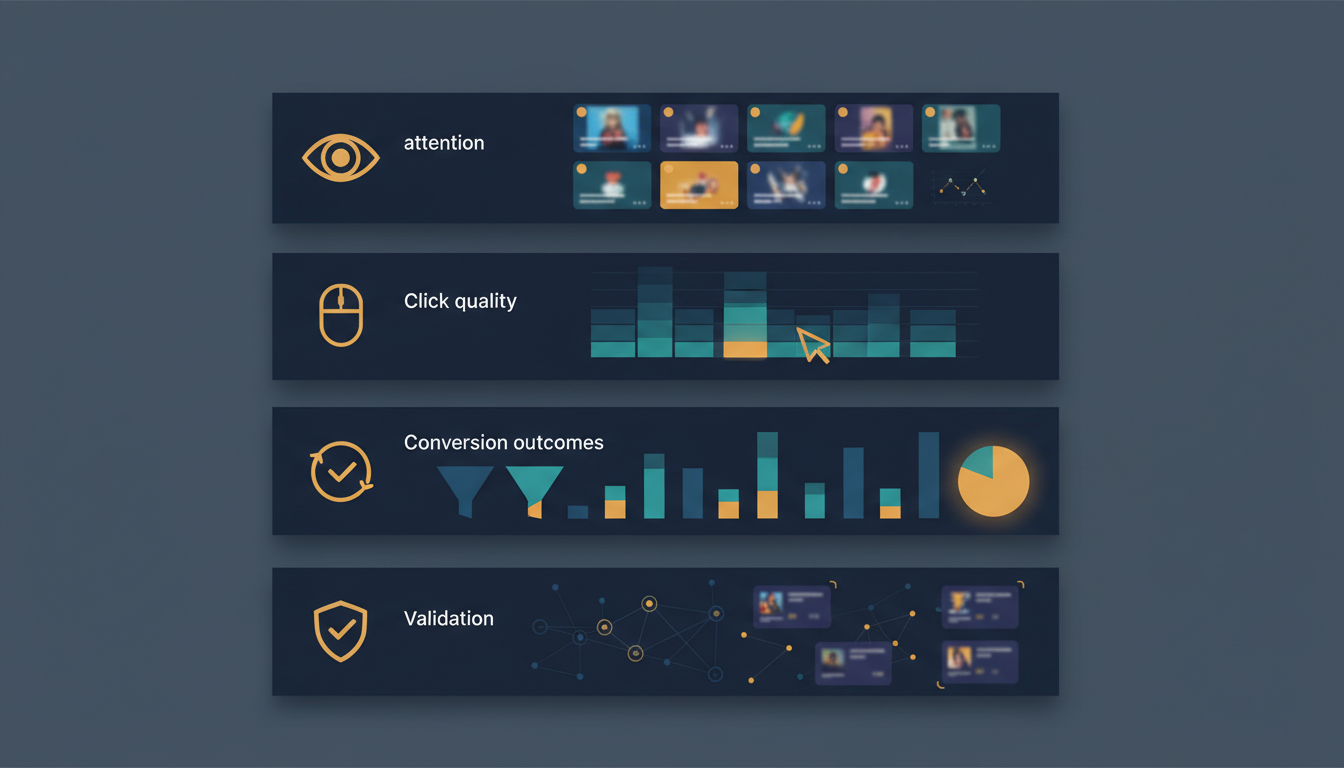
Cheap clicks become expensive when the promise earns attention but attracts the wrong visitor. A high CTR can be useful evidence, but it is only the first layer. We look for a consistent progression from attention to qualified traffic, tracked conversion, and business quality. For businesses with later-stage outcomes, more complete data can include server, CRM, offline, and messaging events alongside website events.
| Evidence Layer | What We Measure By Angle | Decision It Supports | What It Cannot Prove Alone |
|---|---|---|---|
| Attention | Impressions, video engagement, CTR, CPC | Whether the message earns efficient attention | Purchase intent or profit |
| Qualified Traffic | Landing-page views, engaged sessions, product views | Whether visitors act like potential customers | Incremental revenue |
| Conversion | Conversion rate, CPA, attributed revenue, ROAS | Whether the angle produces tracked actions | Causal impact |
| Business Quality | Margin, refunds, retention, new-customer share, LTV | Whether the acquired customer is valuable | The isolated creative cause |
| Incremental Outcome | Lift versus control, calibrated aggregate evidence | Whether advertising added business outcomes | Which untested element created the lift |
The practical standard is simple: do not call an angle a winner because it won the auction. Call it promising when it keeps moving people through the next evidence layer, then label it proven only when the comparison was fair. That distinction creates conversion-ranked evidence instead of a leaderboard of attention metrics.
How Do You Track Meta Creative Angles Beyond ROAS?
ROAS answers an important commercial question, but it cannot tell us whether the angle, the offer, the creator, or a favorable audience did the work. We preserve enough context to make the next brief smarter, even when the platform changes delivery or adapts an asset.

Name Every Variable
We use a controlled tag structure for every execution: angle, hook, format, creator, offer, audience, placement, landing page, and launch cohort.
The angle label should survive across executions. If the same audience promise appears in a customer testimonial, a founder video, and a static image, each asset keeps the same angle ID while its hook, creator, and format receive separate IDs. Our angle tracking guide helps teams keep those labels durable as volume grows.
This matters more when automated creative systems produce variations for different viewers. Meta says its creative tools are used by more than 4M advertisers, so an untagged “winning ad” can easily conceal several delivery and asset differences.
Connect Platform and Business Data
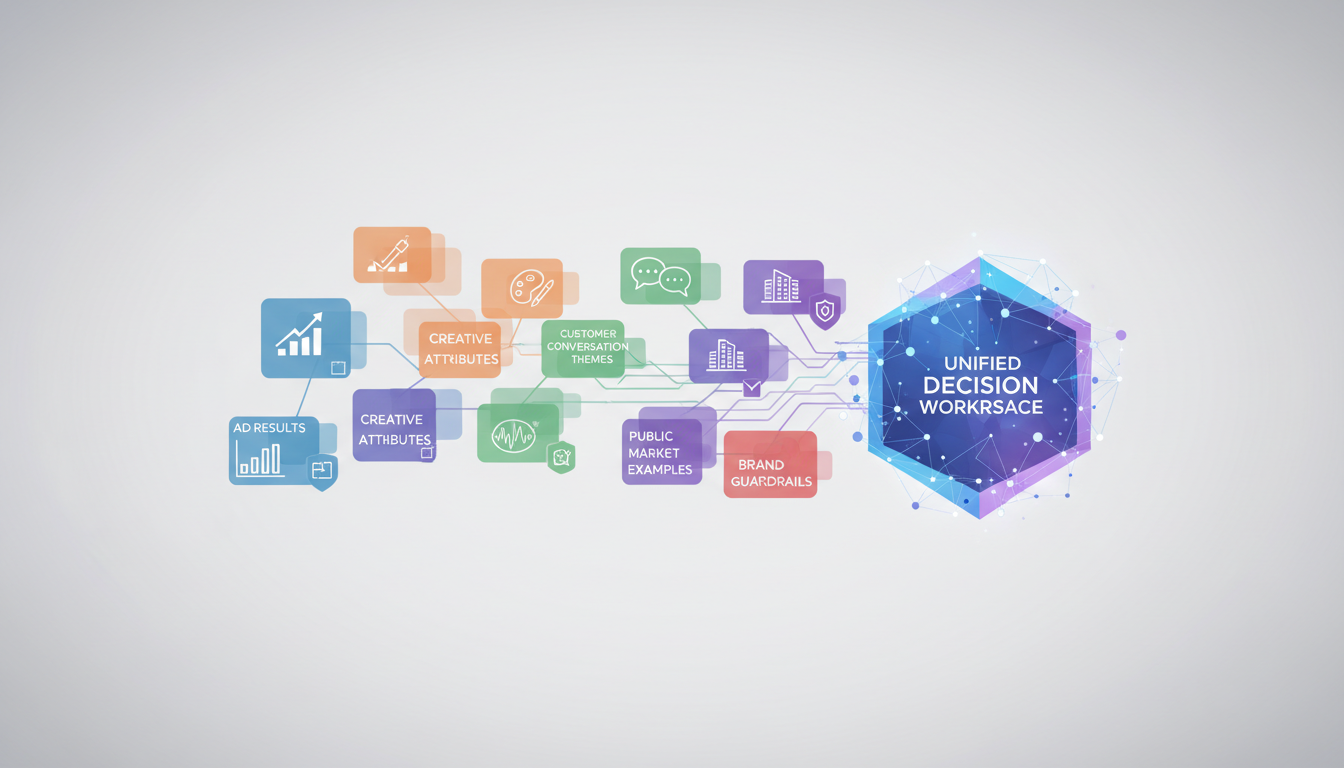
We join each angle ID to its platform performance, UTM data, landing-page behavior, purchase records, and later quality outcomes. For lead generation, that may mean qualified meetings or pipeline stage. For commerce, it may mean contribution margin, refunds, repeat purchase, or customer lifetime value.
This does not make every record perfectly attributable. It does make the decision more honest. A low-CPA angle that attracts low-quality leads should not be scaled simply because it looks efficient inside Ads Manager. We retain the evidence, including the offer and audience conditions that surrounded the result.
Run the Six-Step Workflow
- Define the audience problem and the business outcome before launch.
- Tag the angle, hook, creator, format, offer, audience, placement, and landing page.
- Compare attention and qualified-traffic signals by angle.
- Evaluate conversion, margin, and quality outcomes where available.
- Check delivery, attribution, spend, and fatigue confounders.
- Assign a confidence level and choose the next test, scale decision, or refresh.
The workflow is designed to stop one-week spikes from becoming permanent creative doctrine. It also means we can preserve a useful angle even when one execution fails because the offer, creator, or audience match was wrong.
How Do You Compare Angles Fairly When Delivery and Attribution Are Uneven?
A raw ad-level comparison is rarely fair by default. One concept may receive more spend, a warmer audience, more favorable placements, or more time after learning. Another may barely deliver, making its CPA look volatile because the denominator is too small.
We start with comparable cohorts: the same objective, optimization event, attribution setting, date range, offer, landing page, and audience definition whenever possible. Meta advises allowing at least seven days for budget learning, and daily delivery can vary within its stated weekly constraints. That is not a universal test duration, but it is a reason not to declare an immediate winner from uneven early spend.
Normalize the Comparison Cohort
Review spend, impressions, reach, frequency, placement mix, geography, and launch date before interpreting performance. If one angle served mostly in a placement that another barely reached, compare within placement or rerun the test under a cleaner setup.
Do the same with audience. An angle can be excellent for a problem-aware segment and irrelevant for a cold audience. That is an audience-angle fit finding, not proof that one message wins everywhere. Use a concept prioritization framework to record the audience job before production begins.
Use Attribution as a Layer
Platform attribution is useful for quick optimization. Site analytics adds behavior after the click. CRM and commerce data bring the result closer to the customer outcome. We use all three, while recognizing that each reports a different view of the journey.
Attribution should not be forced to answer an incrementality question it was not designed to answer. When the scaling decision is material, we seek a controlled lift test or use experiment-calibrated marketing-mix evidence. The strongest conclusion comes from a comparison that estimates what would have happened without the advertising.
Choose the Right Validation Method
| Method | Best Question | Strength | Limitation |
|---|---|---|---|
| Platform Reporting | Which execution is producing attributed results now? | Fast tactical feedback | Delivery and attribution can bias the comparison |
| Site And CRM Data | Do clicks become qualified customers? | Captures downstream quality | Still needs careful identity and source handling |
| Controlled Lift Test | Did advertising create additional outcomes? | Strong causal evidence | Requires sufficient scale and disciplined setup |
| Marketing-Mix Evidence | How does media contribute at an aggregate level? | Supports broader allocation choices | Usually cannot isolate a single angle |
A controlled test should change as little as possible. If the hook, creator, offer, and format all change with the angle, we learn only that one bundled ad beat another bundle. That can guide a rollout, but it cannot reliably tell our creative team what to repeat. We preserve these decisions in testing memory so future tests begin with context, not guesswork.
What Can Competitor Patterns Tell You About Account Performance?
Public competitor research is valuable when we use it to expand the hypothesis backlog. It can reveal recurring audience problems, offer patterns, creative formats, and language categories that deserve a closer look. It cannot show another account’s conversion rate, CAC, profit, targeting, attribution model, or incremental sales.

Meta’s Ad Library rules make the limit clear: ordinary commercial research shows currently active ads. The extended archive, spend ranges, and demographic reach details apply to issue, electoral, and political advertising. An active commercial ad may signal that an advertiser is still running it, but it does not establish why.
We use a four-part discipline:
- Observe The Pattern: Classify the visible audience problem, angle, hook, offer, and format.
- State The Hypothesis: Write the proposed reason that pattern may matter for our audience.
- Build A Distinct Test: Preserve the audience problem while creating an original execution and controlled comparison.
- Validate In Our Account: Promote the pattern only after first-party evidence supports it.
This protects teams from copying surface features and calling it insight. A long-running ad may be tied to a broad audience, a bundled offer, a retargeting pool, or a decision we cannot observe. Our competitor research workflow keeps public evidence in its proper role: prioritization, not proof.
How Do Fatigue and Confidence Determine the Next Test?
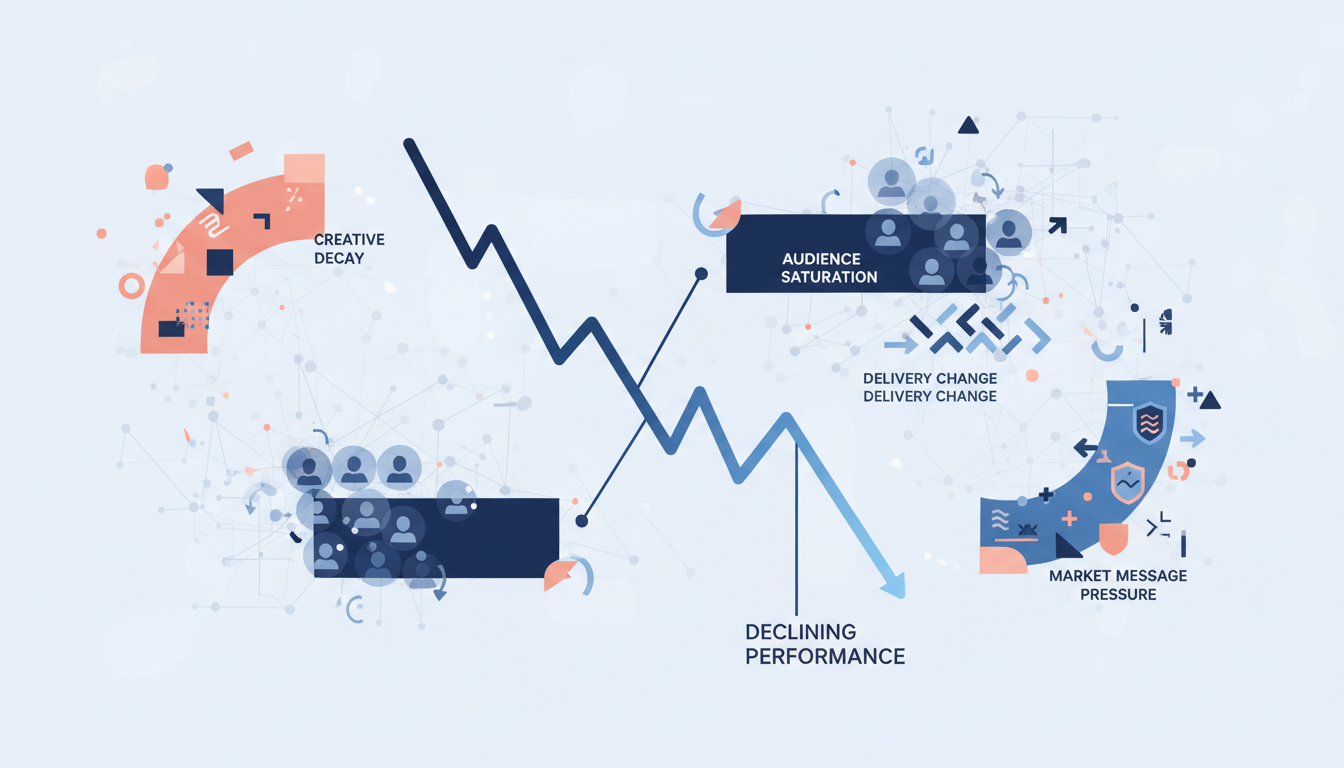
An angle can work while a particular execution becomes tired. Frequency rising alongside weaker qualified-traffic or conversion performance may indicate fatigue, but it can also reflect audience saturation, seasonal demand, changed placement mix, or a revised offer. We diagnose the pattern before replacing the message itself.
Meta reports that advertisers keeping under 20% of their spend in learning can reduce cost per purchase by as much as 68%. That platform-reported figure is not an angle threshold. It does underline why learning status and delivery conditions belong in the evidence record before we conclude an idea stopped working.

| Confidence Level | Required Evidence | Appropriate Decision |
|---|---|---|
| Exploratory | Attention signal only | Create a cleaner follow-up test |
| Directional | Qualified traffic plus attributed conversion signal | Test with matched audience and offer |
| Verified Results | Repeated fair comparisons plus quality outcome | Scale carefully and create variants |
| Incrementally Validated | Controlled lift or calibrated causal evidence | Treat as durable business evidence |
| Pattern | Likely Interpretation | Next Test |
|---|---|---|
| Low CPC, weak qualified visits | Attention without meaningful intent | Improve the promise-to-page match |
| Strong visits, weak conversion rate | Offer, page, or audience mismatch | Hold the angle and test the friction point |
| Strong result in one audience | Audience-angle fit | Expand to adjacent audiences carefully |
| Good ROAS, weak margin or retention | Low-quality acquisition | Optimize toward a later value event |
| Early win, then decline | Fatigue or changing delivery | Refresh execution and rerun a clean cohort |
| Repeated first-party win | Strong angle hypothesis | Build angle variants and validate incrementality |
We treat lifespan as evidence, not a verdict. Our fatigue diagnostic helps distinguish a declining asset from a declining audience opportunity, so a strong message is not discarded because one version wore out.
How Deepsolv Helps Teams Build an Angle Evidence System
At Deepsolv, we help growth teams turn a scattered ad archive into a decision system. Our workflow connects the language people use in ads, comments, and research with the audience problem each execution addresses, then preserves the evidence that tells a team what to test next. That means a creative review can start with a real question, not an endless spreadsheet of assets and vanity metrics.
We built our approach for teams that need to distinguish an interesting market pattern from a proven account result. You can organize angles, compare evidence by audience, retain test context, and brief the next concept without pretending that any public ad or platform metric is causal proof. If your team wants a clearer creative learning loop, explore Deepsolv and make each budget decision easier to explain across marketing, finance, and creative teams every week.
FAQs on Meta Ad Angles
Which Meta Ad Angles Drive Conversions Rather Than Cheap Clicks?
We treat a low-cost click as attention evidence only. An angle wins only when qualified traffic and downstream outcomes hold in a fair comparison consistently.
How Do We Track Meta Creative Angles Separately?
We tag angle, hook, creator, format, offer, audience, placement, and landing page separately, then connect each record to site, CRM, and quality outcomes over time.
Can Competitor Ad Angles Predict Our Account Performance?
Public competitor activity reveals recurring messages and executions, but it cannot reliably reveal targeting, spend, conversion quality, profitability, attribution, or incremental outcomes for another account.
Is ROAS Enough to Evaluate Facebook Ad Creative Performance?
We use platform reporting for rapid optimization, then validate promising angles with first-party quality data and controlled tests when the decision justifies that level rigor.