Strategic Ad Intelligence Alternatives to Swipe Files
Compare strategic ad intelligence alternatives by competitor history, audience signals, test memory, writing support, and ranked next-test plans.

Creative consistency is not just a brand preference. An IPA creative study analyzed more than 4,000 ads and found that the most consistent brands generated stronger brand and business effects.
Strategic ad intelligence alternatives are best for teams that need more than saved ads: they combine competitor message history, audience objections, first-party creative results, and remembered experiments to rank the next test. Choose a simple organizer for retrieval, analytics for reporting, or an intelligence platform when your real bottleneck is deciding what to make.
This comparison explains the jobs different tools perform, what evidence they retain, and how to evaluate whether a platform can turn research into better creative decisions.
How Do Strategic Ad Intelligence Alternatives Compare?
An alternative only makes sense when it removes the bottleneck that starts after discovery. Teams that cannot find references need fast capture and retrieval. Teams that keep repeating weak angles need a system that connects market signals with their own creative history.

| Platform Type | Best Strategic Job | Competitor History | Audience Signals | Own-Account Data | Test Memory | Writing Support | Ranked Next-Test Plan |
|---|---|---|---|---|---|---|---|
| Swipe-File Organizer | Save and retrieve references | Saved examples only | No | No | No | Sometimes | No |
| Competitor Tracker | Detect launches and messaging changes | Yes, from tracking start | No | No | No | Limited | Usually no |
| Creative Analytics Platform | Explain performance patterns | Limited or separate | Limited | Yes | Reporting, not necessarily memory | Varies | Sometimes |
| Creative Intelligence Platform | Prioritize what to test next | Yes | Yes | Yes | Yes | Yes | Yes |
| Official Ad Library | Baseline market research | Current commercial ads | No | No | No | No | No |
The useful dividing line is not how many ads a product can display. It is whether the platform can explain the relationship between an observed ad, a customer objection, a prior test, and the next decision. Our guide to ad strategy platforms covers the broader category in more detail.
A saved-ad workflow can still be valuable. It becomes limiting when a team needs to know whether an offer is expanding, a hook is fading, or an angle already failed for its own audience. Meta’s library documentation also makes an important distinction: ordinary commercial ads are searchable while active, so outside observation should be treated as evidence, not proof of spend or profitability.
Which Bottleneck Should Guide Your Choice?
The fastest way to choose is to name the decision your team cannot currently make. “We need more inspiration” is a retrieval problem. “We do not know what to test on Monday” is a prioritization problem, and buying another collection tool will not solve it.
Inspiration Is a Retrieval Problem
Choose a simple organizer when references live in browser tabs, chats, and personal folders. Its job is to save, tag, search, and share examples quickly. That is useful operationally, but it does not tell a strategist whether a reference addresses a relevant objection or fits the brand’s past learnings.
Monitoring Is a Change-Detection Problem
Choose a tracker when the important question is what competitors launched, paused, repeated, or changed. Strong monitoring records hook, offer, positioning, format, status, and dates. Use it alongside a deliberate competitor research guide, rather than treating an ad’s presence as a performance verdict.
Recommendations Are a Decision Problem
Choose creative intelligence when the team needs evidence-backed direction. The platform should connect audience language with the results of previous tests, then explain why one concept deserves priority over another. That is the difference between collecting inspiration and making a defensible creative decision.

What Evidence Should a Platform Retain?
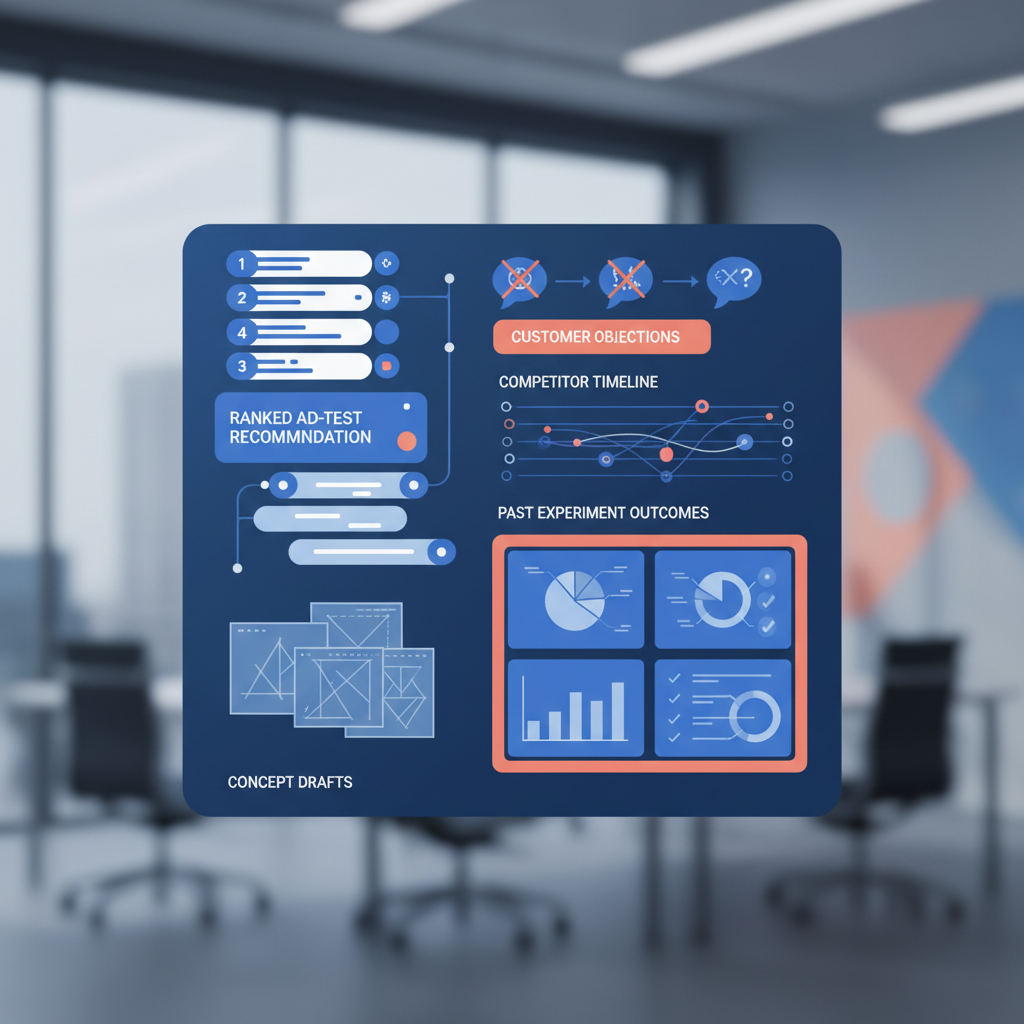
A good creative system does not merely collect inputs. It preserves the context around an outcome, including what was tested, for whom, why it was tested, and what happened next. That is what turns a stream of ideas into a compounding strategy.
| Decision Stage | Saved-Ad Workflow | Deepsolv Workflow | Strategic Effect |
|---|---|---|---|
| Observe | Save a reference | Track ads, audience signals, and account results | More complete evidence |
| Interpret | Manually infer the angle | Connect hooks to objections and prior learnings | Clearer hypothesis |
| Create | Draft from inspiration | Generate concepts from documented signals | More relevant briefs |
| Learn | Add informal notes | Retain winners, failures, and reasons | Fewer repeated tests |
| Prioritize | Choose by judgment alone | Rank next tests by supporting evidence | Faster decisions |
Competitor Messaging History
History should show more than a gallery. It should make changes visible: a new offer, a revised promise, a different proof device, or a format that persists. That helps a team form a hypothesis about a market shift without copying the execution.
Audience Evidence
Reviews, comments, direct messages, and relevant discussions can reveal objections, desires, trust gaps, and buying triggers. These signals need context and human judgment, but they are often the missing bridge between a competitor’s message and the language a brand should test itself.
A repeatable method for customer comments makes those inputs more useful. Rather than treating a loud comment as a universal truth, group patterns, preserve their source, and compare them with account results before elevating them into a new message or offer.
Brand Memory
Creative work becomes expensive when teams repeatedly rediscover the same lesson. A durable record should retain both winning and failed angles, then surface those precedents when a similar concept is proposed.

The practical record also needs enough detail to be useful: the audience, format, hook, offer, metric, date range, result, and reason for the decision. That is how a system distinguishes a genuinely new hypothesis from a familiar idea with slightly different wording.
Actionable Output
The final output should name the audience, evidence, hypothesis, concept, success metric, and reason for priority. It should also specify what would disprove the idea, because the goal of testing is learning rather than defending the first concept.
Our testing memory is designed to retain that context, including the approaches a team should stop repeating. When the evidence supports a fresh direction, we can turn it into usable hooks, scripts, and static concepts without losing the strategic reasoning behind the brief.
How Should a Seven-Day Evaluation Work?
A short evaluation should test the actual decision workflow, not just whether the interface feels familiar. Bring a representative sample of competitor ads, customer language, and recent creative results, then require every recommendation to point back to evidence.

- Day One: Save relevant ads and assess capture speed, metadata quality, search, and duplicate handling.
- Day Two: Ask a teammate to retrieve specific hooks, proof types, and offer patterns without prior setup.
- Day Three: Compare competitor messaging over time and check whether dates, status, offers, and creative changes are visible.
- Day Four: Load customer language and assess whether the platform distinguishes objections, desires, and trust gaps.
- Day Five: Connect account data and test whether it separates strong click-through from weak downstream conversion.
- Day Six: Request concepts, hooks, and scripts, then inspect whether each recommendation cites a real signal.
- Day Seven: Search prior winners and failures to confirm the system can prevent repeated weak hypotheses.
Official sources are useful controls during this process. TikTok’s Top Ads guide supports filtering by region, industry, objective, and timeframe, which makes it a practical free benchmark for research quality. Use that baseline to judge whether a paid workflow adds interpretation and memory, not just a prettier search experience.
Do not score systems merely by the number of features available. Score whether a strategist can move from evidence to an approved test with fewer manual handoffs, a clearer rationale, and a usable learning record when the result arrives. Our creative intelligence software connects those steps in a single decision workflow.
The final choice should reflect the team’s actual constraint. A lean team may need research discipline before it needs another platform. A team with plentiful creative volume but weak learning loops needs better prioritization. Before committing, assign an owner for each evaluation task, document where evidence came from, and agree on which outcome would count as a successful trial. This avoids choosing a platform because it produces attractive summaries while leaving the actual decision process unchanged.
Use our concept prioritization framework to compare ideas by evidence, confidence, expected learning value, and the cost of being wrong. The resulting score is not a substitute for judgment, but it makes disagreements visible and gives teams a practical reason to test one concept before another.

Why Choose Deepsolv for Strategic Ad Intelligence?
At Deepsolv, we work with teams whose creative problem is prioritization, not a shortage of references. We bring competitor activity, customer language, account performance, and prior experiments into one working view so the next brief begins with evidence. Our Brand Brain records the angles, formats, offers, and messages that produced a result, including the approaches that did not. That context helps us prevent recycled tests and show the reason behind each recommendation. We also turn the underlying signal into usable hooks, scripts, and static concepts so strategists, media buyers, and creators can move from a decision to production without a loose handoff. If your team needs weekly direction on what to test, what to improve, and what to stop, we can help build the operating rhythm around it. During onboarding, we align evidence categories with naming conventions and review cadence, then surface the priority for everyone involved. Book a demo
FAQs on Strategic Ad Intelligence Alternatives
These answers address the decisions that matter after ad discovery. They focus on evidence quality, retained learning, and the practical limits of external ad research.
Can a Swipe File Recommend the Next Test?
A swipe file organizes examples and speeds retrieval, but it cannot rank your next test unless it connects audience evidence, account results, and prior outcomes.
Does Competitor History Prove Performance?
History reveals repeated hooks, offers, and timing, but it does not show profitability or causality. Treat it as a hypothesis source, then validate it yourself.
Why Should Customer Language Inform Creative Strategy?
Customer language identifies the objection, desire, or trust gap an ad should address. Review it with context, then pair it with first-party performance results before deciding.
What Should a Ranked Next-Test Plan Include?
A useful plan names the hypothesis, audience, evidence, concept, success metric, and reason for priority. It also flags similar tests that already underperformed for your brand.
Can Official Ad Libraries Replace a Platform?
Official libraries are a valuable free research baseline, but they do not retain your test history, connect customer evidence, or prioritize production decisions for teams.