How AI Plans Facebook Ad Tests: Evidence-Ranked Weekly Test Plans


TL;DR
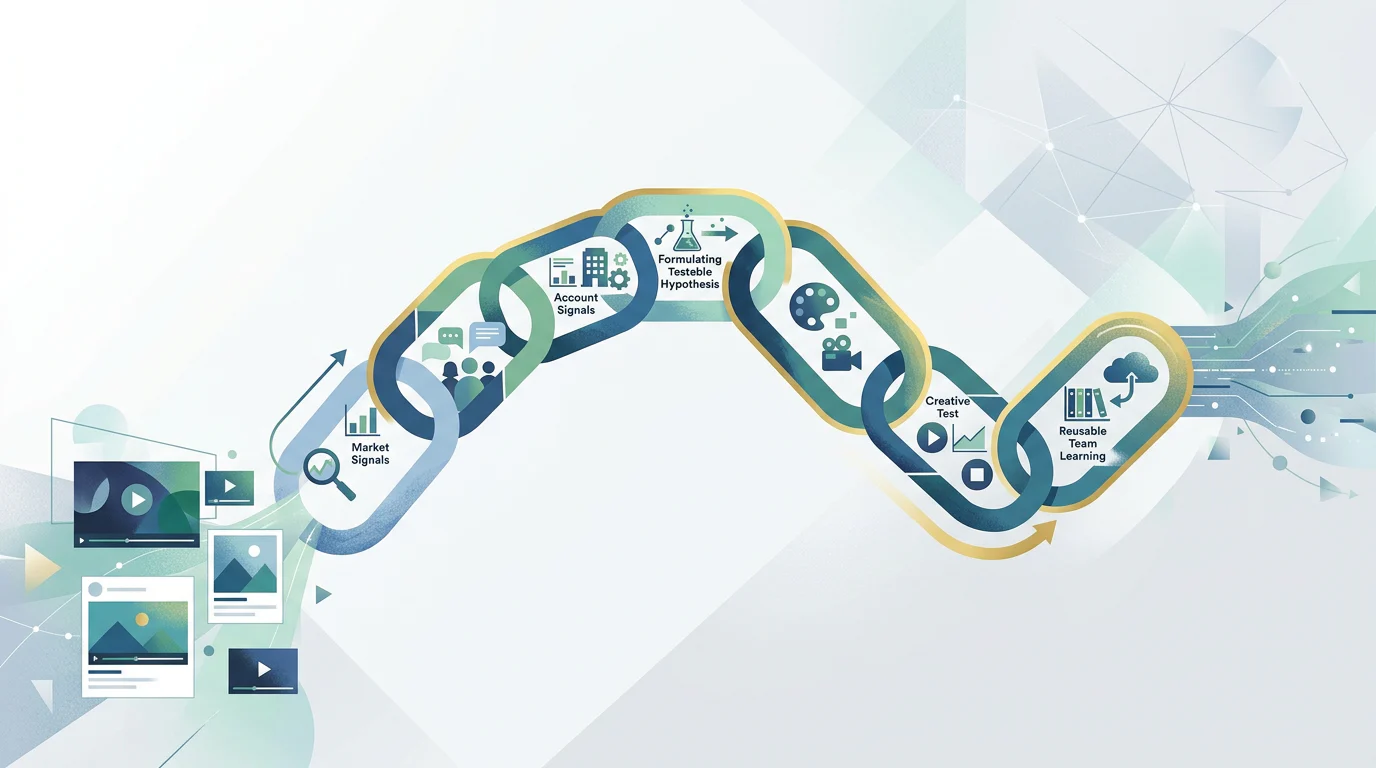
At Deepsolv, we use AI-powered Facebook ad test planning to rank evidence-backed creative hypotheses, not to promise winners before launch. We show which inputs matter, how to score and review a weekly plan, how performance can inform testable copy, and how results, including failed tests, improve the next decision.
Meta recommends giving campaigns budget for at least 7 days so its delivery system can learn, which is one reason early results need more context than a dashboard snapshot provides.
At Deepsolv, we treat AI-powered Facebook ad test planning as a way to rank hypotheses, not know which creative will win before launch. We combine account history, creative attributes, customer language, market patterns, fatigue, and constraints into an evidence-backed brief, copy options, disqualifiers, and a measurement plan, never an unsupported performance promise.
Here, we explain the inputs behind a useful plan, the ranking logic that makes it defensible, and the feedback loop that helps each week’s testing become smarter.
How Does AI-Powered Facebook Ad Test Planning Work?
The useful middle ground sits between two bad extremes: treating AI as a crystal ball, or using it only to put tests on a calendar. We use it to find patterns, assemble hypotheses, expose uncertainty, and help our team choose the next test that is both worth running and possible to measure fairly.
Historical ad data is observational. It can show that certain combinations appeared alongside stronger outcomes, but it cannot independently prove that a new creative will cause the same result. That distinction matters because causal research warns that observational data generally cannot validate causal-effect estimates by itself.
| What We Use AI To Do | What We Do Not Claim |
|---|---|
| Generate distinct hook, proof, and format hypotheses | Know which ad will win before launch |
| Schedule valid tests around team capacity | Turn a calendar into causal evidence |
| Rank concepts using visible evidence and constraints | Prove incremental lift from correlations alone |
| Draft copy tied to observed signals | Promise a ROAS, conversion rate, or revenue result |
| Flag low confidence, fatigue, or missing data | Infer another advertiser’s conversions or profitability |
In practice, generation creates options. Scheduling assigns an owner and a launch slot. Ranking orders hypotheses by evidence and value. Forecasting may estimate a plausible range, but it remains uncertain. Causal learning happens only when we launch a controlled test with a clear comparison.
We also use research beyond swipe files to keep market observation useful without confusing visible creative patterns with private commercial results.
Which Inputs Make a Recommendation Worth Testing?
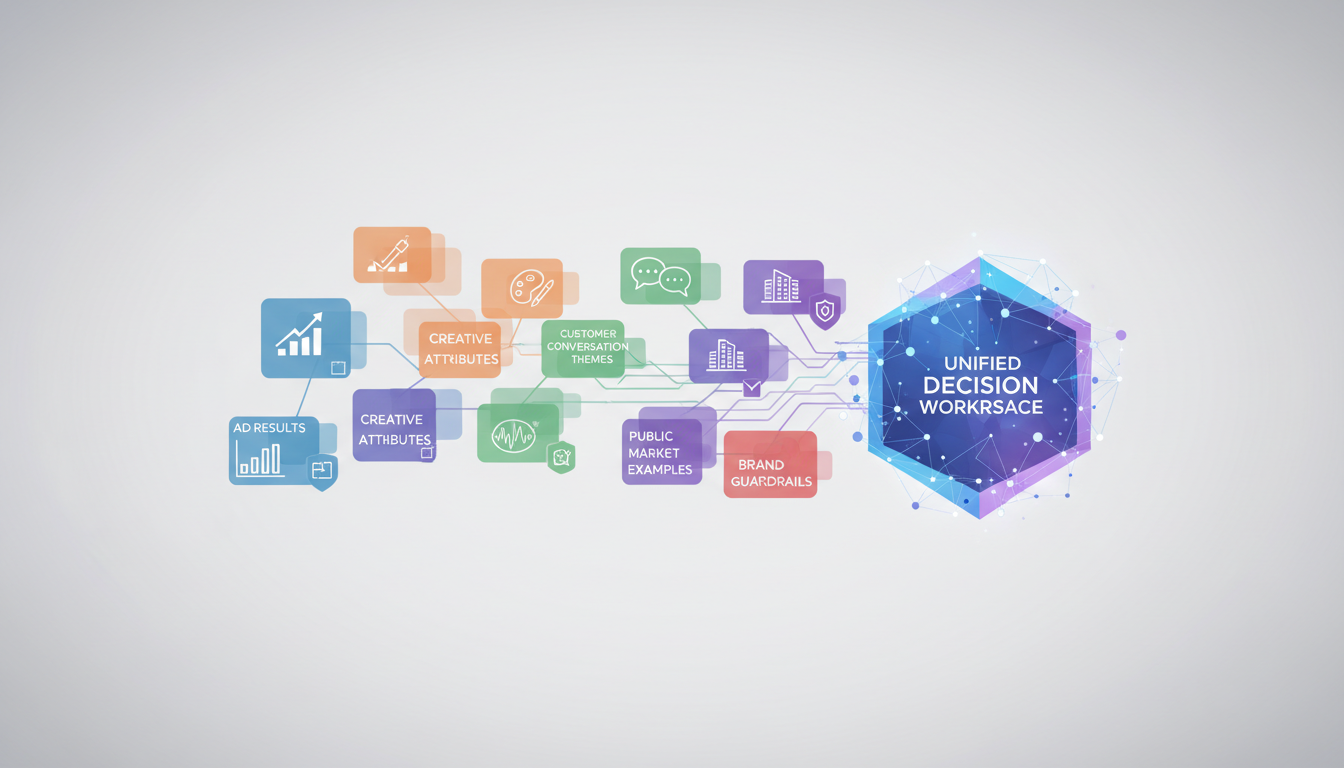
A recommendation becomes useful when its evidence can be inspected. We start with the account, then add creative structure, customer language, public market observation, and the practical constraints that determine whether a team can act this week.
Collect and Normalize Account Evidence
We collect spend, impressions, CPM, CTR, CPC, purchases or qualified outcomes, attribution settings, placement, audience, objective, budget, delivery status, and the creative itself. We also preserve the original hypothesis and the exact variable a prior test intended to change.
Before we compare anything, we normalize it. Different attribution windows, currencies, date ranges, objectives, naming conventions, and conversion definitions can make two apparently similar rows incomparable. We treat missing creative tags, unclear test names, uneven delivery, and incomplete event data as confidence problems, not inconvenient details to ignore.
Meta’s Conversions API can send website, app, CRM, offline, and messaging events, which can improve measurement completeness. It does not convert a weak comparison into proof that copy or creative caused an outcome.
Tag Creative and Add Customer Language
We tag the parts of an ad that a team might test: hook, angle, format, proof type, offer, CTA, placement, audience context, production style, and launch date. This lets us compare patterns such as objection-led hooks against product demonstrations without pretending that every visual difference is the same variable.
Customer comments, reviews, support themes, and messages can sharpen a hypothesis. If people repeatedly ask the same question, we may test an opening that answers it. Our competitor research guide uses public signals for the same reason: visible patterns can inspire a direction, but they should never be presented as someone else’s private performance data.
For ordinary commercial advertising, the Ad Library rules let us inspect currently active ads, while spend and reach disclosures apply to issue, election, and political ads. We therefore use market research to identify formats, claims, offers, and recurring messages, not ROAS or conversion totals.
Form Hypotheses and Preserve Constraints
Every proposed test needs a single clear learning goal. Rather than asking whether an entire ad “works,” we define a comparison such as whether an objection-led opening earns more qualified clicks than the current product-first control.
We map each idea, then add production capacity, brand restrictions, policy risk, remaining budget, and strategic priority. A strong concept that cannot be made this week, cannot be substantiated, or cannot be measured cleanly should not sit at the top of the queue.
How Should We Rank the Next Week’s Ad Tests?
A ranked weekly plan should make its logic visible. We do not hide a subjective decision behind a single score, and we do not let a recent winner monopolize the queue simply because it is recent.
The best plan balances likely business value with learning value. A concept can rank highly because it may address a meaningful weakness, because its evidence is strong, or because the result would clarify several future choices. It can rank lower because production effort is high, fatigue risk is unclear, or the data cannot support a fair comparison.
Score Impact, Confidence, and Learning Value
We use team-defined weights for expected impact, evidence confidence, novelty, effort, fatigue risk, and learning value. The weights are strategic choices, not verified facts. The evidence column remains separate so our team can see what actually supports the recommendation.
| Rank | Hypothesis | Verified Evidence | Expected Impact | Evidence Confidence | Effort | Fatigue Risk | Learning Value |
|---|---|---|---|---|---|---|---|
| 1 | Test an objection-led hook against the current control | Repeated customer objection and comparable angle history | Team-defined score | Team-defined score | Team-defined score | Team-defined score | Team-defined score |
| 2 | Test a product demonstration opening in a short video | Stronger early engagement in a related format | Team-defined score | Team-defined score | Team-defined score | Team-defined score | Team-defined score |
| 3 | Refresh a fatigued concept with new proof | Frequency and declining response under comparable conditions | Team-defined score | Team-defined score | Team-defined score | Team-defined score | Team-defined score |
Discount Weak or Incomparable Evidence
Confidence drops when a test is still learning, a naming convention does not identify the changed variable, an attribution setting changed, or one variant received meaningfully different delivery. We would rather rank a less exciting hypothesis with strong evidence than amplify an attractive story built on a broken comparison.
Meta notes that performance is less stable during the learning phase. That is why we mark immature outcomes as provisional instead of calling a winner too early.
Separate Fatigue from Saturation
A decline can reflect creative fatigue, audience saturation, seasonality, price changes, landing-page friction, or a mix of factors. We inspect creative angle performance, then apply our fatigue diagnosis before deciding whether a fresh execution or a different audience question belongs next.
This protects the plan from overfitting. A recent winner may reveal an angle worth exploring, but it does not justify endlessly cloning its exact hook, structure, or claim.
How Can Current Performance Shape Testable Ad Copy?
Performance-linked copy should begin with evidence, not an empty prompt asking for “high-converting” language. We use current signals to decide what question the next draft should answer, then make the draft a controlled hypothesis rather than a forecast disguised as confidence.
For example, if a product demonstration has drawn qualified engagement but comments show a recurring objection, we may test a version that addresses that objection in the opening. If a benefit-led angle converted under a particular placement, we may test a new proof form while keeping the offer and CTA stable.
Build a Copy Brief Before Writing Variants
A useful brief records the audience and placement, the control, the one planned variable, the verified evidence, the proposed hook direction, required proof, prohibited claims, and the measurement plan. It should also name disqualifiers, such as insufficient delivery or an incompatible attribution setting.
Our performance-linked copy tools help connect drafts to those inputs, so a team can see why a line was proposed and what it is meant to learn.
Keep the Draft a Hypothesis
We write two or three purposeful variants, not a pile of cosmetic rewrites. One may test a direct objection response, another a product demonstration lead, and another a customer-outcome framing. We keep the control conditions clear enough that the result can inform the next decision.
We also review customer language before turning it into copy. That preserves the difference between a genuine audience insight and a claim we cannot responsibly make.
Review Brand, Claims, Policy, and Strategy
Before launch, we review brand accuracy, claim substantiation, destination-page alignment, policy compliance, and strategic fit. Meta’s ad review process considers images, video, text, targeting, and the destination, so a compelling draft still needs operational scrutiny.
Human review is not an optional final polish. It is how we reject unsupported promises, prevent policy problems, and make sure the work answers the business question rather than merely producing more copy.
How Do Results Improve the Following Plan?
The plan gets better only if we keep the memory. A winner without its context is not a reusable insight, and a failed test that disappears is an invitation to spend again on the same unproductive idea.
For every completed test, we retain the original hypothesis, creative tags, control and variable, audience, placements, budget conditions, attribution context, outcome, confidence level, and disqualifiers. We record customer response in our feedback-to-test workflow, then label results as positive, negative, inconclusive, or invalid rather than forcing every test into a simple winner-loser story.

Meta advises minimizing changes during learning and reports that advertisers keeping under 20% of spend in that phase can lower cost per purchase by as much as 68%. We use that guidance to plan test capacity carefully, not as a promise that any individual ad will improve.
Our creative testing memory gives negative and inconclusive outcomes a permanent place in the decision record. That means next week’s ranking can avoid repeated dead ends, revisit a good idea under a different condition, and distinguish weak evidence from a genuinely disproven hypothesis.
How Does Deepsolv Turn Research into a Weekly Test Plan?
Deepsolv helps performance teams turn scattered account results, customer feedback, and public market signals into a weekly plan their creative and media teams can actually run. We connect each proposed concept to the evidence that prompted it, the variable it changes, the reason it earned its rank, and the result that would change our next recommendation. That gives our teams a durable testing memory instead of a collection of screenshots and half-remembered winners. We also keep the human decision where it belongs: our users review claims, brand fit, policy risk, strategic priority, and the cost of making each asset before launch. If a signal is incomplete or a comparison is unfair, we surface the uncertainty rather than decorate it with false precision. The result is a practical, evidence-led workflow for deciding what to test next. It is built for teams that learn week after week. Explore Deepsolv.
FAQs on AI-Powered Facebook Ad Test Planning
Can AI Predict Winning Facebook Ads?
AI can prioritize testable hypotheses using tagged history and current signals, but only a controlled launch can establish whether a creative caused a better outcome.
What Data Should AI Use to Rank Ad Tests?
Use comparable account results, creative metadata, prior test outcomes, customer language, public market patterns, delivery status, fatigue indicators, attribution settings, and brand or production constraints.
Can AI Write Ad Copy from Current Performance Data?
Use performance signals to form angle and hook hypotheses, then hold the intended variable constant. A draft remains a candidate until measured against a control.
Does Market Research Reveal ROAS or Conversions?
Public advertising research can reveal observable patterns, such as active formats, offers, and recurring messages. It cannot reveal ordinary advertisers’ ROAS, revenue, or conversion totals.
How Should Failed Tests Affect Next Week’s Plan?
Store the hypothesis, evidence, setup, attribution context, result, confidence, and disqualifiers. Negative and inconclusive outcomes should lower or redirect future hypotheses, not disappear from the weekly queue.