
Can You Predict Which Meta Ads Will Last? Meta Ad Creative Lifespan Forecasting


TL;DR
You cannot reliably tell a durable Meta ad from its first few days of ROAS. Our creative lifespan forecasting separates survival likelihood from profitability by weighing eligible conversion evidence, CPA stability, quality, audience expansion, frequency, and cohort consistency, treating competitor run length as context, not proof. We then show how to build an account-specific survival curve and calibrate a weekly kill, hold, iterate, or scale decision.
When an ad launches, a few attributed purchases can look like a verdict. Meta advises advertisers to give sufficient budget across at least seven days so its system can learn from performance.
We cannot reliably identify a durable Meta ad from its first few days of ROAS alone. Our Meta ad creative lifespan forecasting separates survival likelihood from profitability by weighing eligible conversion evidence, CPA stability, quality, audience expansion, frequency, response decay, and cohort or placement consistency. Competitor run length is context, never proof of performance.
We then show how we build an account-specific survival curve, use observed ads cautiously, and calibrate a weekly kill, hold, iterate, or scale decision. The goal is to stop treating a first-week spike as an answer.
| State | Early Performance | Survival Likelihood | Profitability Evidence | Correct Action |
|---|---|---|---|---|
| Early Winner | Strong but immature | Unknown | Unconfirmed | Hold and gather eligible evidence |
| Durable Winner | Stable across mature cohorts and placements | High | Meets the account threshold | Scale with guardrails |
| False Positive | Initial spike followed by decay or weak quality | Low | Fails the mature threshold | Iterate or stop |
| Insufficient Evidence | Too little data or disrupted delivery | Unscorable | Unscorable | Fix measurement or delivery first |
What Can We Predict Before Scaling?
Before we decide whether to scale, we define the outcome we are forecasting. A creative can win an early auction, collect cheap clicks, or convert a warm pocket of people without proving it will stay profitable as delivery broadens. Meta’s auction inputs include bid, estimated action rate, and ad quality, which is why the first result is always a mix of creative, audience, offer, and delivery conditions.
- Early performance: The first observed attributed results after launch.
- Sustained profitability: Whether mature conversion cohorts meet our CPA, ROAS, or contribution-margin floor.
- Creative lifespan: The probability that a concept stays above that floor through a defined horizon.
- Account-level scalability: Whether performance persists as spend, audience breadth, and placements expand.
For us, the distinction matters because each answer drives a different action. An early winner earns more observation. A durable winner earns a measured budget increase. A false positive earns a diagnosis, not a victory lap. We use creative angle tracking to keep those outcomes attached to the underlying concept rather than losing them inside ad-level noise.
Why Can Early ROAS Mislead?
Early ROAS is useful evidence, but it is not a durability forecast. The platform can initially find a familiar audience pocket, favor one inexpensive placement, or report conversions before the broader cohort has had time to mature. A creative that looks efficient in that narrow moment may not keep converting once delivery seeks new people.
Meta notes that performance is less stable during learning and CPAs are usually worse in that period, according to its learning guidance. That does not mean we wait blindly for a fixed number of days. It means we separate immature results from eligible results, investigate broken tracking or delivery immediately, and avoid treating one short run of ROAS as a scale signal.
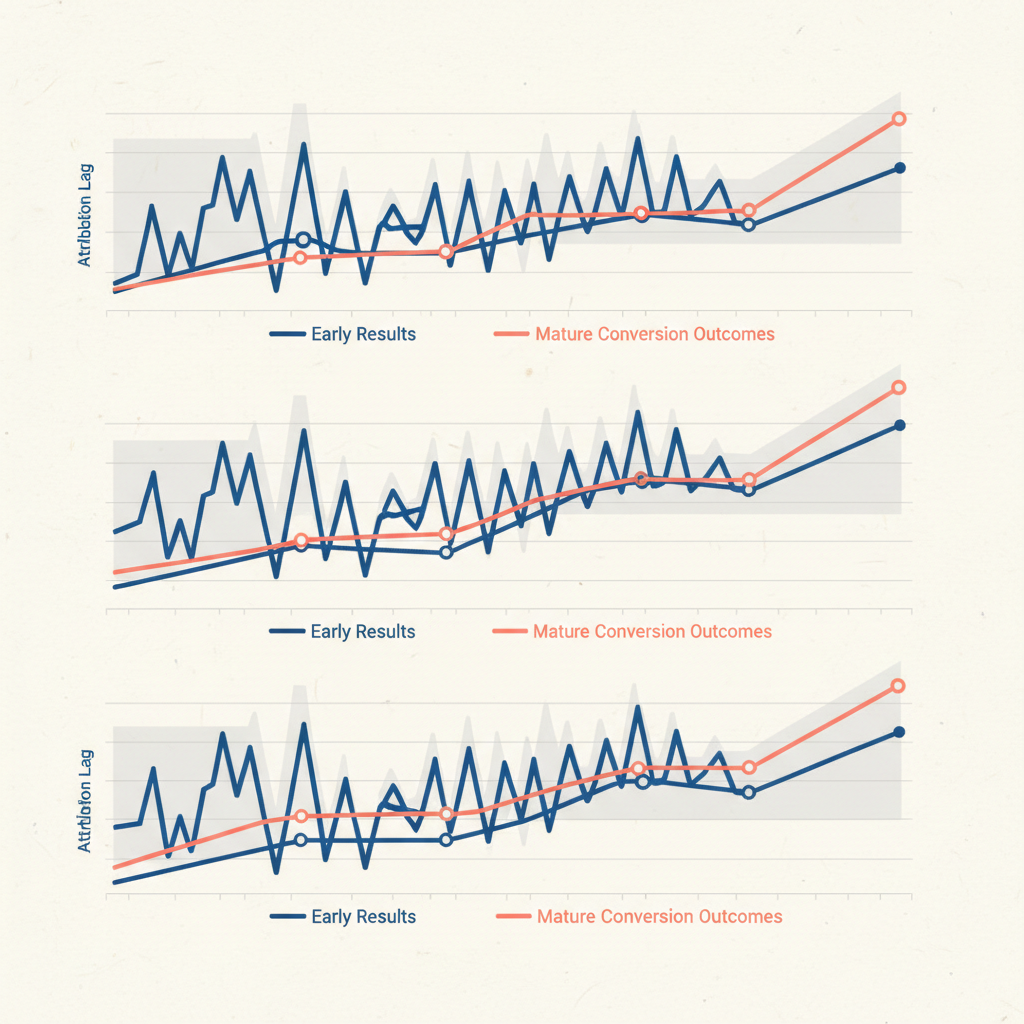
We also check whether an apparent decline is actually a changed offer, landing-page issue, stock constraint, edit, or audience shift. Our testing memory helps us compare a new result with prior concepts under similar conditions, instead of forcing every creative into a universal CPA or CTR rule.
How Do We Read Creative Decay Without Guessing?
Creative fatigue is a pattern of changing response, not a single frequency number. We look for agreement between exposure pressure, attention, click quality, conversion quality, and delivery context. A 2023 fatigue study links repeated exposure with diminished interest and lower CTR, but it does not give us permission to invent a universal cutoff for every account.
Attention and Click Quality
A falling hook signal or outbound CTR can indicate that the message is losing attention. But attention is not intent. If click-through rate stays strong while landing-page views, add-to-cart behavior, or qualified conversion rate weaken, we inspect the promise, offer, and page experience before blaming the creative.
Frequency, Reach, and Response Decay
Rising frequency with falling CTR can indicate repetition pressure. Stable frequency with falling CTR can point to angle fatigue, placement shifts, or auction pressure. Stable CTR with falling conversion rate often points downstream: product availability, pricing, checkout friction, audience quality, or measurement.
Cohorts and Placements
A durable creative should not depend entirely on one placement or one narrow pocket of users. We compare launch cohorts, placements, devices, and returning versus new-audience behavior where available. That makes fatigue versus saturation a diagnosis based on evidence, not a reflexive reason to make more ads.
| Feature | What It Can Support | What It Cannot Prove |
|---|---|---|
| CPA Or ROAS Trend | Early efficiency direction | Mature profitability without eligible conversions |
| Hook Or CTR Trend | Attention and message resonance | Buyer quality |
| Frequency And Reach | Repetition pressure | A universal fatigue threshold |
| Funnel Conversion Rate | Click quality and promise match | That the creative caused a site problem |
| Cohort And Placement Consistency | Breadth of the signal | Future scale capacity by itself |
| Competitor Run Length | A messaging prior | Spend, profit, or account fit |
How Does Meta Ad Creative Lifespan Forecasting Work?
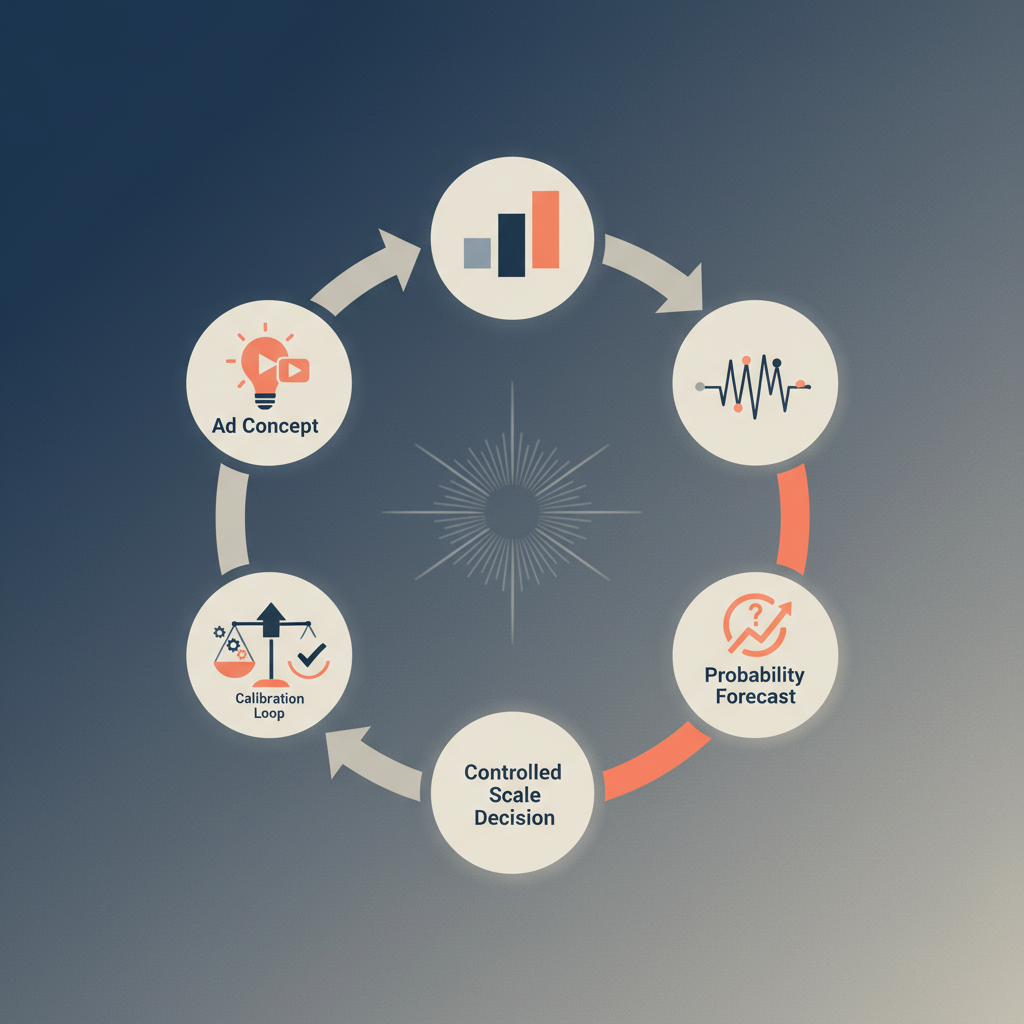
Our Meta ad creative lifespan forecasting process is deliberately simple enough to audit. We do not score an ad because a dashboard looks impressive. We build labels from verified account data, use a defined forecast horizon, and keep survival likelihood separate from profitability likelihood.
Define the Cohort and Label the Outcome
Step 1: We define the observation unit: concept, ad, launch date, offer, audience setup, and placement configuration. Step 2: We label whether it survived to the account’s horizon and whether it was profitable at that horizon.
Those labels should use mature outcomes when possible. Meta’s later outcomes guidance supports connecting website, CRM, offline, and later-customer-journey data, which gives us a better basis for judging conversion quality than an early platform-only total.
Build Account-Relative Features
Step 3: We calculate early features, including mature CPA variance, attention slope, conversion-rate slope, frequency and reach change, placement concentration, and audience expansion. Step 4: We add context, such as offer changes, landing-page changes, inventory conditions, meaningful edits, and observed market activity.
We use concept prioritization to decide which evidence deserves the next test. When a concept earns attention but not qualified outcomes, we preserve that learning rather than treating the creative as a simple win or loss.
Forecast, Backtest, and Recalibrate
Step 5: We produce separate probabilities for survival and profitability, with an insufficient-evidence state when the data is immature or sparse. Step 6: We backtest on later time periods, log the decision made, and compare predicted bands with observed outcomes.
Use this calibration scorecard in the weekly review:
| Review Field | Calculation | Why It Matters |
|---|---|---|
| High-Confidence Forecasts | Ads predicted to survive at high probability | Shows whether scale calls are selective |
| Observed Durable Share | Durable ads divided by predicted durable ads | Tests forecast precision |
| False-Positive Rate | Incorrect durable calls divided by durable calls | Quantifies wasted scale risk |
| Calibration Gap | Observed durable share minus predicted probability | Shows overconfidence or underconfidence |
| Decision Review | Hold, iterate, stop, or scale outcome | Preserves learning for the next test |
Keep the forecast dashboard compact enough to use:
| Dashboard Column | Weekly Read |
|---|---|
| Ad Or Concept | Creative family and hook |
| Launch Cohort | Start period and context |
| Eligible Conversions | Mature outcome count |
| CPA Or ROAS Versus Floor | Profitability signal |
| Attention And Conversion Slopes | Decay diagnosis |
| Frequency And Reach Trend | Exposure pressure |
| Cohort And Placement Consistency | Breadth of performance |
| Survival And Profitability Probability | Forecast output |
| Next Decision | Hold, iterate, stop, or scale |
When calibration reveals that particular messages repeatedly earn attention but fail to mature into quality outcomes, we use performance-aware copy tools to turn the pattern into a more focused next test.
How Should We Use Competitor Ad Longevity?
We treat competitor ad longevity as a messaging prior, not a performance claim. If an angle remains observable for a long period, it may suggest that the advertiser considers the message worth keeping in market. It cannot tell us how much was spent, whether the ad was profitable, how often it was shown, or whether it will work with our offer and audience.
Meta’s Ad Library rules are especially important here. Commercial ads are searchable while active, while the expanded historical spend and reach information applies to issue, election, and political advertising. We should never turn an observed run length into an invented ROAS estimate.
For every observed creative, we log the first-seen date, last-seen date, concept, hook, format, offer pattern, and visible variations in our competitor ad research. That record is most useful when it preserves changes without confusing a new cut, caption, or offer with proof that the underlying message improved.
We compare those observations with our own mature outcome history, then ask whether the visible pattern resembles a durable account result or only an interesting hypothesis. Before we reuse an angle, we also check whether its visible duration overlaps a sale, season, product launch, or sequence of minor variations. Those circumstances affect what the observation means and keep us from calling persistence a standalone performance signal. This is where strategic ad intelligence helps us connect visible market patterns to account evidence without confusing observation with proof.
How Deepsolv Helps Teams Forecast Creative Lifespan
At Deepsolv, we help competitive-ads-research teams turn scattered observations into a reusable decision record. Our workflow keeps the original concept, hook, offer, audience, launch context, and later outcome together, so a promising creative is not judged by a screenshot or a single dashboard spike. We make it easier to compare what the account saw early with what actually held after attribution matured, identify recurring decay patterns, and preserve the reasons a team chose to hold, iterate, stop, or scale. That memory matters when the next concept resembles a past winner or past false positive. Instead of treating competitor research as proof, we use it as organized context alongside account evidence. The result is a clearer weekly review, a more defensible scaling conversation, and less budget spent relearning the same lesson across every paid-social test our teams evaluate with durable confidence. Deepsolv
FAQs on Meta Ad Creative Lifespan Forecasting
Can I Scale an Ad After Three Good Days?
We scale only after eligible, mature evidence supports the account threshold. We compare cohorts, placements, and conversion quality, then increase budget through controlled steps gradually.
Does a High CTR Predict a Durable Meta Ad?
We treat high click-through rate as attention evidence, not durability evidence. It cannot confirm qualified traffic, mature conversions, profitability, or resistance to audience changes over time.
Does a Long-Running Competitor Ad Prove Profitability?
We treat it as a messaging prior only. Active commercial-ad records reveal observable run length, not investment, reach, contribution margin, attribution setup, or future fit inside our account.
How Often Should We Recalibrate the Forecast?
We review the forecast weekly and recalibrate after material changes to offers, audience, site experience, measurement, or delivery. Our model earns trust only when predicted bands match observed outcomes.