
Ad Copy Tools That Learn from Performance: Performance-Connected Tools Compared
Compare performance-connected ad copy tools by the evidence behind their recommendations, from predictive scores to conversion-linked test plans.

Producing more ad variants is easy. Turning campaign data into a reliable creative decision is harder, especially when 14-day minimum lift studies may be needed to measure longer conversion cycles properly.
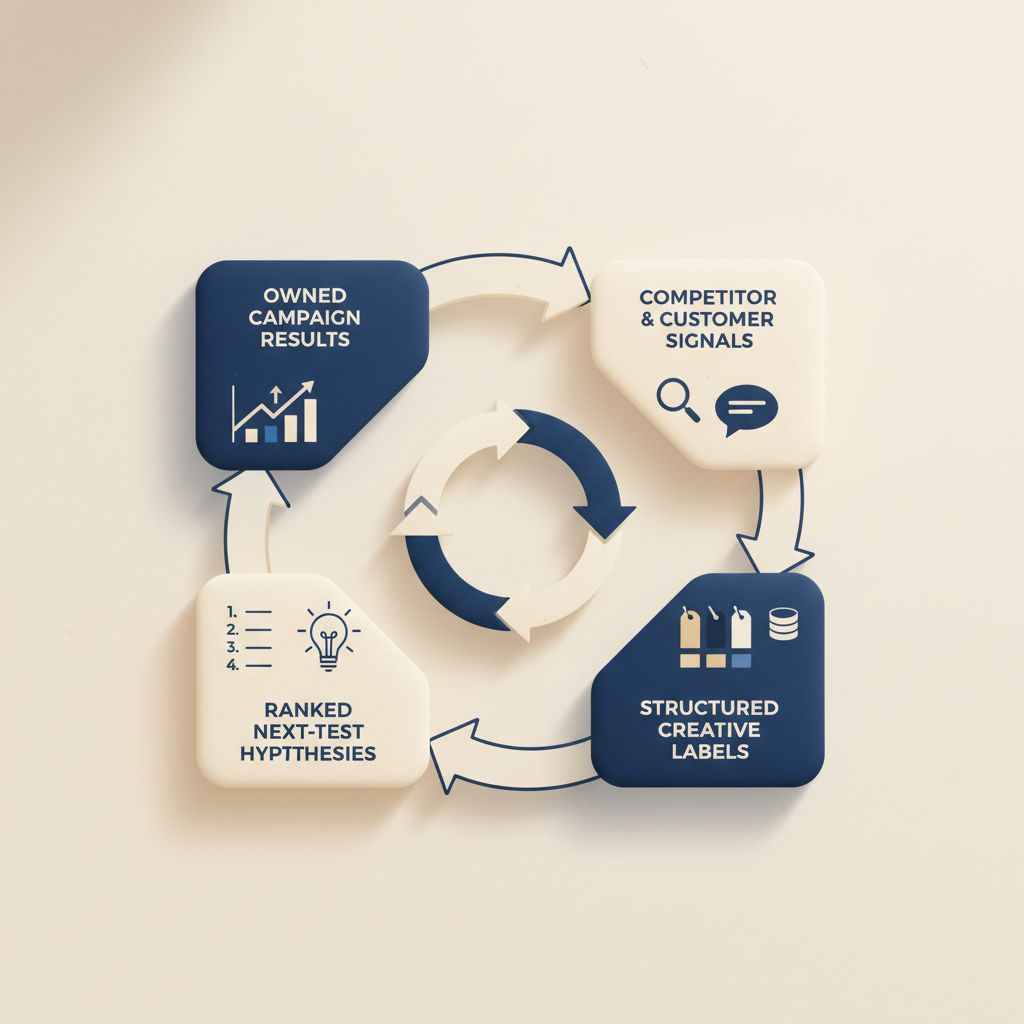
Performance-connected ad copy tools learn only when they link named creative elements, such as hooks, offers, audiences, and scripts, to outcomes from the advertiser’s own campaigns. Generators draft language and predictive scorers estimate response, but a connected system should retain wins, failures, and the evidence behind its next-test recommendation.
This comparison separates generic generators, predictive scorers, connected writers, and creative-intelligence systems so paid-social teams can see what actually changes a recommendation.
What Do Performance-Connected Ad Copy Tools Actually Learn From?
A tool does not learn from performance merely because it calls copy “conversion-focused.” The useful question is whether the system can connect a specific creative choice to a measured outcome, then reuse that learning when it recommends the next angle.

Native ad platforms already optimize combinations within their own delivery environments. For example, responsive search ads can contain up to 15 headlines and four descriptions, then test combinations over time through responsive search ads. That is optimization, but it does not automatically create a cross-campaign memory of why a particular hook, offer, or objection worked.
| Category | What Changes The Recommendation | Evidence Type | Learning Loop |
|---|---|---|---|
| Generic Generator | Prompt, product details, and brand inputs | Drafting context | No, unless account outcomes are connected separately |
| Predictive Scorer | Model patterns or benchmarks | Predicted response | Partial, but a score is not an observed conversion |
| Performance-Connected Writer | Owned campaign results linked to copy labels | Attributed outcomes | Yes, when labels persist across tests |
| Creative-Intelligence Platform | Owned results, market signals, customer language, and past tests | Observed, inferred, and tested evidence | Yes, when it remembers both winners and failures |
For a deeper look at the system behind this category, see our creative intelligence software.
What Evidence Should Change a Copy Recommendation?
The strongest recommendations make their source visible. “Try this hook” is not enough. A team should be able to see whether the idea came from an observed account result, a public market pattern, a customer objection, or a prediction.

Owned outcomes are the most valuable layer because they reflect the advertiser’s actual economics. Meta’s conversion infrastructure can receive website, app, CRM, offline, phone, messaging, and other marketing events through the Conversions API. That makes it possible to connect creative labels to metrics such as conversion rate, cost per acquisition, or return on ad spend, subject to the account’s attribution setup.
Owned Account Outcomes
A performance-connected system should preserve the creative context around each outcome: hook, angle, audience, offer, objection, format, funnel stage, creator, landing-page promise, spend, and date range. Without those labels, a dashboard may show which ad won but cannot reliably explain what to test next.
Public Competitor Signals
Public ads are useful for identifying active messaging, formats, and market patterns. They are not conversion proof. Meta says its Ad Library lets people search ads currently active across its products, while expanded spend and reach details apply to issue, electoral, and political ads that remain available for seven years through the public ad library.
Use public creative as an INFERRED signal. It can suggest a pattern worth investigating, but it cannot establish another advertiser’s CPA, conversion rate, revenue, or causal lift. Our competitor analysis guide explains how to turn market observations into testable hypotheses rather than copied creative.
Customer and Brand Inputs
Customer comments, reviews, direct messages, and support language help identify the objections and desires a script must address. Brand guidelines then define what claims, tone, proof, and offers are acceptable.
Labels Make Outcomes Reusable
Use four evidence labels consistently: Predicted means a model estimates likely response before launch. Observed means an outcome was measured under stated attribution settings. Inferred means a pattern correlates with a result but has not proven cause. Tested means a controlled experiment or lift study supports the claim.
How Do Predicted Scores, Observed Results, and Tested Lift Differ?
These distinctions matter because a high score can be useful without being proof. A team that treats every score as a result will overstate confidence, repeat weak assumptions, and struggle to learn from failed tests.

Predicted Scores
A predicted score is a model estimate. Before relying on it, ask what outcome it predicts, what data informed it, whether owned account data changes the result, and how recently the method was calibrated. A score can prioritize a queue, but it should remain PREDICTED until real delivery data arrives.
Observed Results
Observed results are campaign metrics collected after an ad runs. They are still shaped by attribution rules, which determine how conversion credit is assigned across the customer journey. Google describes an attribution model as the rules used to assign that credit in its attribution guidance.
That does not make observed ROAS or CPA unhelpful. It means the recommendation should name the metric, timeframe, attribution setting, and audience context instead of presenting a result as universally true.
Inferred Correlations
Correlation is a useful lead, not a verdict. A hook may appear alongside strong conversion performance because of its offer, audience, placement, landing page, budget, or timing. The right output is: “This angle correlated with lower CPA in this segment,” followed by the evidence and a testable next step.
Tested Causal Evidence
Causal evidence requires a controlled comparison. Conversion lift measures the difference between a treatment group exposed to ads and a control group that was not, making it the clearest route to incremental impact in a conversion lift study.
A reliable memory should preserve that difference. Our creative testing memory keeps the hypothesis, conditions, verdict, and re-test rationale together, so a failed idea does not return as a “new” recommendation without a material reason.
Which Tool Capabilities Actually Support Better Next-Test Decisions?
The practical comparison is not “which tool has AI?” It is whether the tool connects evidence, workflow, and memory well enough to reduce debate over what to test next.
| System Or Category | Owned Conversion Results | Competitor Inputs | Customer Inputs | Failure Memory | Script And Variation Output | Next-Test Guidance | Pricing Disclosure |
|---|---|---|---|---|---|---|---|
| Public Ad Library | No | Yes, active public ads | No | No | No | No | No software price listed on the public source |
| Native Ad Reporting | Yes, within the connected account | No | Limited to connected first-party event sources | Not a creative-memory system | Limited to platform asset workflows | Delivery optimization, not angle prioritization | Media spend varies |
| Generic Generator | Only if manually provided or integrated | Optional reference input | Optional prompt input | Usually limited | Yes | Usually prompt-led | Varies by provider |
| Predictive Scorer | Varies by disclosed integration | Varies | Varies | Varies | Often variations or rankings | Predicted prioritization | Varies by provider |
| Our Deepsolv Workflow | Historical performance is used with creative signals | Yes | Reviews, comments, direct messages, and audience discussion signals | Yes, including past failures and rationale | Hooks, briefs, scripts, and statics | Ranked weekly test plan | Public price not listed |
We built our workflow around the gap between reporting and decision-making. Rather than making a team infer the next move from disconnected charts, we turn evidence into a ranked creative hypothesis with a reason to test, reject, or revisit it. Our concept prioritization framework shows how to turn that reasoning into a repeatable review process.

How Should Paid-Social Teams Choose a Tool?
Choose based on the bottleneck. If the team needs more first drafts, a generator may be enough. If the team needs to narrow a large production queue, a scorer can help. If the team is losing time debating creative direction after reviewing dashboards and saved ads, the deciding factor is whether the system produces a source-linked next-test recommendation.
A useful review process brings customer language into the same decision as campaign outcomes, rather than treating it as a separate research exercise. A recurring objection may change the script, while a recurring desire may change the proof or offer a team tests. That context helps teams distinguish an angle worth adapting from a pattern that only looked persuasive in a saved ad.
Our comment analysis guide explains how to turn recurring audience language into usable creative inputs without presenting isolated feedback as performance proof.
| Buying Criterion | What To Ask | Strong Evidence |
|---|---|---|
| Speed | Does it produce a usable hypothesis, not just a dashboard? | Time from signal to approved brief |
| Governance | Can reviewers inspect the source and approval trail? | Source links, permissions, and revision history |
| Analytical Depth | Are creative labels joined to account outcomes? | Ad-level metrics mapped to hooks, offers, and formats |
| Next-Test Guidance | Does it rank what to test and explain what to skip? | Hypothesis, confidence, and failure-memory rationale |
| Measurement Integrity | Does it separate prediction, attribution, correlation, and causality? | Clear evidence badges and methodology |
| Cost | Is pricing published or sales-led? | Current pricing information or direct confirmation |
A good buying process also requires a testing discipline. Google recommends recording experiments so future prioritization becomes easier, a principle reflected in its experiment guidance. For a broader selection framework, compare creative strategy platforms against the decision process your team already uses.
Why Deepsolv Is Built for This Decision
Deepsolv exists for the moment after a team has gathered dashboards, saved ads, and collected comments, but still needs to decide what to make on Monday. We combine the signals a paid-social team already has: account performance, market activity, customer language, and the record of previous creative decisions. Our aim is not to turn a weak hunch into a polished script. It is to give every proposed hook, angle, and format a traceable reason, a confidence level, and a clear condition for rejecting or retesting it.
We help teams move from research to a ranked test plan, then from that plan to briefs and scripts that respect brand context. That lets creative, growth, and media teams debate evidence instead of personal preference. We keep the review process practical for cross-functional teams. Our workflow keeps the learning usable after launch. If your bottleneck is choosing the next angle rather than producing another variation, start with Deepsolv.
FAQs on Performance-connected Ad Copy Tools
Do Predictive Scores Use My Conversion Data?
Not always. A score can reflect model training data or broad benchmarks. It becomes account-specific only when the provider documents use of your account outcomes.
Can Public Competitor Ads Prove Conversion Performance?
No. Public libraries can show that an ad is active, but they do not reveal ordinary advertisers’ conversion rate, acquisition cost, revenue, or causal lift.
What Counts as Causal Evidence?
Causal evidence comes from a controlled test comparing a treatment group with a valid control group, then reporting the incremental difference and uncertainty for decisions.
How Should Failed Creative Tests Be Stored?
Store the hypothesis, labels, audience, offer, timeframe, spend, attribution setting, result, and verdict rationale. Require new evidence showing changed test conditions before retesting the idea again.