
Tools That Turn Meta Feedback into Ad Strategy: Meta Ad Feedback Analysis Tools


TL;DR
We turn authorized Meta comments and DMs into tested creative, not guesswork. This guide sorts feedback into what you can actually act on, maps it across five tool categories from native inbox triage to approved API workflows, and shows how AI clusters comments into themes such as price objections or desired outcomes that become specific ad tests, while flagging where it misreads sarcasm or spam and the governance that keeps it compliant.
Most ad teams can see customer reactions but lose the language before it reaches the next brief. Meta retains inactive issue, election, and political ads in its library for seven years, but that public record is not a substitute for authorized customer conversations, and this guide explains the difference.
Meta ad feedback analysis tools turn authorized comments and direct messages into ad strategy when they group repeated questions, objections, desired outcomes, and sentiment, then connect those themes to the creative that triggered them. The useful result is a prioritized insight, validated by a person, with one specific creative action to test.
What Meta Feedback Can You Collect?
We start with access, because a visible comment and a private conversation are not the same kind of research material. Our teams collect only conversations tied to assets the business owns or has explicitly authorized us to analyze, then retain the context that makes a theme useful: source ad, date, placement, and creative version.
Meta’s Business Suite Inbox can bring Messenger, Instagram, and WhatsApp messages together, while also surfacing Facebook and Instagram comments. It can filter conversations that came from an ad, which makes it a useful native starting point for a small research workflow.
- Public Ad Comments: We can observe visible comments for directional market language, subject to platform rules and available workflows.
- Owned Page Comments: We can collect and organize comments from connected business assets, then connect them to the creative that prompted them.
- Private DMs: We can analyze only authorized inbox conversations. These need stricter handling because they can contain personal or sensitive details.
- Competitor Comments: We can study publicly visible language, but we cannot access private messages, account performance, or customer records from another advertiser.
For a deeper operational view of organizing owned-account reactions, see our complete guide. The important boundary is simple: public visibility can inform market research, but it does not grant permission to collect private customer conversations.
Which Meta Ad Feedback Analysis Tools Fit the Job?
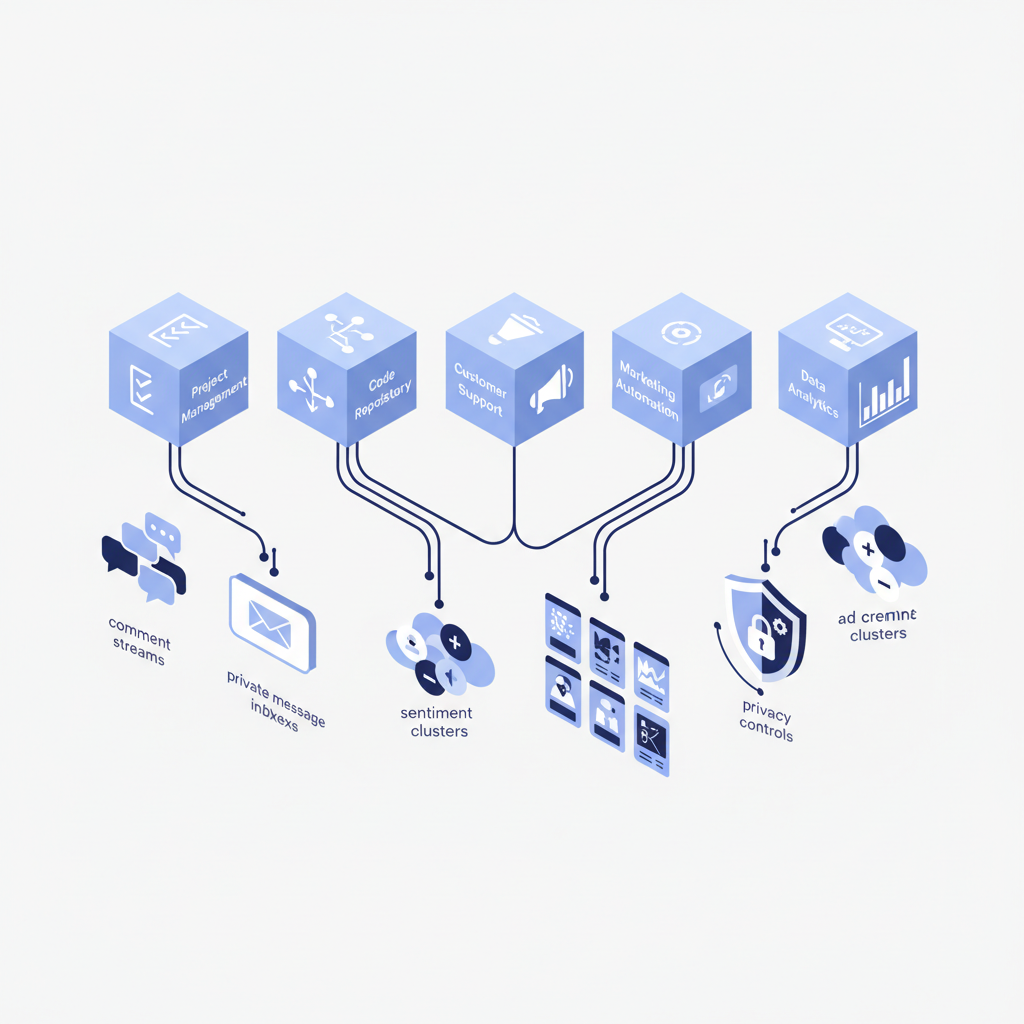
The right tool depends on the decision you need to make, not on whether it can produce a sentiment chart. We look for a workflow that can preserve source context, group language into a useful theme, export a reviewable record, and hand a clear action to the creative team.
| Tool Category | Access And Sources | Analysis | Action Output | Privacy Controls |
|---|---|---|---|---|
| Native Meta Workflow | Owned comments and authorized inbox conversations | Manual search, labels, and triage | Reply, assign, follow up, and flag ad-response threads | Account and Page roles |
| Social Inbox Tool | Authorized owned comments and DMs | Rules, tags, routing, and basic classification | Exports, alerts, and review queues | Role controls and retention settings |
| Social Listening Tool | Public conversations where permitted | Topic monitoring and directional sentiment | Market-language watchlists | Public-data restrictions |
| Creative Intelligence Tool | Authorized feedback plus ad-performance context | Theme clustering, objection extraction, and source-ad linkage | Ranked insights and test recommendations | Redaction, access controls, and audit trails |
| Approved API Workflow | Permissions appropriate to connected assets | Custom taxonomy and quality checks | Warehouse exports, dashboards, and alerts | Least privilege and deletion policies |
Meta’s official API documentation distinguishes between comment and message permissions for professional accounts, which is why DM access should be a procurement question, not an assumption. We use this distinction to decide whether a native inbox, a social workflow, or a more connected research system fits the job.
How Does AI Turn Feedback into Usable Themes?
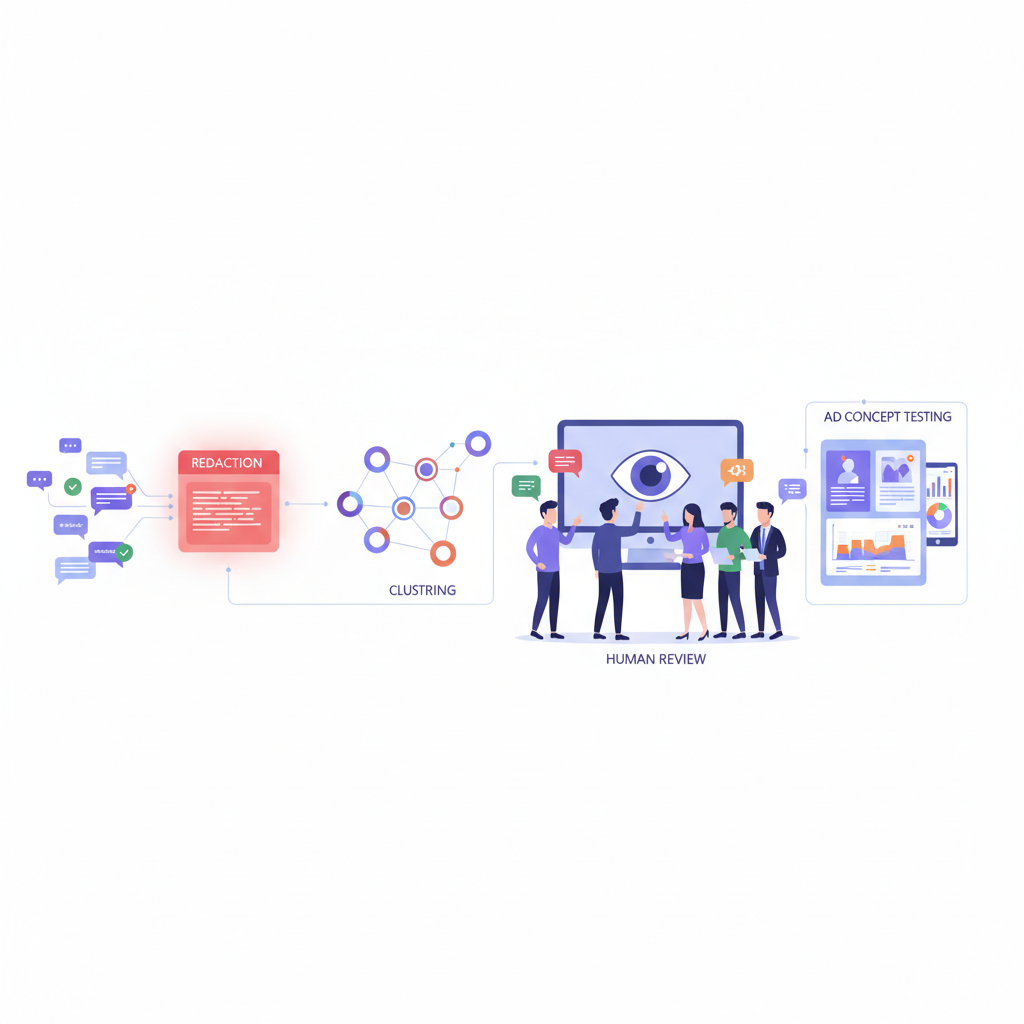
AI is useful when it shortens the route from raw language to a well-framed creative decision. We do not treat it as an autonomous analyst. We use it to organize evidence, surface repeated patterns, and make human review faster.
Collect and Clean the Evidence
First, we collect only authorized text and the metadata needed to interpret it: channel, date, ad ID, creative version, placement, and performance window. Next, we remove duplicates, separate spam and scam content, detect language, and redact direct identifiers before wider analysis.
Cluster Decision Language
We cluster by what a team can act on, not just whether a message reads as positive or negative. Useful groups include price objections, desired outcomes, product questions, proof requests, recurring phrases, and new angle opportunities.
Validate Before You Generalize
Every theme needs a visible sample size, time window, source split, and redacted examples. The GDPR principles require that personal data be limited to what is necessary and stored no longer than necessary, which supports a deliberate, narrow research dataset.
Turn Themes into Tests
A validated cluster becomes one proposed action: a new hook, clearer proof, a FAQ card, a revised landing-page explanation, or a separate creative concept. Our feedback-to-test workflow keeps that handoff traceable so the creative team knows what language informed the test and why.
How Do Feedback Themes Become Better Ads?
Sentiment alone does not explain conversion. We connect a theme to the source ad, then use it to form a hypothesis about what to test next. The performance result decides whether the creative change earned its place, not the volume of comments alone.
| Feedback Theme | Evidence To Preserve | Source-Ad Context | Creative Action | Test Readout |
|---|---|---|---|---|
| Price Objection | Frequency, redacted wording, and sample size | Ad ID, audience, spend, and date range | Test value framing or price explanation | Compare conversion efficiency |
| Desired Outcome | Repeated outcome language | Existing hook and visual | Lead with the stated outcome | Compare against the current hook |
| Product Question | Question category and unanswered rate | Ad, placement, and format | Add a FAQ card or caption clarification | Track question rate and performance |
| Proof Request | Requested evidence and context | Current claim and proof shown | Add demonstration or substantiation | Compare qualified engagement and conversion |
| New Angle | Cluster plus representative examples | Existing angle coverage | Build a distinct concept | Test separately from existing creative |
Meta’s delivery guidance notes that performance is less stable during the learning phase, so we avoid reading early results as a final verdict. We use angle performance tracking to compare concepts fairly, then prioritize what earns further spend.

Where Does AI Analysis of Meta Feedback Fail?
AI can summarize a large volume of feedback, but it can also flatten the context that gives a message its meaning. We keep uncertainty visible, particularly when a cluster could change positioning, policy-sensitive copy, or the treatment of private conversations.
Our concept prioritization framework helps us decide which validated themes deserve a place in the next creative brief. It keeps prioritization focused on evidence, relevance, and a clearly stated test rather than a vague impression of audience mood.
Sarcasm and Mixed Sentiment
Sarcasm often looks positive on the surface while communicating frustration or contempt. Sarcasm research describes its widespread use in social media, so we route uncertain or high-impact messages to human review rather than forcing a confident label.
Spam and Repeated Text
Repeated comments, coordinated complaints, scams, and irrelevant replies can distort a cluster. We separate moderation signals from product feedback before concluding that a recurring phrase reflects a genuine customer objection.
Multilingual Text and Small Samples
Language detection is only a first pass. We preserve the original wording, use reviewers with relevant language knowledge, and show the number of messages behind each theme because a small or skewed sample should generate a question, not a strategic certainty.
Our creative testing memory helps prevent a team from repeatedly rediscovering the same unvalidated angle. It also keeps past feedback, test decisions, and outcomes connected without treating any single sentiment score as a performance claim.
How Should Teams Govern Comment and DM Data?
Governance is what makes feedback analysis sustainable. If a workflow cannot explain who can access a message, why it was retained, what was redacted, and how the insight was approved, it is not ready to influence creative strategy.
The European Commission’s privacy principles emphasize purpose limitation, data minimization, storage limitation, and security. We apply those concepts to feedback research even when a team is working outside the EU, then confirm jurisdiction-specific obligations with its legal and privacy owners.
- Permissions: Verify Page, professional-account, inbox, and vendor access before collection.
- Purpose: Document that feedback supports approved creative research and campaign improvement.
- Redaction: Remove names, contact details, order information, payment details, health information, and other sensitive content where possible.
- Retention: Set a review and deletion schedule tied to the research purpose.
- Approved Use: Require human approval before a cluster becomes a public claim, a targeting decision, or ad copy.
- Audit Trail: Record the source, owner, recommendation, and final creative decision.
Our creative intelligence software supports the same evidence-to-decision discipline. It helps us make competitive ads research useful to strategists while respecting the boundary between a customer’s conversation and a reusable creative insight.
Turn Feedback into Tests with Deepsolv
At Deepsolv, we help competitive ads research teams move from scattered reactions to an evidence-backed testing queue. Our platform gives strategists a durable place to connect recurring customer language with the creative concepts, competitors, and performance patterns they are already reviewing. That means a question in a comment or an objection in an authorized inbox does not disappear after a weekly scan. It becomes a traceable input to a hypothesis, alongside the source creative and the decision it informs. We keep the workflow centered on human judgment: researchers decide what counts as a meaningful pattern, writers decide how to express it, and media teams decide whether the test merits spend. If your team wants faster creative learning without treating private customer conversations as raw fuel, we can help turn feedback into a governed research process with clear, accountable ownership. Start with Deepsolv
FAQs on Meta Ad Feedback Analysis Tools
Our answers set practical boundaries.
Can We Analyze Competitor Meta Comments and DMs?
We study publicly visible comments for directional language, but we never access another advertiser’s private DMs, account performance, or customer records through a legitimate workflow.
Do We Need a Tool to Analyze Meta Ad Comments?
Not always. Native workflows can support small volumes, while a dedicated system becomes useful when teams need consistent clustering, source-ad linkage, exports, alerts, and review trails.
Is Negative Sentiment Proof an Ad Will Not Convert?
No. Sentiment captures an expressed reaction, not causal conversion impact. We use it to form a hypothesis, then compare a controlled creative test with performance data.
What Should We Remove from DMs Before AI Analysis?
Remove or redact direct identifiers, contact details, order information, health details, payment data, and other sensitive content. Keep only the context necessary for approved creative research.