

TL;DR
We combine owned Meta performance, public competitor activity, customer language, and creative analysis to rank what a team should test, refresh, or reject. This guide shows what the software knows directly, what it only infers, how we protect sensitive inputs, and when a small team should stay manual or choose Deepsolv.
Meta’s Ad Library makes active ads visible, while political and issue ads can remain searchable for seven years. That visibility is useful, but it is only one input into a sound creative decision.
Meta creative intelligence software combines first-party ad performance, observable competitor activity, customer language, and attributes extracted from images, video, and copy. It maps those signals to hooks, angles, offers, and formats, then ranks what to test, refresh, or reject. It can observe competitor ads, but it cannot see their private spend, conversions, or ROAS.
We will show how the intelligence loop works, where its data boundaries sit, and how a three-person team can choose between a managed decision layer and a manual research workflow.
How Does Meta Creative Intelligence Software Differ from a Library or Dashboard?
An ad library answers, “What is visible?” A swipe file answers, “What did we save?” An analytics dashboard answers, “What happened in our account?” A creative generator answers, “What could we make?”
Meta creative intelligence software answers a more useful operating question: “Given what our market, customers, and account are telling us, what should we do next?” It turns raw evidence into a decision with supporting context, stated uncertainty, and an outcome that can be remembered after the campaign ends.
That distinction matters because a folder of examples does not tell a team whether an angle is new for its audience, repeated in its own account, supported by customer language, or already losing traction. Our creative intelligence software is built to connect those questions before the brief reaches production.
Which Four Signal Layers Power Better Creative Decisions?
A useful recommendation needs more than a collection of ads. We combine four layers because each one answers a different part of the creative question, and each has limits the others can help expose.
First-Party Performance
Owned performance is the strongest evidence a team has, provided it comes from an authorized account and is interpreted in context. Metrics such as CTR, CPC, CPA, conversion rate, ROAS, spend, and fatigue trends can show where a concept created attention, where it created intent, and where it failed to carry through.
Observable Competitor Activity
Public ads reveal what other advertisers are putting into market: creative, copy, Page identity, format, delivery timing, and visible variation. This layer is valuable for research, but it remains an observation layer rather than a competitor performance report.
Customer Language
Comments, reviews, DMs, surveys, and support themes can expose objections, desires, trust gaps, and buying triggers. When a customer repeats a concern in their own words, that language can improve the proof, framing, and specificity of the next test.
Multimodal Creative Attributes
Images, video, and copy contain reusable attributes: the hook, offer, proof device, CTA, format, creator style, pacing, demonstration, and visual structure. Our creative angle performance tracking connects those attributes to actual outcomes, so a team can assess an angle rather than simply collect examples.

What Does the Software Know Directly, Infer, or Never Access?
The clearest way to use competitor research is to separate facts from educated hypotheses. Public ad data can tell us that an ad is active and what it looks like, while the marketing outcome behind that ad remains private.
| Data Type | Known Directly | Inferred Cautiously | Unavailable |
|---|---|---|---|
| Ad Activity | Active creative, copy, Page, dates, and platform | Testing cadence and category momentum | Private campaign structure |
| Performance | Owned-account results with authorization | Whether competitor longevity merits investigation | Competitor ROAS, CPA, conversion rate, and profit |
| Spend And Reach | Limited regulated-ad transparency | Relative investment from visible variation patterns | Ordinary commercial spend and impressions |
| Audience | Brand-owned feedback and public context | Likely message-market fit | Competitor customer lists and individual targeting |
| Customer Language | Permitted owned comments, DMs, and reviews | Repeated objections or desires | Private competitor conversations |
Meta’s API lists creative content, Page information, delivery dates, and publisher platforms for available ads. Its spend and impression ranges apply to specific political or issue-ad contexts, so we do not treat them as a shortcut to ordinary commercial competitor results.
Permissions also matter. We only need public activity to research the market, but account performance and customer feedback should come from sources a team is authorized to connect and use. Our Facebook ads competitor analysis tools guide explores the research side, while the decision layer keeps the difference between visible evidence and private outcomes explicit.
Our current privacy policy states a default six-month post-termination retention period, deletion from active systems within 28 days after a request, and operational-log retention of up to 30 days. Disconnecting an integration stops new collection, which helps teams retain control over the information they share with us.
How Does the System Turn Signals into Creative Decisions?
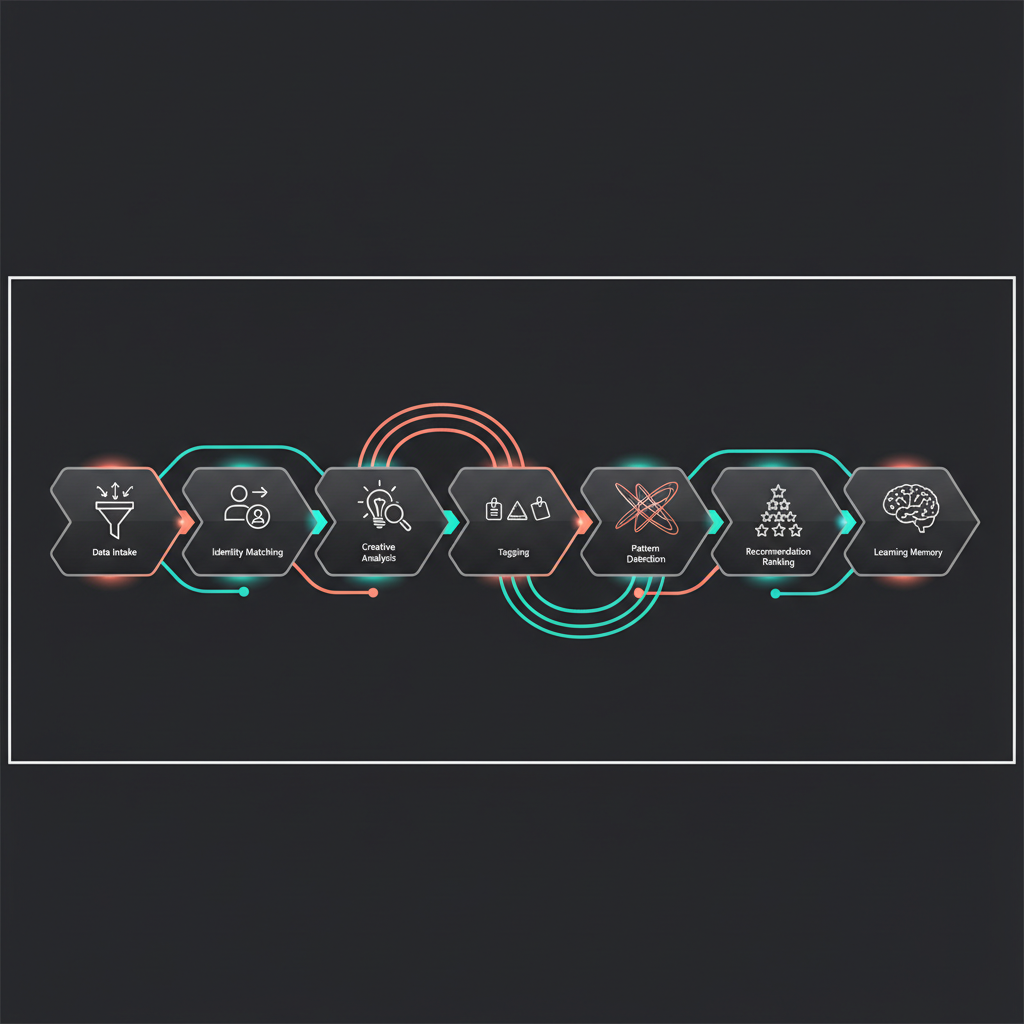
The intelligence loop works best when it is repeatable. We treat it as a sequence that gathers evidence, preserves context, and updates the team’s memory after each creative decision.
Ingest and Match
- Ingest: Bring together authorized account data, permitted customer feedback, and public competitor activity.
- Match: Connect ads, variants, dates, products, campaigns, and recurring creative concepts.
- Normalize: Resolve inconsistent names, duplicated assets, and mismatched date ranges before analysis.
Extract and Tag
- Extract: Identify creative attributes from visual, video, and copy inputs.
- Tag: Apply a consistent taxonomy for hooks, angles, offers, proof, format, audience problem, and lifecycle state.
Detect and Reason
- Detect: Find patterns across owned performance, customer themes, and public market activity.
- Reason: Rank possible tests with the evidence behind each choice, the uncertainty around it, and a recommendation to test, refresh, pause, or reject.
Use creative fatigue vs audience saturation to diagnose an apparent decline before assuming the idea itself has failed. A low result may reflect audience conditions, weak message match, or an exhausted creative execution.
Learn and Review
A recommendation is not a promise. A team should review the rationale, approve the action, and send the resulting outcome back into its internal learning record. That feedback prevents the same failed idea from returning just because it looks fresh in a new format.
A confidence label should also communicate the quality of evidence, not pretend to predict certainty. The UK regulator’s accuracy guidance cautions that an AI inference may not reflect objective fact when reliable ground truth is unavailable. For creative work, that means a strategist should be able to inspect, challenge, and override every recommendation.
How Should a Three-Person Team Choose Its Workflow?
A three-person team does not need more software for its own sake. It needs the shortest path from market evidence to a credible brief, plus a durable creative testing memory, without turning research, tagging, and reporting into a part-time operations job.
| Decision Factor | Deepsolv | Commercial Swipe-File Workflow | Manual Workspace Workflow |
|---|---|---|---|
| Signal Sources | Competitor activity, customer language, and owned performance | Saved public ads and team notes | Manually collected ads and notes |
| Historical Tracking | Connected decision memory | Depends on manual saving and product setup | Only what the team records |
| Customer Insights | Included in the decision process | Usually separate from research | Manual collection and tagging |
| Owned-Performance Linkage | Included in the decision process | Often separate from saved references | Manual exports and matching |
| Recommendation Output | Ranked tests and improve, stop, or wait decisions | Reference boards and briefs | Human-created conclusions |
| Ongoing Maintenance | Shared and structured | Moderate curation | Highest manual workload |
| Setup | Guided workflow | Workspace configuration | Database design and team discipline |
| Cost Profile | Current plan discussion | Subscription plus team time | Workspace software plus team time |
Choose a manual workspace when budget is the hard constraint and one person can protect a weekly research ritual. Choose a swipe-file workflow when the immediate problem is gathering references and shaping briefs. Choose Deepsolv when the bottleneck is deciding what deserves production after research, feedback, and account performance have all been considered.
The build-versus-buy choice becomes clearer when a team scores its own capacity honestly.
| Factor | Stay Manual Or Build Lightly | Use A Managed Decision Layer |
|---|---|---|
| Budget | Subscription spend cannot yet be justified | Research time is becoming more expensive than the tool |
| Account Complexity | One account and a short competitor list | Multiple products, markets, or active concepts |
| Testing Volume | Infrequent creative launches | Weekly testing and repeated fatigue decisions |
| Analyst Capacity | An owner can maintain research and tags | Analysis is delaying briefs or production |
| Time To Value | The team can build patiently | The team needs usable decisions now |
Our ad creative strategy platforms framework can help teams identify whether their actual constraint is research, performance analysis, production, or decision-making. That diagnosis should come before the purchase decision.
Why Deepsolv Fits Creative Decision Teams
At Deepsolv, we built our platform for the moment after a team has collected enough ads, comments, and performance rows to feel informed but still cannot choose the next brief. We bring those signals into one decision loop, preserve the reasoning behind prior tests, and show what evidence supports a recommendation or makes it weak. That matters when three people are splitting media buying, research, and production, because lost context becomes expensive quickly. Our role is not to replace the strategist or promise a competitor’s results. It is to make the evidence visible, rank the next questions, and keep lessons from disappearing into screenshots and scattered documents. If your team wants a practical view of which concepts deserve production, which creative is tiring, and which ideas should wait, start with a working session when your team needs a repeatable weekly research rhythm, then book a demo.
FAQs on Meta Creative Intelligence Software
These short answers clarify the data boundaries and operating choices teams should understand. They are designed to help a team assess research inputs before acting on a recommendation.
Does Meta Creative Intelligence Software Use Competitor Data?
Yes. It analyzes public ads and recurring patterns, but private competitor spend, conversion results, targeting, and ROAS remain unavailable and must never be treated as verified facts.
Can a Long-Running Competitor Ad Prove It Works?
No. Longevity can make a concept worth investigating, but it cannot prove profit, incremental lift, or fit with your audience, offer, creative, and landing page.
What Data Do We Need to Connect?
Connect authorized account performance and customer-feedback sources you are entitled to use. Public ads need no competitor permission, but every recommendation improves when ownership and context are clear.
Should a Three-Person Team Stay Manual?
Stay manual when a clear owner can maintain weekly research, tagging, and outcome notes. Buy when that work delays creative decisions, testing, or production more than it informs them.
How Should We Handle a Low-Confidence Recommendation?
Treat it as a research prompt, not a fact. Ask what evidence is missing, request human review, and log the eventual outcome before letting it shape future decisions.