Deepsolv Blog
Deepsolv Blog
Backed by





Creative Decision Intelligence for Meta growth teams. Know what to test next — before you spend on it.
Follow Deepsolv on InstagramFollow Deepsolv on LinkedInFollow Deepsolv on TwitterAll rights reserved © 2026 deepsolv.ai
5 min read
Published: 9/29/2025
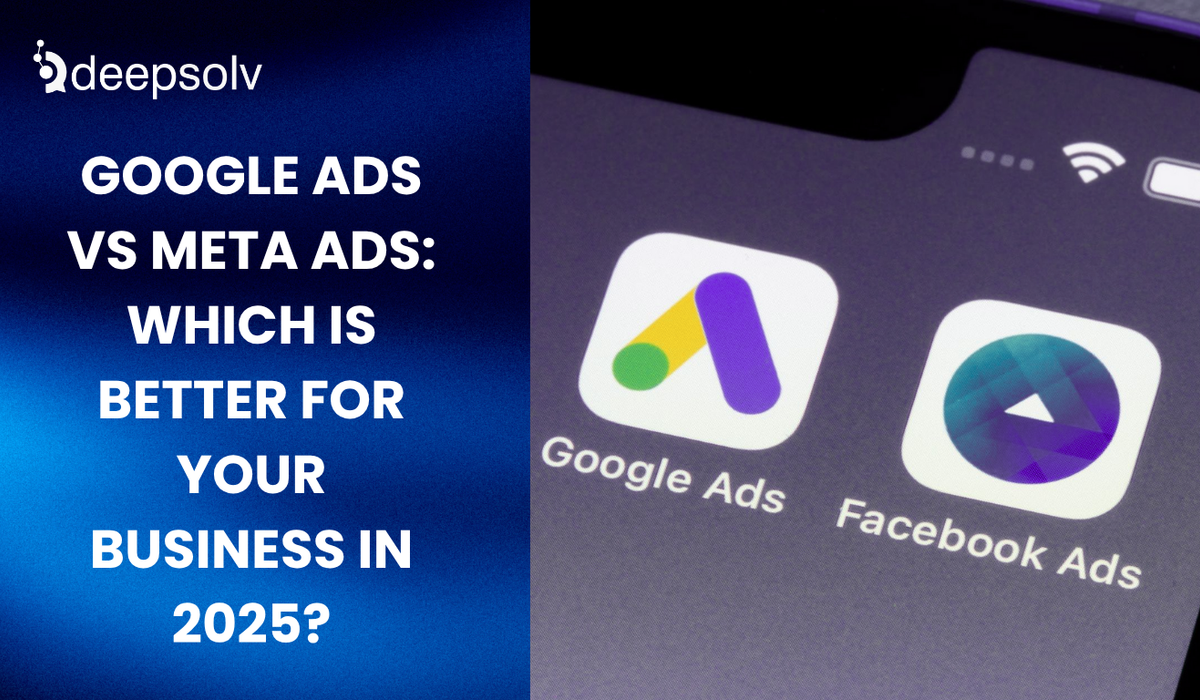
In 2025, one of the biggest strategic questions for any business deciding where to spend its marketing budget is: should I go deeper with Google Ads or lean into Meta Ads (Facebook, Instagram, Messenger, etc.)?
The answer isn’t simply “one is always better than the other.” Instead, it depends on your business type, goals, audience, and creative setup.
In this blog, I’ll walk you through what each platform does best in 2025, where each has weaknesses, how they compare across 10 critical dimensions, and how you can decide which one (or both) is right for you. I’ll end with actionable advice: how to test them, combine them, and pull ahead of competitors who choose without thinking.
Advertising costs are rising across the board. According to recent benchmarks, 87% of industries saw increases in CPC for Google Ads, up by 12.9% year-on-year. Meanwhile, for Facebook/Meta lead ads, the increase in cost per lead was much slower. (WordStream)
At the same time, user behavior is evolving: privacy changes, loss of third-party cookies, changing attention spans, and more consumption on mobile/social make the playing field different than it was a few years ago.
So, choosing where to invest and more importantly how to invest, can determine whether you get profitable returns or just pour money into underperforming campaigns.
Here are first the core high-level differences so you have a mental map.
Many expert comparisons note exactly that: Meta = discovery & awareness, Google = search & capture. (Shopify)
Below we compare both platforms across critical dimensions you should care about in 2025. This will help you see which one may suit you better or whether you should use both together.
| # | Dimension | Google Ads Strengths | Meta Ads Strengths | What to Watch / Weaknesses |
| 1 | User Intent | Very strong. If someone searches “buy running shoes size 10”, they’re likely to convert. | Lower intent. User sees ad while browsing feed, not actively searching. | Meta may need more nurturing; Google often costs more per click. |
| 2 | Audience Reach & Discovery | Can reach large numbers via Display/YouTube, but less “social discovery”. | High reach + discovery potential. You can show your brand to new audiences in immersive formats. | Meta may generate impressions but fewer immediate purchases in some cases. |
| 3 | Ad Formats & Creative | Search text ads, shopping ads, display banners, video on YouTube. High diversity. | Strong: feed posts, story/reels, carousel, collection ads — highly visual. | For Google Search, creative is constrained (text). For Meta, creative fatigue and ad blind spots are big risks. |
| 4 | Targeting & Audience Data | Keyword + intent targeting, demographic, in-market audiences. Solid for capturing. | Deep interest, behaviour, lookalikes, retargeting — very powerful for prospecting. (technosters.in) | Meta’s interest targeting is evolving (some granular interests removed) and privacy constraints are increasing. |
| 5 | Cost & Efficiency (CPC/CPA) | Often higher CPCs in competitive niches. But efficient for conversions when set up well. | Generally lower CPCs for awareness; Meta benchmark shows lower CPCs in many categories. (WordStream) | Meta costs are rising too; also conversions may be less efficient if audience not warmed up. |
| 6 | Conversion Tracking & Attribution | Usually more mature tracking frameworks, especially if you integrate Google Analytics, GA4, server-side tracking. | Meta has pixel, CAPI, but privacy changes (e.g., iOS) affect reliability. | Both require strong implementation; common mistake is poor tracking leading to misleading ROI. |
| 7 | Time to Results | Often faster for bottom-funnel conversions because user intent is high. Some sources say results in 2-4 weeks. (Bright Click Digital Marketing) | May take longer to optimize — need audience warming, creative testing, engagement. | If you rush Meta expecting Google-search-like speeds, you’ll be disappointed. |
| 8 | Suitability by Business Type | Great for local services, B2B, any business where search demand exists. | Great for D2C, ecommerce, viral/social products, brand building. | The best businesses often use both in tandem. (Search Engine Journal) |
| 9 | Scaling & Saturation Risks | Scaling means bidding up — can hit steep cost increases; requires high-quality keywords and landing pages. | Scaling via new creatives, broader lookalikes; but audience fatigue and declining marginal returns are real risks. | Automated rules, creative rotation, fresh audiences are essential. |
| 10 | Future-Proof & Platform Trends | Google is pushing more AI in Search and Performance Max. Ecosystem heavily invested. | Meta is shifting deeply into AI-driven targeting (Advantage+), automation, and social commerce. (Axios) | Both platforms will evolve — staying agile and data-driven is key. |
Here’s a decision-tree style simplified approach:
Often the best answer is not choose one, but use both in tandem: Meta to warm up audiences, Google to capture high-intent traffic. (Velocity)
Here’s a roadmap you can follow:
Rather than picking Google or Meta, the most advanced advertisers think in terms of “Google + Meta”. Here’s why:
According to recent expert writings: “Use Google Ads when you need to convert high-intent search traffic. Use Meta Ads when you’re building demand, launching a product, or nurturing an audience.” (Search Engine Journal)
You now understand the strategic differences between Google Ads vs Meta Ads and how each platform plays in 2025. Here’s your move:
👉 Schedule a free strategy session with Deepsolv. In this call, we’ll review your business goals, current setup, budget, and help you decide:
Only a few slots remain this month — if you’re serious about maximizing ROI in 2025, don’t wait. Book it now.
FAQs
Frequently asked questions related to this blog post